



1240514-89-9
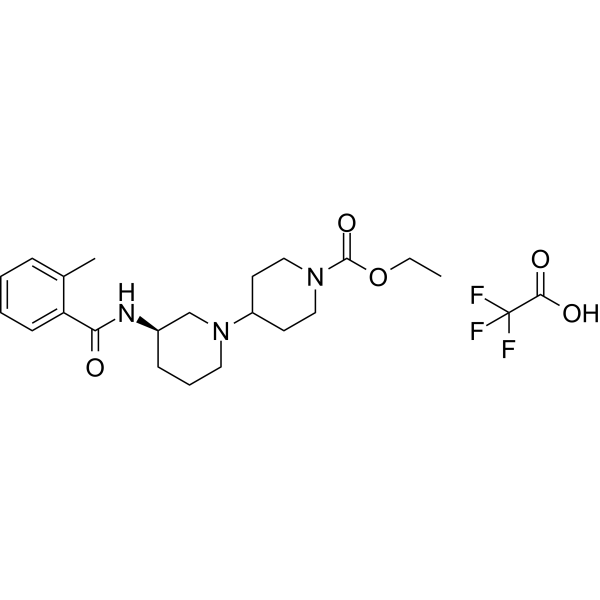
1240514-89-9
Chemical Structure
VU0364572 TFA
- CAS No.: 1240514-89-9
- Formula:C23H32F3N3O5
- Molecular Weight:487.51
IUPAC Name: ethyl (R)-3-(2-methylbenzamido)-[1,4'-bipiperidine]-1'-carboxylate 2,2,2-trifluoroacetate
InChIKey: QEFQJTFXOBPBLZ-UNTBIKODSA-N
SMILES: O=C(N1CCC(N2C[C@H](NC(C3=CC=CC=C3C)=O)CCC2)CC1)OCC.O=C(O)C(F)(F)F
Biological Activity: VU0364572 TFA is an orally active and selective allosteric agonist of the M1 muscarinic receptor with an EC50 of 0.11 μM. VU0364572 TFA has neuroprotective potential for preventing memory impairments and reducing neuropathology in Alzheimer’s Disease. VU0364572 TFA is CNS penetrant[1][3].
| Cat. No. | Product Name | Purity | Description | Pricing | |||||||||||||||||||
|---|---|---|---|---|---|---|---|---|---|---|---|---|---|---|---|---|---|---|---|---|---|---|---|
|
|
VU0364572 TFA | 98.79% | VU0364572 TFA is an orally active and selective allosteric agonist of the M1 muscarinic receptor with an EC50 of 0.11 μM. VU0364572 TFA has neuroprotective potential for preventing memory impairments and reducing neuropathology in Alzheimer’s Disease. VU0364572 TFA is CNS penetrant. | ||||||||||||||||||||
|
loading...
/
|
|||||||||||||||||||||||
Structural Analogs
-
Similarity Score 0.89
 HY-113616VU0364572
-
Similarity Score 0.63
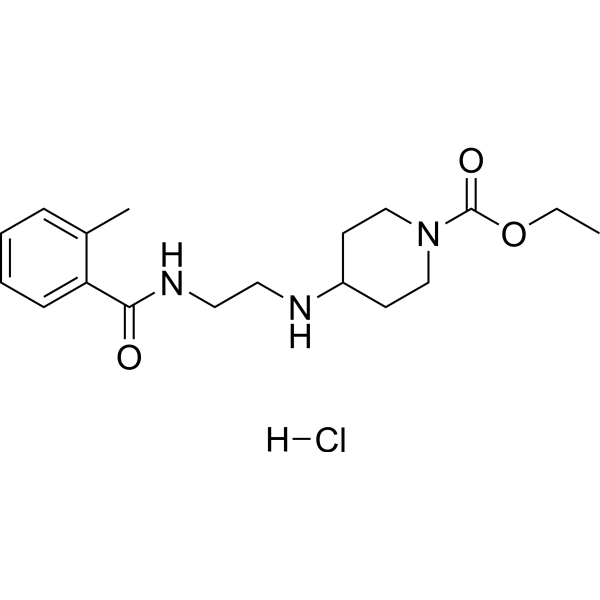 HY-19752AVU0357017 hydrochloride
-
Similarity Score 0.63
 HY-19752VU0357017
-
Similarity Score 0.56
 HY-W904851Boc-Piperidine-piperazine-Cbz
-
Similarity Score 0.55
 HY-W293394Boc-cyclohexane-piperazine-Ac-Ph
-
Similarity Score 0.53
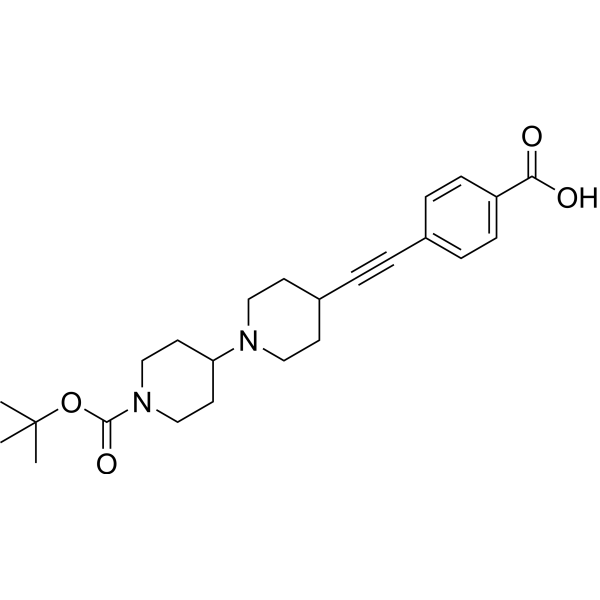 HY-139661Boc-bipiperidine-ethynylbenzoic acid
-
Similarity Score 0.52
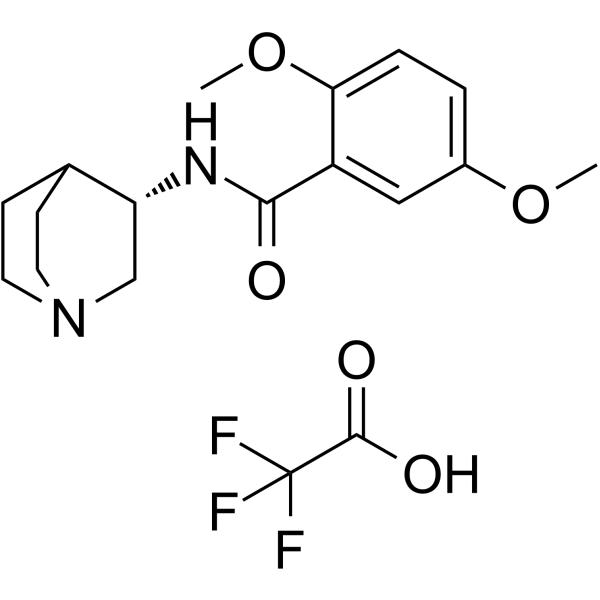 HY-112217APSEM 89S TFA
-
Similarity Score 0.50
 HY-148961HTL-9936
-
Similarity Score 0.50
 HY-P4612Z-Pro-Pro
-

Explore the MedChemAI to find more analogs


References
- [1]. Lebois EP, et al. Disease-Modifying Effects of M1 Muscarinic Acetylcholine Receptor Activation in an Alzheimer's Disease Mouse Model. ACS Chem Neurosci. 2017 Jun 21;8(6):1177-1187. [Content Brief]
- [3]. Lebois EP, et al. Development of a highly selective, orally bioavailable and CNS penetrant M1 agonist derived from the MLPCN probe ML071. Bioorg Med Chem Lett. 2011 Nov 1;21(21):6451-5. [Content Brief]



