



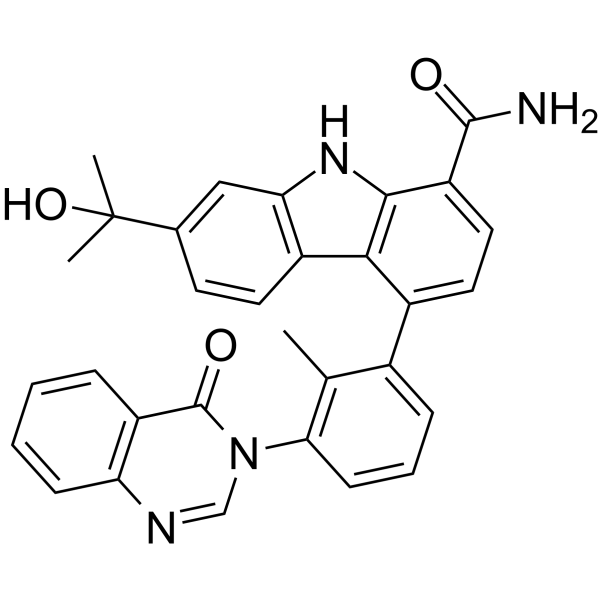
BMS-935177

Based on 1 Customer Validation
BMS-935177 is a potent and selective reversible inhibitor of Bruton’s tyrosine kinase (Btk) with an IC50 of 3 nM.
Nos produits utilisent uniquement pour la recherche. Nous ne vendons pas aux patients.
- Pureté: 98.35%
- CAS No.: 1231889-53-4
- Formule: C31H26N4O3
- Masse moléculaire:502.56
-
Stockage:Powder -20°C, 3 years , 4°C, 2 years ; In solvent -80°C, 2 years , -20°C, 1 year

To place orders, for customer services and technical support, please contact: MedChemExpress USA
Tel: 609-228-6898 E-mail: [email protected] [email protected]


-
 Activité biologique
-
Chemical Information
-
Solvant et solubilité
- Protocole
- Pureté et documentation
- Références
-
 Help & FAQs
-

Anti-Blood Cancer Compound Library
HY-L079
-
Targeted Diversity Library
HY-L099
-
Autoimmune Disease Compound Library
HY-L156
-
Highly Selective Inhibitors Library
HY-L158
-
Serine/Threonine Kinase Inhibitor Library
HY-L164
-
Anti-Hematopathy Compound Library
HY-L171
-
Bioactive Compound Library Max
HY-L181
-
MCE Bioactive Compound Library
HY-L001V
-
Bioactive Compound Library
HY-L001
-
Protein Kinase Compound Library
HY-L196
-
High-Throughput Bioactive Compound Library
HY-L205
-
Anti-Rheumatic Arthritis Compound Library
HY-L210
-
Posttranslational Modification Library
HY-L226
-
Immunology/Inflammation Compound Library
HY-L007
-
Kinase Inhibitor Library
HY-L009
-
Protein Tyrosine Kinase Compound Library
HY-L016




Activité biologique
IC50: 3 nM (BTK)[1]
|
Cell Line

|
Type | Value | Description | References |
|---|---|---|---|---|
| B cell | IC50 |
8 nM
Compound: 1
|
Antiproliferative activity against anti-IgM/IgG-induced human peripheral B cells
Antiproliferative activity against anti-IgM/IgG-induced human peripheral B cells
|
[PMID: 33214829] |
| Ramos | IC50 |
30 nM
Compound: 2; BMS-935177
|
Inhibition of BTK in human Ramos-B cells assessed as suppression of BCR/anti-IgG-stimulated Ca2+ flux after 1 hr incubation in dark by FLIPR1 assay
Inhibition of BTK in human Ramos-B cells assessed as suppression of BCR/anti-IgG-stimulated Ca2+ flux after 1 hr incubation in dark by FLIPR1 assay
|
[PMID: 27583770] |
In B cells stimulated through the BCR, BMS-935177 selectively inhibits several different readouts. BMS-935177 inhibits calcium flux in human Ramos B cells (IC50=27 nM) and inhibits CD69 surface expression in peripheral B cells stimulated with antiIgM and anti-IgG. However, BMS-935177 has no effect on CD69 surface expression in B cells stimulated through the CD40 receptor with CD40 ligand. Against IgG-containing immune complexdriven low affinity activating Fcγ receptor (FcγRIIa and FcγRIII) end points in peripheral blood mononuclear cells (PBMCs), BMS-935177 effectively inhibits TNFα production with an IC50 value of 14 nM. BMS-935177 shows mean IC50 values of 550±100 (n=11) and 2060±240 nM (n=3) in human and mouse whole blood, respectively[1].
MedChemExpress (MCE) has not independently confirmed the accuracy of these methods. They are for reference only.
MedChemExpress (MCE) has not independently confirmed the accuracy of these methods. They are for reference only.


Chemical Information
-
CAS No. 1231889-53-4
-
Appearance Solid
-
Masse moléculaire 502.56
-
Formule C31H26N4O3
-
Color White to light yellow
-
SMILES
O=C(C1=CC=C(C2=CC=CC(N3C=NC4=C(C=CC=C4)C3=O)=C2C)C5=C1NC6=C5C=CC(C(C)(O)C)=C6)N
-
Livraison
Room temperature in continental US; may vary elsewhere.
-
Stockage
Powder -20°C 3 years 4°C 2 years In solvent -80°C 2 years -20°C 1 year


Solvant et solubilité
DMSO : 75 mg/mL (149.24 mM; ultrasonic and warming and heat to 60°C; Hygroscopic DMSO has a significant impact on the solubility of product, please use newly opened DMSO)
Please refer to the solubility information to select the appropriate solvent. Once prepared, please aliquot and store the solution to prevent product inactivation from repeated freeze-thaw cycles.
Storage method and period of stock solution: -80°C, 2 years; -20°C, 1 year. When stored at -80°C, please use it within 2 years. When stored at -20°C, please use it within 1 year.
Please refer to the solubility information to select the appropriate solvent. Once prepared, please aliquot and store the solution to prevent product inactivation from repeated freeze-thaw cycles.
Storage method and period of stock solution: -80°C, 2 years; -20°C, 1 year. When stored at -80°C, please use it within 2 years. When stored at -20°C, please use it within 1 year.
Concentration (start) × Volume (start) = Concentration (final) × Volume (final)
Select the appropriate dissolution method based on your experimental animal and administration route.
- For the following dissolution methods, please ensure to first prepare a clear stock solution using an In Vitro approach and then sequentially add co-solvents:
- To ensure reliable experimental results, the clarified stock solution can be appropriately stored based on storage conditions. As for the working solution for In Vivo experiments, it is recommended to prepare freshly and use it on the same day.
- The percentages shown for the solvents indicate their volumetric ratio in the final prepared solution. If precipitation or phase separation occurs during preparation, heat and/or sonication can be used to aid dissolution.
Add each solvent one by one: 10% DMSO 40% PEG300 5% Tween-80 45% Saline
Solubility: 3.75 mg/mL (7.46 mM); Clear solution; Need ultrasonic
This protocol yields a clear solution of 3.75 mg/mL.
Taking 1 mL working solution as an example, add 100 μL DMSO stock solution (37.5 mg/mL) to 400 μL PEG300, and mix evenly; then add 50 μL Tween-80 and mix evenly; then add 450 μL Saline to adjust the volume to 1 mL.
Preparation of Saline: Dissolve 0.9 g sodium chloride in ddH₂O and dilute to 100 mL to obtain a clear Saline solution.
Add each solvent one by one: 10% DMSO 90% (20% SBE-β-CD in Saline)
Solubility: 3.75 mg/mL (7.46 mM); Suspended solution; Need ultrasonic
This protocol yields a suspended solution of 3.75 mg/mL. Suspended solution can be used for oral and intraperitoneal injection.
Taking 1 mL working solution as an example, add 100 μL DMSO stock solution (37.5 mg/mL) to 900 μL 20% SBE-β-CD in Saline, and mix evenly.
Preparation of 20% SBE-β-CD in Saline (4°C, storage for one week): 2 g SBE-β-CD powder is dissolved in 10 mL Saline, completely dissolve until clear.
Please enter the basic information of animal experiments:
-
-
-
-
Recommended: Prepare an additional quantity of animals to account for potential losses during experiments.
Please enter your animal formula composition:
-
%DMSO +
Recommended: Keep the proportion of DMSO in working solution below 2% if your animal is weak.
-
%+
-
+%Tween-80 + +
-
%Saline +
The co-solvents required include: DMSO, . All of co-solvents are available by MedChemExpress (MCE). , Tween 80. All of co-solvents are available by MedChemExpress (MCE).
Working solution concentration: 0.22 mg/mL
Method for preparing stock solution: mg drug dissolved in μL DMSO. Stock solution concentration: mg/mL.
1. Take μL DMSO stock solution;
2. Add μL .
μL , mix evenly;
3. Then add μL Tween 80, mix evenly;
4. Then add μL
Please ensure that the stock solution in the first step is dissolved to a clear state, and add co-solvents in sequence. You can use ultrasonic heating (ultrasonic cleaner, recommended frequency 20-40 kHz), vortexing, etc. to assist dissolution.

Protocole
BMS-935177 is dissolved at 10 mM in DMSO and evaluated at 11 concentrations . To V-bottom 384- well plates are added BMS-935177, human recombinant BTK (1 nM), fluoresceinated peptide (1.5 μM), ATP (20 μM (Km app)), and assay buffer (20 mM HEPES, pH 7.4, 10 mM MgCl2, 0.015% Brij 35 surfactant, and 4 mM DTT in 1.6% DMSO), with a final volume of 30 μL. After incubation at room temperature for 60 min, the reaction is terminated by adding 45 μL of 35 mM EDTA to each sample. The reaction mixture is analyzed on the by electrophoretic separation of the fluorescent substrate and phosphorylated product (excitation, 488 nm; emission, 530 nm)[1].
MedChemExpress (MCE) has not independently confirmed the accuracy of these methods. They are for reference only.
Rats[1]
Male Sprague−Dawley rats (255-298 g) are used in the PK studies. To investigate the oral bioavailability of BMS-935177 after crystalline microsuspension doses, rats receive BMS-935177 by oral gavage (1, 5, and 20 mg/kg), T99.5% 10 mM citrate buffer, pH 4, 0.02% DOSS, Methocel A4M. Serial blood samples are obtained after oral dosing at 0.25, 0.5, 0.75, 1, 2, 4, 6, 8, and 24 h postdose. Plasma samples, obtained by centrifugation at 4 °C (1500-2000g), are stored at −20 °C until analysis[1].
Mice[1]
Efficacy of BMS-935177 (10 and 30 mg/kg) vs vehicle and dexamethasone (Dex) is studied in a mouse anti-collagen antibody-induced arthritis (CAIA) inflammation model. Mice are injected intraperitoneally (ip) with a mixture of four monoclonal antimouse type II collagen antibodies (1 mg of each). Daily oral dosing is immediately started with vehicle (EtOH:TPGS:PEG300, 5:5:90), BMS-935177 (10 or 30 mg/kg), or dexamethasone (dex, 1 mg/kg). Three days later, the mice are injected ip with 1.25 mg/kg LPS. Thereafter, mice are monitored 3×/ week for the development and severity of paw inflammation[1].
MedChemExpress (MCE) has not independently confirmed the accuracy of these methods. They are for reference only.


Pureté et documentation
-
Fiche technique (287 KB)
-
SDS (254 KB)
- English - EN (254 KB)
- Français - FR (254 KB)
- Deutsch - DE (254 KB)
- Norwegian - NO (254 KB)
- Español - ES (254 KB)
- Swedish - SV (254 KB)
- Italian - IT (254 KB)
- Korean - KR (254 KB)
- Portuguese - PT (254 KB)
-
Instruction de manipulation (2659 KB)
Références


Complete Stock Solution Preparation Table
Please refer to the solubility information to select the appropriate solvent. Once prepared, please aliquot and store the solution to prevent product inactivation from repeated freeze-thaw cycles.
Storage method and period of stock solution: -80°C, 2 years; -20°C, 1 year. When stored at -80°C, please use it within 2 years. When stored at -20°C, please use it within 1 year.
| Optional Solvent | Concentration Solvent Mass | 1 mg | 5 mg | 10 mg | 25 mg |
|---|---|---|---|---|---|
| DMSO | 1 mM | 1.9898 mL | 9.9491 mL | 19.8981 mL | 49.7453 mL |
| 5 mM | 0.3980 mL | 1.9898 mL | 3.9796 mL | 9.9491 mL | |
| 10 mM | 0.1990 mL | 0.9949 mL | 1.9898 mL | 4.9745 mL | |
| 15 mM | 0.1327 mL | 0.6633 mL | 1.3265 mL | 3.3164 mL | |
| 20 mM | 0.0995 mL | 0.4975 mL | 0.9949 mL | 2.4873 mL | |
| 25 mM | 0.0796 mL | 0.3980 mL | 0.7959 mL | 1.9898 mL | |
| 30 mM | 0.0663 mL | 0.3316 mL | 0.6633 mL | 1.6582 mL | |
| 40 mM | 0.0497 mL | 0.2487 mL | 0.4975 mL | 1.2436 mL | |
| 50 mM | 0.0398 mL | 0.1990 mL | 0.3980 mL | 0.9949 mL | |
| 60 mM | 0.0332 mL | 0.1658 mL | 0.3316 mL | 0.8291 mL | |
| 80 mM | 0.0249 mL | 0.1244 mL | 0.2487 mL | 0.6218 mL | |
| 100 mM | 0.0199 mL | 0.0995 mL | 0.1990 mL | 0.4975 mL |


BMS-935177 Related Classifications
HY-101793 Related Classifications
 Powered by Bioz