



BAFFR/TNFRSF13C Protein, Human

Based on 1 Customer Validation
BAFF Receptor (B-cell activating factor receptor, BAFF-R), also known as TNFRSF13C and BR3, is a membrane protein of the TNF receptor superfamily which recognizes BAFF. BAFF Receptor is the crucial receptor for B-cell survival and also is a potent costimulator of both B and T cell activation. BAFFR/TNFRSF13C Protein, Human is a recombinant protein produced in E. coli.
- Species: Human
- Source: E. coli
-
Storage:Stored at -20°C for 2 years from date of receipt. After reconstitution, it is stable at 4°C for 1 week or -20°C for longer (with carrier protein). It is recommended to freeze aliquots at -20°C or -80°C for extended storage.


To place orders, for customer services and technical support, please contact: MedChemExpress USA
Tel: 609-228-6898 E-mail: [email protected] [email protected]


-
 Biological Activity
-
Technical Parameters
-
Product Properties
- Documentation
- References
- Help & FAQs




Biological Activity
Description
BAFF Receptor (B-cell activating factor receptor, BAFF-R), also known as TNFRSF13C and BR3, is a membrane protein of the TNF receptor superfamily which recognizes BAFF. BAFF Receptor is the crucial receptor for B-cell survival and also is a potent costimulator of both B and T cell activation[1]. BAFFR/TNFRSF13C Protein, Human is a recombinant protein produced in E. coli.
Background
BAFF Receptor is expressed on all B cells (except plasma cells), including immature, transitional, mature, memory, and germinal center B cells, as well as on plasma cells[2], while BAFF-R is also expressed on follicular helper T cells (TFH)[3].
The amino acid sequence of human BAFF Receptor protein has low homology for mouse and rat BAFF Receptor protein.
BAFF Receptor binds to BAFF and recruits TNF receptor-associated factor 3 (TRAF-3) and TRAF-2 to the intracellular domain of BAFF-R molecules. The binding of TRAF3 to the BAFF-R reverses the inhibitory effect of unbound/cytoplasmic TRAF3 on the alternative NF-κB2 signaling pathway. It releases NF-κB-inducing kinase (NIK), which phosphorylates inhibitor of κB kinase 1 (IKK1) leading to activation of non-canonical NF-κB. BAFF-R signaling is critical for peripheral B cell survival and differentiation, germinal center formation, plasma cell survival, and IgG and IgE class switching[2].
BAFF Receptor binds to BAFF mediates B-cell survival, proliferation, and differentiation, and involves in the formation of GCs in secondary follicles in murine models and tertiary lymphoid structures in autoimmune diseases[3]. BAFF/BAFF-R signaling is crucial for primary B cell survival, differentiation and homeostasis[4]. A/WySnJ mice expressing a defective BAFF-R have disrupted B cell maturation, similar to that seen in BAFF-deficient mice[5].
In Vitro
BAFF Receptor (human) (500 ng/mL; 30 min) inhibits BAFF-mediated proliferation of human mesangial cells when co-cultured with 20 ng/mL BAFF for 48h[4].
In Vivo
Human BAFF-R deficiency strongly impairs the development and homeostasis of follicular, IgM memory/marginal zone, and class-switched memory B cells[6].
Verified Bioactivity
Fully biologically active when compared to standard. The ED50 as determined by its ability to block BAFF induced mouse splenocyte survival is 1.0-5.0 μg/mL in the presence of 1.0 μg/mL of rHuBAFF.
MCE Validation Data
-
Purity - SDS-PAGE
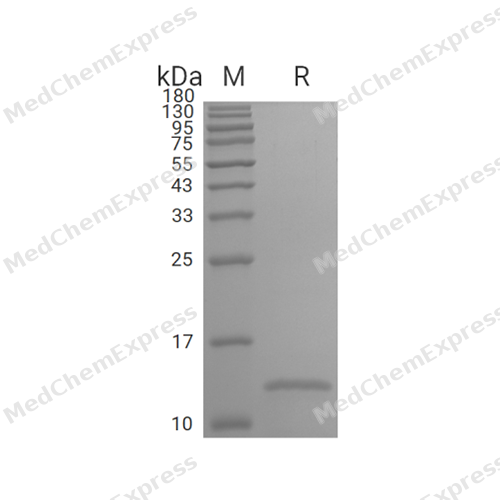
Purity - SDS-PAGE


Technical Parameters
-
Species Human
-
Source E. coli
-
Tag Tag Free
-
Accession
Q96RJ3-1 (M1-G76)
-
Molecular Construction
-
N-term
-
BAFFR (M1-G76)
Accession # Q96RJ3-1 -
C-term
-
-
Protein Length
Extracellular Domain
-
Synonyms
TNFRSF13C; BLyS Receptor 3; TNF Receptor Superfamily Member 13C; B Cell-Activating Factor Receptor; BAFFR; B-Cell-Activating Factor Receptor; BAFF Receptor; CD268 Antigen; BAFF-R; Prolixin; CD268; BROMIX; Tumor Necrosis Factor Receptor Superfamily, Member
-
AA Sequence
MRRGPRSLRGRDAPAPTPCVPAECFDLLVRHCVACGLLRTPRPKPAGASSPAPRTALQPQESVGAGAGEAALPLPG
-
Predicted Molecular Mass
7.8 kDa
-
Molecular Weight
Approximately 13 kDa, based on SDS-PAGE under reducing conditions.
-
Purity
≥ 95%, as determined by reducing SDS-PAGE.


Product Properties
Lyophilized powder.
Lyophilized from a 0.22 μm filtered solution of 20 mM PB, pH 8.0, 500 mM NaCl.
<1 EU/μg, determined by LAL method.
It is not recommended to reconstitute to a concentration less than 100 μg/mL in ddH2O. For long term storage it is recommended to add a carrier protein (0.1% BSA, 5% HSA, 10% FBS or 5% Trehalose).
Stored at -20°C for 2 years from date of receipt. After reconstitution, it is stable at 4°C for 1 week or -20°C for longer (with carrier protein). It is recommended to freeze aliquots at -20°C or -80°C for extended storage.
Room temperature in continental US; may vary elsewhere.


Documentation
-
Data Sheet (264 KB)
-
SDS (251 KB)
- English - EN (251 KB)
- Français - FR (251 KB)
- Deutsch - DE (251 KB)
- Norwegian - NO (251 KB)
- Español - ES (251 KB)
- Swedish - SV (251 KB)
- Italian - IT (251 KB)
- Korean - KR (251 KB)
- Portuguese - PT (251 KB)
-
Handling Instructions (2659 KB)


References
[1]. Rodig SJ, et al. BAFF-R, the major B cell-activating factor receptor, is expressed on most mature B cells and B-cell lymphoproliferative disorders. Hum Pathol. 2005 Oct;36(10):1113-9. [Content Brief]
[2]. Thompson JS, et al. BAFF-R, a newly identified TNF receptor that specifically interacts with BAFF. Science. 2001 Sep 14;293(5537):2108-11. [Content Brief]
[3]. Thompson N, et al. Exploring BAFF: its expression, receptors and contribution to the immunopathogenesis of Sjögren's syndrome. Rheumatology (Oxford). 2016 Sep;55(9):1548-55. [Content Brief]
[4]. Losi CG, et al. Mutational analysis of human BAFF receptor TNFRSF13C (BAFF-R) in patients with common variable immunodeficiency. J Clin Immunol. 2005 Sep;25(5):496-502. [Content Brief]
[5]. Carrillo-Ballesteros FJ, et al. B-cell activating factor receptor expression is associated with germinal center B-cell maintenance. Exp Ther Med. 2019 Mar;17(3):2053-2060. [Content Brief]
[6]. Zheng N, et al. BAFF promotes proliferation of human mesangial cells through interaction with BAFF-R. BMC Nephrol. 2015 May 15;16:72. [Content Brief]
[7]. Ng LG, et al. B cell-activating factor belonging to the TNF family (BAFF)-R is the principal BAFF receptor facilitating BAFF costimulation of circulating T and B cells. J Immunol. 2004 Jul 15;173(2):807-17. [Content Brief]
[8]. Warnatz K, et al. B-cell activating factor receptor deficiency is associated with an adult-onset antibody deficiency syndrome in humans. Proc Natl Acad Sci U S A. 2009 Aug 18;106(33):13945-50. [Content Brief]

Calculators
Concentration (start) × Volume (start) = Concentration (final) × Volume (final)


 Powered by Bioz

