



Neurotoxic Agent
-
Neurotoxic Agent (7)

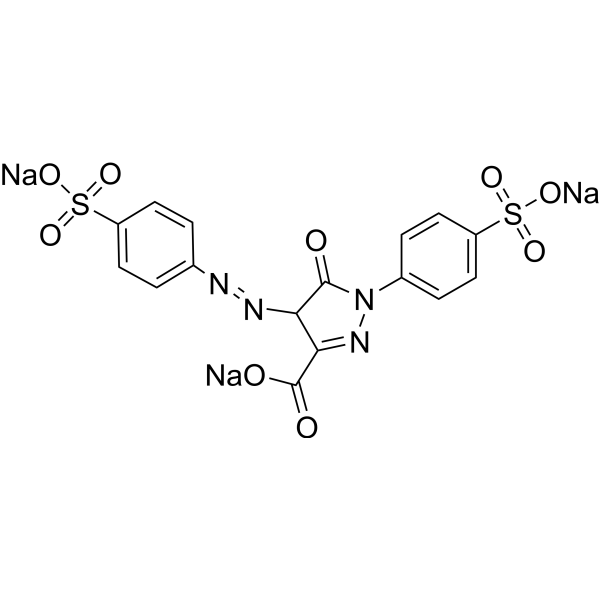
- Formula: C16H9N4Na3O9S2
- Molecular Weight: 534.36
Tartrazine (Acid Yellow 23; FD&C Yellow No. 5) is an orally active azo acid dye, orange-yellow powder, soluble in water and turns yellow. Tartrazine is mainly used as a synthetic lemon yellow azo dye for food coloring. Tartrazine is the most stable colorant.Tartrazine induces mitochondria-mediated Apoptosis. Tartrazine can cause neurodevelopmental toxicity, cytotoxicity, and genotoxicity.

- Formula: C13H21N3O8S
- Molecular Weight: 379.39
S-D-Lactoylglutathione (S-Lactylglutathione; (R)-S-Lactoylglutathione) is a multifunctional metabolic intermediate of the glyoxalase system. S-D-Lactoylglutathione activates K+ efflux in bacteria by displacing inhibitory glutathione from KefGB channels, thereby acidifying the cytoplasm. In eukaryotic cells, S-D-Lactoylglutathione mediates S-glutathionylation as a substrate of glyoxalase 2. S-D-Lactoylglutathione serves as a sensitive metabolic biomarker for neodymium nitrate neurotoxicity; when used in combination with MSCs-exo, it upregulates glutathione levels, downregulates lactate dehydrogenase and Glo2 levels, and inhibits cellular inflammatory responses and pyroptosis. S-D-Lactoylglutathione can be used in research related to prostate cancer, breast cancer, non-small cell lung cancer, sepsis-associated encephalopathy, and neurotoxicity.
![Benz[a]anthracene](https://file.medchemexpress.com/product_pic/hy-w012278.gif "Click to View Benz[a]anthracene Product Detail")
- Formula: C18H12
- Molecular Weight: 228.29
Benz[a]anthracene (Tetraphene) is a polycyclic aromatic hydrocarbon pollutant and also a ligand of aryl hydrocarbon receptor 2 (AHR2), with a pIC50 of 7.319. Benz[a]anthracene can be detected in spruce needles near aluminum smelters. Exposure to Benz[a]anthracene during zebrafish embryonic stage activates the AHR-CYP1A signaling pathway and induces AHR2 expression, leading to social behavioral deficits that persist into adulthood, accompanied by impaired neuro-immune interaction, while anxiety levels remain unaffected. Benz[a]anthracene can be used in studies related to PAH environmental toxicology, developmental neurotoxicity and biodegradation.
![Benz[a]anthracene-d12](https://file.medchemexpress.com/product_pic/hy-w012278s.gif "Click to View Benz[a]anthracene-d12 Product Detail")
- Formula: C18D12
- Molecular Weight: 240.36
Benz[a]anthracene-d12 (Tetraphene-d12) is the deuterated-labeled Benz[a]anthracene (HY-W012278). Benz[a]anthracene (Tetraphene) is a polycyclic aromatic hydrocarbon pollutant and also a ligand of aryl hydrocarbon receptor 2 (AHR2), with a pIC50 of 7.319. Benz[a]anthracene can be detected in spruce needles near aluminum smelters. Exposure to Benz[a]anthracene during zebrafish embryonic stage activates the AHR-CYP1A signaling pathway and induces AHR2 expression, leading to social behavioral deficits that persist into adulthood, accompanied by impaired neuro-immune interaction, while anxiety levels remain unaffected. Benz[a]anthracene can be used in studies related to PAH environmental toxicology, developmental neurotoxicity and biodegradation.

- Formula: C16H21Br2N3O
- Molecular Weight: 431.17

- Formula: C16H22N4O9S2
- Molecular Weight: 478.50
Asoxime dimesylate (HI-6 dimesylate) is an orally active thiosemicarbazone-based antidote. Asoxime dimesylate is a reversible inhibitor of AChE, and its core mechanism of action is to re-activate AChE inhibited by nerve toxins, thereby restoring the cholinergic nerve function. Asoxime dimesylate significantly restores the function of poisoned muscles without reactivating AChE. Asoxime dimesylate is an antagonist of acetylcholine receptors (AChRs), including nicotinic receptor and α7 nAChR. Asoxime dimesylate can serve as an effective immunomodulator, improving the immune effect of the nervous system.

- Formula: C10H22NO7PS
- Molecular Weight: 331.32
N-Demethyl amiton oxalic is an irreversible cholinesterase (ChE) inhibitor. N-Demethyl amiton oxalic elicits low-level postganglionic neuronal firing in cat vesical parasympathetic ganglia by preventing the breakdown of endogenously released ChE. N-Demethyl amiton oxalic inhibits ChE activity in squid optic ganglia and induces hyperactivity, ink ejection, pigment changes, and death, with a rate of enzymatic detoxification much lower than that of DFP. N-Demethyl amiton oxalic can be used in studies related to the mechanisms of cholinergic transmission in parasympathetic ganglia and neurotoxicology.



