



Benz[a]anthracene

Based on 1 Customer Validation
Benz[a]anthracene (Tetraphene) is a polycyclic aromatic hydrocarbon pollutant and also a ligand of aryl hydrocarbon receptor 2 (AHR2), with a pIC50 of 7.319. Benz[a]anthracene can be detected in spruce needles near aluminum smelters. Exposure to Benz[a]anthracene during zebrafish embryonic stage activates the AHR-CYP1A signaling pathway and induces AHR2 expression, leading to social behavioral deficits that persist into adulthood, accompanied by impaired neuro-immune interaction, while anxiety levels remain unaffected. Benz[a]anthracene can be used in studies related to PAH environmental toxicology, developmental neurotoxicity and biodegradation.
For research use only. We do not sell to patients.
- Purity : 99.90%
- CAS No.: 56-55-3
- Formula: C18H12
- Molecular Weight:228.29
-
Storage:Powder -20°C, 3 years , 4°C, 2 years ; In solvent -80°C, 6 months , -20°C, 1 month
![Benz[a]anthracene Chemical Structure](https://file.medchemexpress.com/product_pic/hy-w012278.gif "Click to View Benz[a]anthracene Chemical Structure")

To place orders, for customer services and technical support, please contact: MedChemExpress USA
Tel: 609-228-6898 E-mail: [email protected] [email protected]


-
 Biological Activity
-
Chemical Information
-
Solvent & Solubility
- Protocols
- Purity & Documentation
- References
-
 Help & FAQs


-
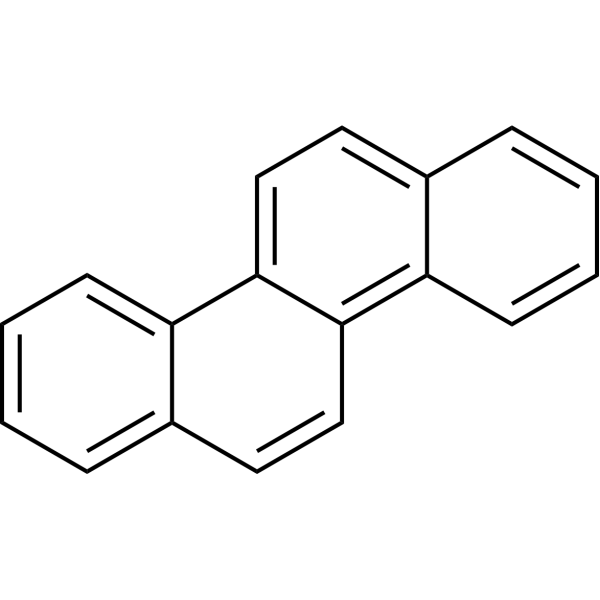
HY-121107
ChryseneCarcinogenic Inducer -

HY-121107R
Chrysene (Standard)Carcinogenic Inducer -
![Indeno[1,2,3-cd]pyrene](https://file.medchemexpress.com/product_pic/hy-23499.gif)
HY-23499
Indeno[1,2,3-cd]pyrenePolycyclic Aromatic Hydrocarbon -
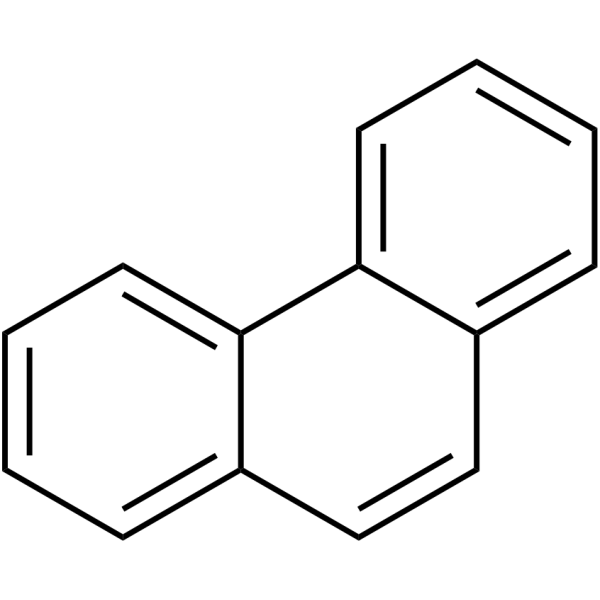
HY-B1727
PhenanthrenePolycyclic Aromatic Hydrocarbon -
![Benzo[k]fluoranthene](https://file.medchemexpress.com/product_pic/hy-23498.gif)
HY-23498
Benzo[k]fluoranthenePAH -

HY-W017708
TriphenyleneDrug Intermediate -

HY-B1727R
Phenanthrene (Standard)Polycyclic Aromatic Hydrocarbon -
![Benzo[e]pyrene](https://file.medchemexpress.com/product_pic/hy-n10021.gif)
HY-N10021
Benzo[e]pyrenePolyaromatic Hydrocarbons -

HY-W094755
1-Nitropyrene -
![Indeno[1,2,3-cd]pyrene (Standard)](https://file.medchemexpress.com/product_pic/hy-23499r.gif)
HY-23499R
Indeno[1,2,3-cd]pyrene (Standard)Polycyclic Aromatic Hydrocarbon -
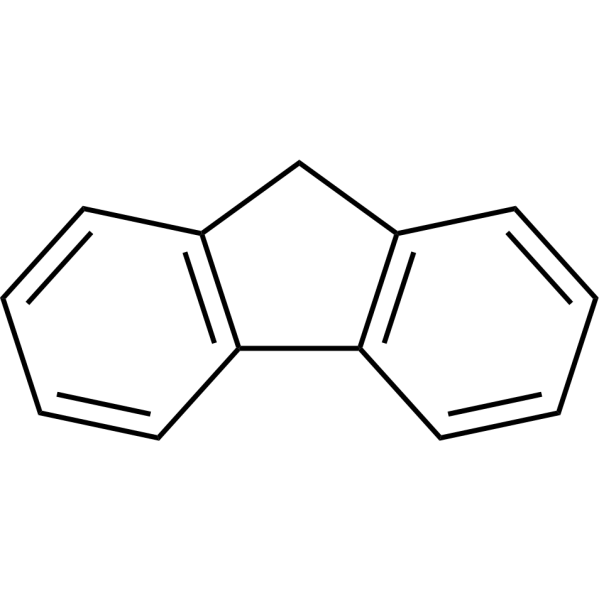
HY-W026772
FluorenePolycyclic Aromatic Hydrocarbon


Biological Activity
Description
IC50 & Target
[1]|
AHR2 7.319 (pIC50) |
In Vitro
MedChemExpress (MCE) has not independently confirmed the accuracy of these methods. They are for reference only.
In Vivo
MedChemExpress (MCE) has not independently confirmed the accuracy of these methods. They are for reference only.
-
Animal Model:AB strain (mixed gender, embryonic stage (8 hpf) through adulthood (90 dpf))[2]
-
Dosage:1 μM; 10 μM
-
Administration:immersion in water; daily solution refreshment; 8 hpf to 4 dpf
-
Result:Reduced zebrafish embryo hatching rates at 48 hpf, 72 hpf, and 96 hpf at 10 μM.
Diminished larval locomotor activity, reduced swimming distance, and blunted speed response to light-dark transitions at 7 dpf at 10 μM.
Reduced larval time spent in the social zone to 27.43% and distance traveled in the social zone to 35.55% at 21 dpf at 1 μM.
Increased larval nearest neighbor distance in shoaling tests at 23 dpf at 1 μM.
Reduced juvenile time and distance spent in the social zone at 43 dpf at 1 μM.
Reduced adult time and distance spent in the social zone at 90 dpf at 1 μM.
Altered larval proteomic profile with 216 differentially expressed proteins (112 up-regulated, 104 down-regulated) at 7 dpf at 1 μM.
Reduced abundance of neurodevelopmental proteins GABBR1B, GABBR2, and CDNF at 7 dpf at 1 μM.
Reduced abundance of neuro-immune related proteins CTNND2A, RAC3B, and FAK1B at 7 dpf at 1 μM.
Activated AHR-CYP1A signaling pathway with increased abundance of AHR2 and CYP1A proteins at 7 dpf at 1 μM.


Chemical Information
-
CAS No. 56-55-3
-
Appearance Solid
-
Molecular Weight 228.29
-
Formula C18H12
-
Color Light yellow to yellow
-
SMILES
C12=CC=CC=C1C3=CC4=CC=CC=C4C=C3C=C2
-
Synonyms
Tetraphene
-
Shipping
Room temperature in continental US; may vary elsewhere.
-
Storage
Powder -20°C 3 years 4°C 2 years In solvent -80°C 6 months -20°C 1 month


Solvent & Solubility
In Vitro:
DMSO : 28.57 mg/mL (125.15 mM; ultrasonic and warming and heat to 60°C; Hygroscopic DMSO has a significant impact on the solubility of product, please use newly opened DMSO)
Please refer to the solubility information to select the appropriate solvent. Once prepared, please aliquot and store the solution to prevent product inactivation from repeated freeze-thaw cycles.
Storage method and period of stock solution: -80°C, 6 months; -20°C, 1 month. When stored at -80°C, please use it within 6 months. When stored at -20°C, please use it within 1 month.
Please refer to the solubility information to select the appropriate solvent. Once prepared, please aliquot and store the solution to prevent product inactivation from repeated freeze-thaw cycles.
Storage method and period of stock solution: -80°C, 6 months; -20°C, 1 month. When stored at -80°C, please use it within 6 months. When stored at -20°C, please use it within 1 month.
Concentration (start) × Volume (start) = Concentration (final) × Volume (final)


Purity & Documentation
-
Data Sheet (288 KB)
-
SDS (644 KB)
- English - EN (644 KB)
- Français - FR (644 KB)
- Deutsch - DE (644 KB)
- Norwegian - NO (644 KB)
- Español - ES (644 KB)
- Swedish - SV (644 KB)
- Italian - IT (644 KB)
- Korean - KR (644 KB)
- Portuguese - PT (644 KB)
-
Handling Instructions (2659 KB)
References


Complete Stock Solution Preparation Table
Please refer to the solubility information to select the appropriate solvent. Once prepared, please aliquot and store the solution to prevent product inactivation from repeated freeze-thaw cycles.
Storage method and period of stock solution: -80°C, 6 months; -20°C, 1 month. When stored at -80°C, please use it within 6 months. When stored at -20°C, please use it within 1 month.
| Optional Solvent | Concentration Solvent Mass | 1 mg | 5 mg | 10 mg | 25 mg |
|---|---|---|---|---|---|
| DMSO | 1 mM | 4.3804 mL | 21.9020 mL | 43.8039 mL | 109.5098 mL |
| 5 mM | 0.8761 mL | 4.3804 mL | 8.7608 mL | 21.9020 mL | |
| 10 mM | 0.4380 mL | 2.1902 mL | 4.3804 mL | 10.9510 mL | |
| 15 mM | 0.2920 mL | 1.4601 mL | 2.9203 mL | 7.3007 mL | |
| 20 mM | 0.2190 mL | 1.0951 mL | 2.1902 mL | 5.4755 mL | |
| 25 mM | 0.1752 mL | 0.8761 mL | 1.7522 mL | 4.3804 mL | |
| 30 mM | 0.1460 mL | 0.7301 mL | 1.4601 mL | 3.6503 mL | |
| 40 mM | 0.1095 mL | 0.5475 mL | 1.0951 mL | 2.7377 mL | |
| 50 mM | 0.0876 mL | 0.4380 mL | 0.8761 mL | 2.1902 mL | |
| 60 mM | 0.0730 mL | 0.3650 mL | 0.7301 mL | 1.8252 mL | |
| 80 mM | 0.0548 mL | 0.2738 mL | 0.5475 mL | 1.3689 mL | |
| 100 mM | 0.0438 mL | 0.2190 mL | 0.4380 mL | 1.0951 mL |


Benz[a]anthracene Related Classifications
HY-W012278 Related Classifications
 Powered by Bioz