



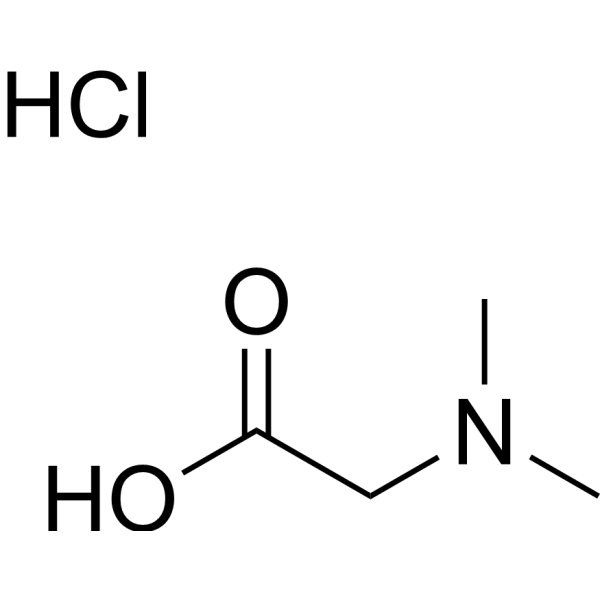
N,N-Dimethylglycine hydrochloride

Based on 1 publication(s) in Google Scholar
N,N-Dimethylglycine (Dimethylglycine) hydrochloride, a natural N-methylated glycine, is a nutrient supplement and acts as an NMDAR glycine site partial agonist. N,N-Dimethylglycine hydrochloride is a methyl donor that can improve immunity, act as an antioxidant to prevent oxidative stress, and scavenge excess free radicals. N,N-Dimethylglycine hydrochloride has antidepressant-like and surfactant effects.
For research use only. We do not sell to patients.
- Purity: 98.0%
- CAS No.: 2491-06-7
- Formula: C4H10ClNO2
- Molecular Weight:139.58
-
Storage:
Store at room temperature, keep dry and cool.
In solvent -80°C, 1 year , -20°C, 6 months


-
 Biological Activity
-
Chemical Information
-
Solvent & Solubility
- Purity & Documentation
- References
-
 Help & FAQs


Publications Citing Use of MedChemExpress (MCE) N,N-Dimethylglycine hydrochloride
MoreAll iGluR Isoforms
MoreAll Endogenous Metabolite Isoforms
More

Biological Activity
|
Human Endogenous Metabolite |
N,N-Dimethylglycine (40 mg/mL) hydrochloride shows 88.40%, 98.90%, and 87.58% scavenging activities in the DPPH radical scavenging, ABTS+ radical scavenging, and H2O2 scavenging experiments[3].
MedChemExpress (MCE) has not independently confirmed the accuracy of these methods. They are for reference only.
N,N-Dimethylglycine (12 mg/0.3 mL sterile saline; gavage; single dose; subcutaneous injection 1 hour later) hydrochloride improves the histological morphology of the small intestine, enhances the antioxidant system, reduces oxidative damage, and increases the expression of antioxidant-related genes in male Kunming mice[2].
N,N-Dimethylglycine (12 mg/0.3 mL sterile saline; gavage; twice a day; 28 days) hydrochloride increases the body weight, the organ proportion of the liver and spleen, enhances the antioxidant capacity of serum and liver, and reduces the activities of serum alanine aminotransferase (ALT) and aspartate aminotransferase (AST) as well as the malondialdehyde (MDA) content in serum and liver in male Kunming mice[3].
N,N-Dimethylglycine (12 mg/0.3 mL sterile saline; gavage; twice a day; 28 days) hydrochloride reduces the serum ALT and AST contents, the ROS level in hepatic mitochondria, and increases the antioxidant capacity of hepatic mitochondria and the mitochondrial membrane potential (MMP) level in male Kunming mice with Lipopolysaccharides (LPS) (HY-D1056)-induced oxidative stress model[3].
MedChemExpress (MCE) has not independently confirmed the accuracy of these methods. They are for reference only.
-
Animal Model:Male ICR mice (body weight 10-12 g, 3-week- old) + Repeated drug exposure (20 mg/kg, i.p., twice daily for 14 days)[1].
-
Dosage:30 mg/kg, 100 mg/kg
-
Administration:Intraperitoneal injection, 20 min prior to each drug injection, twice a day, 14 days.
-
Result:Prevented the drug-induced memory impairments in novel location recognition test (NLRT) and novel object recognition test (NORT), social withdrawal in reciprocal social interaction test, and enhanced head twitch response induced by serotonergic hallucinogen.
-
Animal Model:Male Kunming mice (weight 20-25 g, 40 days old) + Indomethacin injection (10 mg/kg BW)[2].
-
Dosage:12 mg/0.3 mL sterile saline
-
Administration:Orally gavage; single dose; and then subcutaneous injection 1 hour later.
-
Result:Improved the histological morphology of the small intestine. Enhanced the antioxidant system, reduced oxidative damage, and increased the expression of antioxidant-related genes in the small intestine and its mitochondria compared with the indomethacin-treated group2.
-
Animal Model:Male Kunming mice (weight 20-25 g, 40 days old) + Lipopolysaccharides (LPS) injection (100 μg/kg body weight)[3].
-
Dosage:12 mg/0.3 mL sterile saline
-
Administration:Orally gavage; twice a day; 28 days.
-
Result:Significantly decreased the serum ALT and AST content, ROS level, and expression of liver antioxidant gene MnSOD, Gpx1, Sirt1.
Significantly increased the hepatic mitochondrial antioxidant capacity (MnSOD, GSH, GPx, GR) and MMP level compared with the LPS-treated group.
| NCT Number | Sponsor | Condition | Start Date |
Phase

|
|---|---|---|---|---|
| NCT01329991 | Plexxikon| | 2011-05 | PHASE1 |


Chemical Information
-
CAS No. 2491-06-7
-
Appearance Solid
-
Molecular Weight 139.58
-
Formula C4H10ClNO2
-
Color Off-white to light yellow
-
Synonyms
Dimethylglycine hydrochloride; DMG hydrochloride; N-Methylsarcosine hydrochloride
-
Shipping
Room temperature in continental US; may vary elsewhere.
-
Storage
Store at room temperature, keep dry and cool
In solvent -80°C 1 year -20°C 6 months


Publications (1)
-
Journal Impact Factor
-
Most Recent
-
FASEB J
The metabolomic profiling identifies N, N-dimethylglycine as a facilitator of dorsal root ganglia neuron axon regeneration after injury. [Abstract]2022 May;36(5):e22305. PMID: 35394692


Solvent & Solubility
DMSO : 50 mg/mL (358.22 mM; Need ultrasonic; Hygroscopic DMSO has a significant impact on the solubility of product, please use newly opened DMSO)
Please refer to the solubility information to select the appropriate solvent. Once prepared, please aliquot and store the solution to prevent product inactivation from repeated freeze-thaw cycles.
Storage method and period of stock solution: -80°C, 1 year; -20°C, 6 months. When stored at -80°C, please use it within 1 year. When stored at -20°C, please use it within 6 months.
Please refer to the solubility information to select the appropriate solvent. Once prepared, please aliquot and store the solution to prevent product inactivation from repeated freeze-thaw cycles.
Storage method and period of stock solution: -80°C, 1 year; -20°C, 6 months. When stored at -80°C, please use it within 1 year. When stored at -20°C, please use it within 6 months.
Concentration (start) × Volume (start) = Concentration (final) × Volume (final)
Please enter the basic information of animal experiments:
-
-
-
-
Recommended: Prepare an additional quantity of animals to account for potential losses during experiments.
Working solution concentration: 0.22 mg/mL


Purity & Documentation
-
Data Sheet (278 KB)
-
SDS (393 KB)
- English - EN (393 KB)
- Français - FR (393 KB)
- Deutsch - DE (393 KB)
- Norwegian - NO (393 KB)
- Español - ES (393 KB)
- Swedish - SV (393 KB)
- Italian - IT (393 KB)
- Portuguese - PT (393 KB)
-
Handling Instructions (2659 KB)
References
[1]. Hsieh CP, et al. N, N-dimethylglycine Protects Behavioral Disturbances and Synaptic Deficits Induced by Repeated Ketamine Exposure in Mice. Neuroscience. 2021 Sep 15;472:128-137. [Content Brief]
[2]. Bai K, et al. Dimethylglycine sodium salt protects against oxidative damage and mitochondrial dysfunction in the small intestines of mice. Int J Mol Med. 2019 May;43(5):2199-2211. [Content Brief]
[3]. Bai K, et al. Assessment of Free Radical Scavenging Activity of Dimethylglycine Sodium Salt and Its Role in Providing Protection against Lipopolysaccharide-Induced Oxidative Stress in Mice. PLoS One. 2016 May 12;11(5):e0155393. [Content Brief]


Complete Stock Solution Preparation Table
Please refer to the solubility information to select the appropriate solvent. Once prepared, please aliquot and store the solution to prevent product inactivation from repeated freeze-thaw cycles.
Storage method and period of stock solution: -80°C, 1 year; -20°C, 6 months. When stored at -80°C, please use it within 1 year. When stored at -20°C, please use it within 6 months.
| Optional Solvent | Concentration Solvent Mass | 1 mg | 5 mg | 10 mg | 25 mg |
|---|---|---|---|---|---|
| DMSO | 1 mM | 7.1644 mL | 35.8218 mL | 71.6435 mL | 179.1088 mL |
| 5 mM | 1.4329 mL | 7.1644 mL | 14.3287 mL | 35.8218 mL | |
| 10 mM | 0.7164 mL | 3.5822 mL | 7.1644 mL | 17.9109 mL | |
| 15 mM | 0.4776 mL | 2.3881 mL | 4.7762 mL | 11.9406 mL | |
| 20 mM | 0.3582 mL | 1.7911 mL | 3.5822 mL | 8.9554 mL | |
| 25 mM | 0.2866 mL | 1.4329 mL | 2.8657 mL | 7.1644 mL | |
| 30 mM | 0.2388 mL | 1.1941 mL | 2.3881 mL | 5.9703 mL | |
| 40 mM | 0.1791 mL | 0.8955 mL | 1.7911 mL | 4.4777 mL | |
| 50 mM | 0.1433 mL | 0.7164 mL | 1.4329 mL | 3.5822 mL | |
| 60 mM | 0.1194 mL | 0.5970 mL | 1.1941 mL | 2.9851 mL | |
| 80 mM | 0.0896 mL | 0.4478 mL | 0.8955 mL | 2.2389 mL | |
| 100 mM | 0.0716 mL | 0.3582 mL | 0.7164 mL | 1.7911 mL |


 Powered by Bioz