



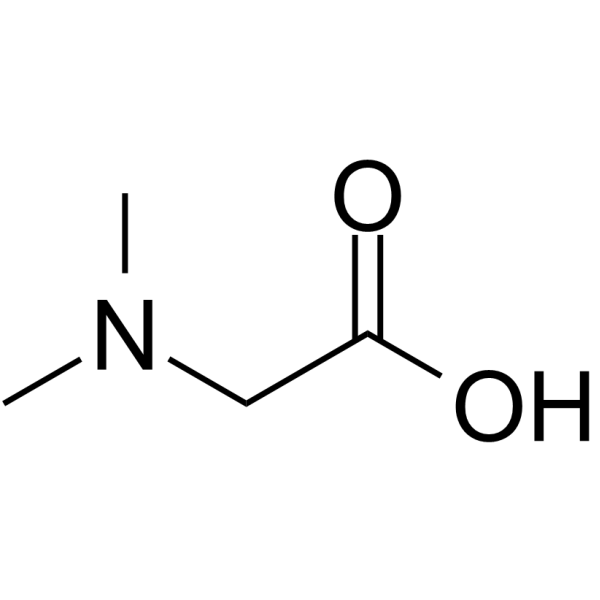
N,N-Dimethylglycine
Based on 1 publication(s) in Google Scholar
N,N-Dimethylglycine (Dimethylglycine), a natural N-methylated glycine, is a nutrient supplement and acts as an NMDAR glycine site partial agonist. N,N-Dimethylglycine is a methyl donor that can improve immunity, act as an antioxidant to prevent oxidative stress, and scavenge excess free radicals. N,N-Dimethylglycine has antidepressant-like and surfactant effects.
For research use only. We do not sell to patients.
- Purity : 98.0%
- CAS No.: 1118-68-9
- Formula: C4H9NO2
- Molecular Weight:103.12
-
Storage:Powder -20°C, 3 years , 4°C, 2 years ; In solvent -80°C, 6 months , -20°C, 1 month

To place orders, for customer services and technical support, please contact: MedChemExpress USA
Tel: 609-228-6898 E-mail: [email protected] [email protected]


-
 Biological Activity
-
Chemical Information
-
Solvent & Solubility
- Protocols
- Purity & Documentation
- References
-
 Help & FAQs


-
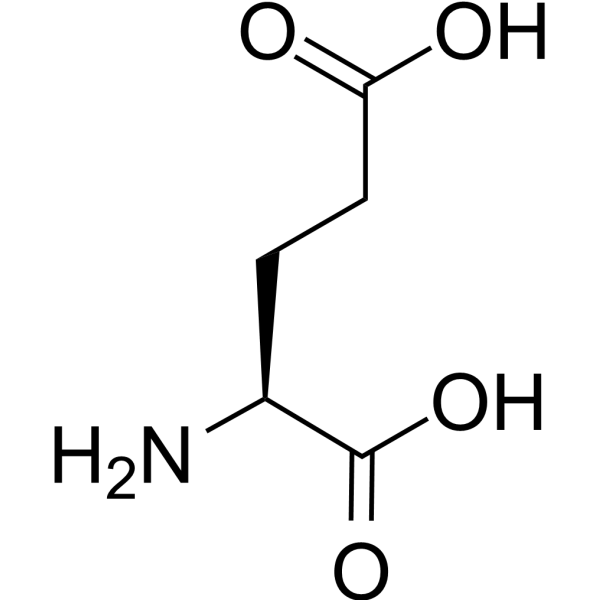
HY-14608
L-Glutamic acidGlutamate Receptors Agonist -

HY-Y0511R
N,N-Dimethylglycine (Standard)Standard of N,N-Dimethylglycine -
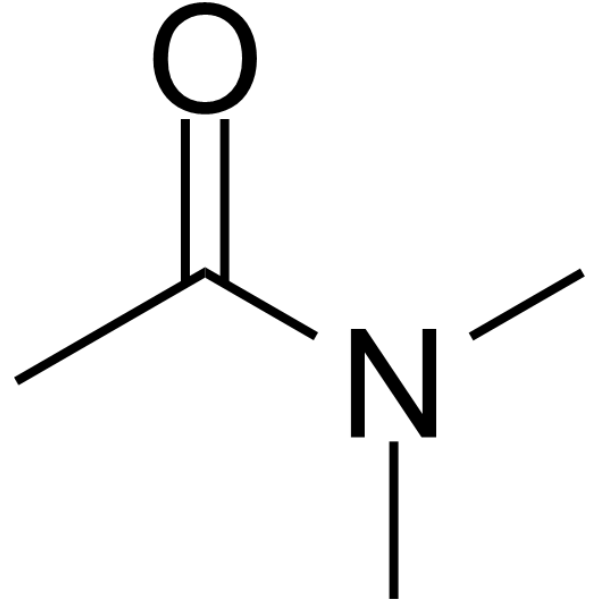
HY-W042416
N,N-DimethylacetamideAnti-inflammatory agent -
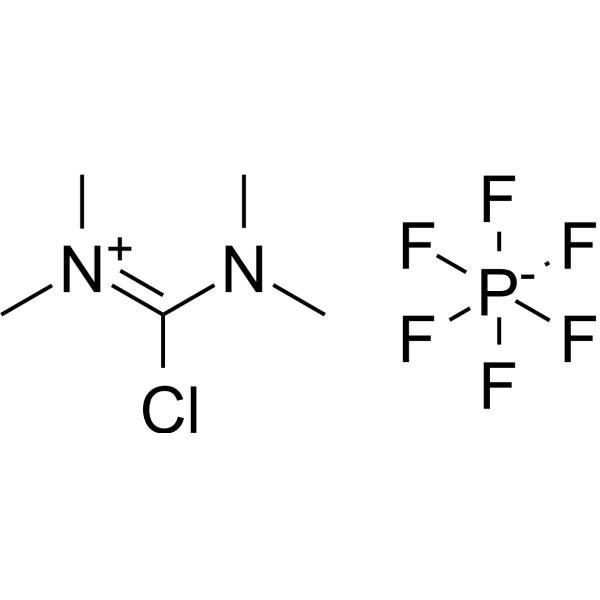
HY-W011556
N,N,N',N'-Tetramethylchloroformamidinium hexafluorophosphateBiochemical Reagent -

HY-W042416R
N,N-Dimethylacetamide (Standard)Anti-inflammatory agent
Publications Citing Use of MedChemExpress (MCE) N,N-Dimethylglycine
MoreAll Endogenous Metabolite Isoforms
MoreAll iGluR Isoforms
More

Biological Activity
Description
IC50 & Target
|
Microbial Metabolite |
Human Endogenous Metabolite |
In Vitro
N,N-Dimethylglycine (40 mg/mL) shows 88.40%, 98.90%, and 87.58% scavenging activities in the DPPH radical scavenging, ABTS+ radical scavenging, and H2O2 scavenging experiments[3].
MedChemExpress (MCE) has not independently confirmed the accuracy of these methods. They are for reference only. Further protocols information, click here.
In Vivo
N,N-Dimethylglycine (12 mg/0.3 mL sterile saline; gavage; single dose; subcutaneous injection 1 hour later) improves the histological morphology of the small intestine, enhances the antioxidant system, reduces oxidative damage, and increases the expression of antioxidant-related genes in male Kunming mice[2].
N,N-Dimethylglycine (12 mg/0.3 mL sterile saline; gavage; twice a day; 28 days) increases the body weight, the organ proportion of the liver and spleen, enhances the antioxidant capacity of serum and liver, and reduces the activities of serum alanine aminotransferase (ALT) and aspartate aminotransferase (AST) as well as the malondialdehyde (MDA) content in serum and liver in male Kunming mice[3].
N,N-Dimethylglycine (12 mg/0.3 mL sterile saline; gavage; twice a day; 28 days) reduces the serum ALT and AST contents, the ROS level in hepatic mitochondria, and increases the antioxidant capacity of hepatic mitochondria and the mitochondrial membrane potential (MMP) level in male Kunming mice with Lipopolysaccharides (LPS) (HY-D1056)-induced oxidative stress model[3].
MedChemExpress (MCE) has not independently confirmed the accuracy of these methods. They are for reference only.
-
Animal Model:Male ICR mice (body weight 10-12 g, 3-week- old) + Repeated drug exposure (20 mg/kg, i.p., twice daily for 14 days)[1].
-
Dosage:30 mg/kg, 100 mg/kg
-
Administration:Intraperitoneal injection, 20 min prior to each drug injection, twice a day, 14 days.
-
Result:Prevented the dtug-induced memory impairments in novel location recognition test (NLRT) and novel object recognition test (NORT), social withdrawal in reciprocal social interaction test, and enhanced head twitch response induced by serotonergic hallucinogen.
-
Animal Model:Male Kunming mice (weight 20-25 g, 40 days old) + Indomethacin injection (10 mg/kg BW)[2].
-
Dosage:12 mg/0.3 mL sterile saline
-
Administration:Orally gavage; single dose; and then subcutaneous injection 1 hour later.
-
Result:Improved the histological morphology of the small intestine. Enhanced the antioxidant system, reduced oxidative damage, and increased the expression of antioxidant-related genes in the small intestine and its mitochondria compared with the indomethacin-treated group2.
-
Animal Model:Male Kunming mice (weight 20-25 g, 40 days old) + Lipopolysaccharides (LPS) injection (100 μg/kg body weight)[3].
-
Dosage:12 mg/0.3 mL sterile saline
-
Administration:Orally gavage; twice a day; 28 days.
-
Result:Significantly decreased the serum ALT and AST content, ROS level, and expression of liver antioxidant gene MnSOD, Gpx1, Sirt1.
Significantly increased the hepatic mitochondrial antioxidant capacity (MnSOD, GSH, GPx, GR) and MMP level compared with the LPS-treated group.


Chemical Information
-
CAS No. 1118-68-9
-
Appearance Solid
-
Molecular Weight 103.12
-
Formula C4H9NO2
-
Color White to off-white
-
SMILES
O=C(O)CN(C)C
-
Synonyms
Dimethylglycine; DMG; N-Methylsarcosine
-
Structure Classification
-
Initial Source
-
Shipping
Room temperature in continental US; may vary elsewhere.
-
Storage
Powder -20°C 3 years 4°C 2 years In solvent -80°C 6 months -20°C 1 month


Publications (1)
-
Journal Impact Factor
-
Most Recent
-
FASEB J
The metabolomic profiling identifies N, N-dimethylglycine as a facilitator of dorsal root ganglia neuron axon regeneration after injury. [Abstract]2022 May;36(5):e22305. PMID: 35394692


Solvent & Solubility
In Vitro:
H2O : 100 mg/mL (969.74 mM; Need ultrasonic)
Please refer to the solubility information to select the appropriate solvent. Once prepared, please aliquot and store the solution to prevent product inactivation from repeated freeze-thaw cycles.
Storage method and period of stock solution: -80°C, 6 months; -20°C, 1 month. When stored at -80°C, please use it within 6 months. When stored at -20°C, please use it within 1 month.
* Note: If you choose water as the stock solution, please dilute it to the working solution, then filter and sterilize it with a 0.22 μm filter before use.
Please refer to the solubility information to select the appropriate solvent. Once prepared, please aliquot and store the solution to prevent product inactivation from repeated freeze-thaw cycles.
Storage method and period of stock solution: -80°C, 6 months; -20°C, 1 month. When stored at -80°C, please use it within 6 months. When stored at -20°C, please use it within 1 month.
* Note: If you choose water as the stock solution, please dilute it to the working solution, then filter and sterilize it with a 0.22 μm filter before use.
Concentration (start) × Volume (start) = Concentration (final) × Volume (final)
In Vivo:
For the following dissolution methods, please prepare the working solution directly:
It is recommended to prepare fresh solutions and use them promptly within a short period of time.
The percentages shown for the solvents indicate their volumetric ratio in the final prepared solution. If precipitation or phase separation occurs during preparation, heat and/or sonication can be used to aid dissolution.
Add each solvent one by one: PBS
Solubility: 100 mg/mL (969.74 mM); Clear solution; Need ultrasonic

Protocols
-
ROS/oxidative-stress fluorescent staining
ROS/oxidative-stress fluorescent staining uses cell-permeant fluorogenic probes that become fluorescent after oxidation inside cells or tissues; commonly used examples include DCFH-DA/DCFDA for broad cellular oxidant detection, DHE for superoxide-related signal detection, MitoSOX for mitochondrial superoxide-related signal detection, and CellROX probes for oxidative-stress-associated fluorescence readouts. The assay detects probe oxidation rather than a single ROS species unless the probe and analysis method have been chemically validated for that species. DCFH-DA enters cells, is deacetylated by intracellular esterases to DCFH, and produces fluorescent DCF after oxidation, so the readout is used as an operational measure of total cellular oxidative stress rather than a species-specific ROS measurement. DHE and MitoSOX can report superoxide-related oxidation, but red fluorescence alone can include non-specific ethidium-like oxidation products; HPLC or optimized spectral approaches are


Purity & Documentation
-
Data Sheet (276 KB)
-
SDS (396 KB)
- English - EN (396 KB)
- Français - FR (396 KB)
- Deutsch - DE (396 KB)
- Norwegian - NO (396 KB)
- Español - ES (396 KB)
- Swedish - SV (396 KB)
- Italian - IT (396 KB)
- Korean - KR (396 KB)
- Portuguese - PT (396 KB)
-
Handling Instructions (2659 KB)
References
[1]. Hsieh CP, et al. N, N-dimethylglycine Protects Behavioral Disturbances and Synaptic Deficits Induced by Repeated Ketamine Exposure in Mice. Neuroscience. 2021 Sep 15;472:128-137. [Content Brief]
[2]. Bai K, et al. Dimethylglycine sodium salt protects against oxidative damage and mitochondrial dysfunction in the small intestines of mice. Int J Mol Med. 2019 May;43(5):2199-2211. [Content Brief]
[3]. Bai K, et al. Assessment of Free Radical Scavenging Activity of Dimethylglycine Sodium Salt and Its Role in Providing Protection against Lipopolysaccharide-Induced Oxidative Stress in Mice. PLoS One. 2016 May 12;11(5):e0155393. [Content Brief]


Complete Stock Solution Preparation Table
Please refer to the solubility information to select the appropriate solvent. Once prepared, please aliquot and store the solution to prevent product inactivation from repeated freeze-thaw cycles.
Storage method and period of stock solution: -80°C, 6 months; -20°C, 1 month. When stored at -80°C, please use it within 6 months. When stored at -20°C, please use it within 1 month.
| Optional Solvent | Concentration Solvent Mass | 1 mg | 5 mg | 10 mg | 25 mg |
|---|---|---|---|---|---|
| H2O | 1 mM | 9.6974 mL | 48.4872 mL | 96.9744 mL | 242.4360 mL |
| 5 mM | 1.9395 mL | 9.6974 mL | 19.3949 mL | 48.4872 mL | |
| 10 mM | 0.9697 mL | 4.8487 mL | 9.6974 mL | 24.2436 mL | |
| 15 mM | 0.6465 mL | 3.2325 mL | 6.4650 mL | 16.1624 mL | |
| 20 mM | 0.4849 mL | 2.4244 mL | 4.8487 mL | 12.1218 mL | |
| 25 mM | 0.3879 mL | 1.9395 mL | 3.8790 mL | 9.6974 mL | |
| 30 mM | 0.3232 mL | 1.6162 mL | 3.2325 mL | 8.0812 mL | |
| 40 mM | 0.2424 mL | 1.2122 mL | 2.4244 mL | 6.0609 mL | |
| 50 mM | 0.1939 mL | 0.9697 mL | 1.9395 mL | 4.8487 mL | |
| 60 mM | 0.1616 mL | 0.8081 mL | 1.6162 mL | 4.0406 mL | |
| 80 mM | 0.1212 mL | 0.6061 mL | 1.2122 mL | 3.0304 mL | |
| 100 mM | 0.0970 mL | 0.4849 mL | 0.9697 mL | 2.4244 mL |
* Note: If you choose water as the stock solution, please dilute it to the working solution, then filter and sterilize it with a 0.22 μm filter before use.


N,N-Dimethylglycine Related Classifications
HY-Y0511 Related Classifications
 Powered by Bioz