



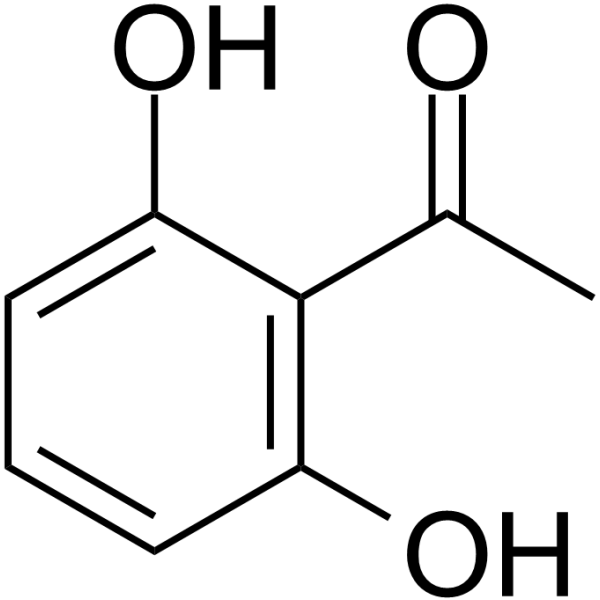
2,6-Dihydroxyacetophenone

Based on 1 Customer Validation
2,6-Dihydroxyacetophenone, a polyphenolic derivative of Acetophenone (HY-Y0989), is an orally active mTOR inhibitor. 2,6-Dihydroxyacetophenone shows antioxidant activity. 2,6-Dihydroxyacetophenone inhibits cell growth and proliferation in CRC cells. 2,6-Dihydroxyacetophenone arrests at G0/G1 phase of cell cycle, induces apoptosis and suppresses cell migration in CRC cells. 2,6-Dihydroxyacetophenone inhibits xanthine oxidase (XOD) with an IC50 of 1.24 mM. 2,6-dihydroxyacetophenone improves uric acid metabolism in hyperuricemia mice, reduces plasma cholesterol in hypercholesterolemic rats, and inhibits lipid accumulation in HFD-induced obese mice. 2,6-Dihydroxyacetophenone can be used for the study of colorectal cancer (CRC), hyperuricemia and hypercholesterolemia.
Para uso exclusivo en investigación. No vendemos a pacientes.
- Pureza: 99.85%
- No. CAS: 699-83-2
- Fòrmula: C8H8O3
- Peso molecular:152.15
-
Almacenamiento:
4°C, stored under nitrogen
* In solvent : -80°C, 6 months; -20°C, 1 month (stored under nitrogen)

To place orders, for customer services and technical support, please contact: MedChemExpress USA
Tel: 609-228-6898 E-mail: [email protected] [email protected]


-
 Actividad biológica
-
Chemical Information
-
Solvente y solubilidad
- Pureza y Documentación
- Referencias
-
 Help & FAQs
-

Apoptosis Compound Library
HY-L003
-
Immunology/Inflammation Compound Library
HY-L007
-
Kinase Inhibitor Library
HY-L009
-
Metabolism/Protease Compound Library
HY-L012
-
PI3K/Akt/mTOR Compound Library
HY-L015
-
Stem Cell Signaling Compound Library
HY-L017
-
Natural Product Library
HY-L021
-
Autophagy Compound Library
HY-L029
-
Anti-Aging Compound Library
HY-L034
-
Antioxidant Compound Library
HY-L037
-
Differentiation Inducing Compound Library
HY-L038
-
Reprogramming Compound Library
HY-L039
-
Oxygen Sensing Compound Library
HY-L045
-
Anti-Cardiovascular Disease Compound Library
HY-L046
-
Phenols Library
HY-L057
-
Glycolysis Compound Library
HY-L058
-
Cytoskeleton Compound Library
HY-L060
-
Orally Active Compound Library
HY-L061
-
Traditional Chinese Medicine Active Compound Library
HY-L065
-
Anti-Breast Cancer Compound Library
HY-L074
-
Anti-Lung Cancer Compound Library
HY-L075
-
Anti-Pancreatic Cancer Compound Library
HY-L077
-
Anti-Blood Cancer Compound Library
HY-L079
-
Anti-Cancer Metabolism Compound Library
HY-L083
-
Anti-Obesity Compound Library
HY-L087
-
Angiogenesis-Related Compound Library
HY-L088
-
Glucose Metabolism Compound Library
HY-L092
-
Anti-Liver Cancer Compound Library
HY-L101
-
Anti-Colorectal Cancer Compound Library
HY-L103
-
Anti-inflammatory Traditional Chinese Medicine Active Compound Library
HY-L114
-
Human Metabolite Library
HY-L123
-
Anti-Prostate Cancer Compound Library
HY-L124
-
Anti-Pulmonary Fibrosis Compound Library
HY-L125
-
Cancer Stem Cells Compound Library
HY-L135
-
Pain-Related Compound Library
HY-L139
-
Mitochondrial Protection Compound Library
HY-L144
-
Metabolic Enzyme Compound Library
HY-L146
-
Cell Death Library
HY-L162
-
Serine/Threonine Kinase Inhibitor Library
HY-L164
-
Anti-Hematopathy Compound Library
HY-L171
-
Anti-Ovarian Cancer Compound Library
HY-L173
-
Multi-Target Compound Library
HY-L176
-
Radioprotector Library
HY-L178
-
Bioactive Compound Library Max
HY-L181
-
MCE Bioactive Compound Library
HY-L001V
-
Natural Product Library Plus
HY-L021P
-
Natural Product and Natural Product-Like Compound Library
HY-L021M
-
Bioactive Compound Library
HY-L001
-
Anti-Gastric Cancer Compound Library
HY-L184
-
Anti-Fibrosis Compound Library
HY-L185
-
Anti-Brain Cancer Compound Library
HY-L188
-
Miao Ethnicity Medicine Compound Library
HY-L190
-
Non-Alcoholic Fatty Liver Disease (NAFLD) Compound Library
HY-L199
-
RO5 Drug-like Natural Product Library
HY-L200
-
High-Throughput Bioactive Compound Library
HY-L205
-
High-Throughput Natural Product Library
HY-L206
-
Mass Spectrometry Human Metabolite Library
HY-L215
-
Diarrhea-Related Traditional Chinese Medicine Active Compound Library
HY-L224
-
Chinese Baijiu Compound Library
HY-L241
-
Lactylation Compound Library
HY-L249
-
Mass Spectrometry Natural Product Library
HY-L262




Actividad biológica
2,6-Dihydroxyacetophenone (5-40 µM, 48 h) inhibits cell growth and proliferation of HCT8 cells[1].
2,6-Dihydroxyacetophenone (10-100 µM, 24-48 h) arrests the cell cycle at the G0/G1 phase, induces apoptosis and suppresses cell migration in HCT8 cells[1].
2,6-Dihydroxyacetophenone (40 µM, 48 h) reduces the expression of p70S6K1 and AKT1 in HCT8 cells[1].
2,6-Dihydroxyacetophenone (0.1-2 mM) inhibits xanthine oxidase (XOD) with an IC50 of 1.24 mM[2].
2,6-Dihydroxyacetophenone (200 µM, 48 h) decreases the survival rate of BRL 3A cells[2].
2,6-Dihydroxyacetophenone (0.325-1.3 mM, 24 h) inhibits lipid accumulation in FFA-induced LO2 cells, and 1.3 mM reduces intracellular TG levels[6].
MedChemExpress (MCE) has not independently confirmed the accuracy of these methods. They are for reference only.
-
Cell Line:HCT8 cells
-
Concentration:5, 10, 20, 40 μM
-
Incubation Time:48 h
-
Result:Inhibited cell growth and proliferation of HCT8 cells.
-
Cell Line:HCT8 cells
-
Concentration:40 μM
-
Incubation Time:24 h
-
Result:Arrested HCT8 cells in G0/G1 phase of cell cycle with a 10% reduction in the percentage in the G2/M phase.
-
Cell Line:HCT8 cells
-
Concentration:40, 80, 100 μM
-
Incubation Time:48 h
-
Result:Reduced the BCL2 expression.
Induced the BID expression.
Reduced the expression of p70S6K1 and AKT1.
-
Cell Line:HCT8 cells
-
Concentration:10, 20, 40 μM
-
Incubation Time:48 h
-
Result:Suppressed colorectal cancer cell migration.
2,6-dihydroxyacetophenone (60.86 mg/kg (400 μmol/kg), i.g., twice daily, 3 weeks) decreases plasma cholesterol levels in hypercholesterolemic rats[5].
2,6-dihydroxyacetophenone (7 mg/kg, i.g., daily, 8 weeks) inhibits lipid accumulation high-fat diet (HFD)-induced obese mice[6].
MedChemExpress (MCE) has not independently confirmed the accuracy of these methods. They are for reference only.
-
Animal Model:A hyperuricemia (HUA) mouse model (8-week male Kunming mice), which was established by daily intragastric administration of Hypoxanthine (HY-N0091) (500 mg/kg), intraperitoneal injection of Potassium oxonate (HY-17511) (300 mg/kg), and supplementation with 10% fructose water[4].
-
Dosage:40 mM/kg
-
Administration:i.g. daily for 21 days
-
Result:Reduced serum UA levels in HUA mice.
Inhibited XOD activity in serum and liver.
Decreased serum CRE and BUN levels.
Improved renal tissue inflammatory infiltration and renal tubular lesions.
Increased the relative abundance of Lactobacillus.
Reduced the proportion of Firmicutes, and the abundance of Proteobacteria and Actinobacteria.
Regulated the gut microbiota structure.
Had no significant effect on the body weight and liver and kidney coefficients of mice.
-
Animal Model:Adult male Sprague-Dawley rats (weighing 200-250g) were fed a high-cholesterol diet containing 1.5% cholesterol and 0.5% cholic acid for 3 weeks to induce hypercholesterolemia[5].
-
Dosage:60.86 mg/kg (400 μmol/kg)
-
Administration:i.g. twice daily for 3 weeks
-
Result:Decreased Plasma cholesterol levels in hypercholesterolemic rats significantly after 2 weeks treatment, and this effect persisted until the 3rd week.
Decreased the plasma cholesterol to 152 mg/dl.
-
Animal Model:Male and female KM mice (4 weeks) received high-fat diet (DIO series diets, 60% H10060)[6].
-
Dosage:7 mg/kg
-
Administration:i.g. daily for 8 weeks
-
Result:Caused a decreasing trend in body weight gain of mice compared with the HFD group.
Reduced the serum levels of triglycerides (TG) and low-density lipoprotein cholesterol (LDL-C) in mice.
Decreased the atherosclerosis index (AI) and coronary artery risk index (CRI) of mice.
Reversed the HFD-induced gut microbiota dysbiosis in mice.
Increased the relative abundance of the genus Odoribacter in the gut of mice.
Decreased the abundances of the genera Helicobacter and Mucispirillum in the gut of mice.
Reduced the HFD-induced increase in the Firmicutes/Bacteroidetes ratio in the gut of mice.


Chemical Information
-
No. CAS 699-83-2
-
Appearance Solid
-
Peso molecular 152.15
-
Fòrmula C8H8O3
-
Color Light yellow to yellow
-
SMILES
CC(C1=C(O)C=CC=C1O)=O
-
Structure Classification
-
Initial Source
-
Envío
Room temperature in continental US; may vary elsewhere.
-
Almacenamiento
4°C, stored under nitrogen
* In solvent : -80°C, 6 months; -20°C, 1 month (stored under nitrogen)


Solvente y solubilidad
DMSO : 100 mg/mL (657.25 mM; Need ultrasonic; Hygroscopic DMSO has a significant impact on the solubility of product, please use newly opened DMSO)
Please refer to the solubility information to select the appropriate solvent. Once prepared, please aliquot and store the solution to prevent product inactivation from repeated freeze-thaw cycles.
Storage method and period of stock solution: -80°C, 6 months; -20°C, 1 month (stored under nitrogen). When stored at -80°C, please use it within 6 months. When stored at -20°C, please use it within 1 month.
Please refer to the solubility information to select the appropriate solvent. Once prepared, please aliquot and store the solution to prevent product inactivation from repeated freeze-thaw cycles.
Storage method and period of stock solution: -80°C, 6 months; -20°C, 1 month (stored under nitrogen). When stored at -80°C, please use it within 6 months. When stored at -20°C, please use it within 1 month.
Concentration (start) × Volume (start) = Concentration (final) × Volume (final)
Select the appropriate dissolution method based on your experimental animal and administration route.
- For the following dissolution methods, please ensure to first prepare a clear stock solution using an In Vitro approach and then sequentially add co-solvents:
- To ensure reliable experimental results, the clarified stock solution can be appropriately stored based on storage conditions. As for the working solution for In Vivo experiments, it is recommended to prepare freshly and use it on the same day.
- The percentages shown for the solvents indicate their volumetric ratio in the final prepared solution. If precipitation or phase separation occurs during preparation, heat and/or sonication can be used to aid dissolution.
Add each solvent one by one: 10% DMSO 40% PEG300 5% Tween-80 45% Saline
Solubility: ≥ 2.5 mg/mL (16.43 mM); Clear solution
This protocol yields a clear solution of ≥ 2.5 mg/mL (saturation unknown).
Taking 1 mL working solution as an example, add 100 μL DMSO stock solution (25.0 mg/mL) to 400 μL PEG300, and mix evenly; then add 50 μL Tween-80 and mix evenly; then add 450 μL Saline to adjust the volume to 1 mL.
Preparation of Saline: Dissolve 0.9 g sodium chloride in ddH₂O and dilute to 100 mL to obtain a clear Saline solution.
Add each solvent one by one: 10% DMSO 90% (20% SBE-β-CD in Saline)
Solubility: ≥ 2.5 mg/mL (16.43 mM); Clear solution
This protocol yields a clear solution of ≥ 2.5 mg/mL (saturation unknown).
Taking 1 mL working solution as an example, add 100 μL DMSO stock solution (25.0 mg/mL) to 900 μL 20% SBE-β-CD in Saline, and mix evenly.
Preparation of 20% SBE-β-CD in Saline (4°C, storage for one week): 2 g SBE-β-CD powder is dissolved in 10 mL Saline, completely dissolve until clear.
Please enter the basic information of animal experiments:
-
-
-
-
Recommended: Prepare an additional quantity of animals to account for potential losses during experiments.
Please enter your animal formula composition:
-
%DMSO +
Recommended: Keep the proportion of DMSO in working solution below 2% if your animal is weak.
-
%+
-
+%Tween-80 + +
-
%Saline +
The co-solvents required include: DMSO, . All of co-solvents are available by MedChemExpress (MCE). , Tween 80. All of co-solvents are available by MedChemExpress (MCE).
Working solution concentration: 0.22 mg/mL
Method for preparing stock solution: mg drug dissolved in μL DMSO. Stock solution concentration: mg/mL. * In solvent : -80°C, 6 months; -20°C, 1 month (stored under nitrogen)
1. Take μL DMSO stock solution;
2. Add μL .
μL , mix evenly;
3. Then add μL Tween 80, mix evenly;
4. Then add μL
Please ensure that the stock solution in the first step is dissolved to a clear state, and add co-solvents in sequence. You can use ultrasonic heating (ultrasonic cleaner, recommended frequency 20-40 kHz), vortexing, etc. to assist dissolution.


Pureza y Documentación
-
Ficha de datos (290 KB)
-
SDS (394 KB)
- English - EN (394 KB)
- Français - FR (394 KB)
- Deutsch - DE (394 KB)
- Norwegian - NO (394 KB)
- Español - ES (394 KB)
- Swedish - SV (394 KB)
- Italian - IT (394 KB)
- Korean - KR (394 KB)
- Portuguese - PT (394 KB)
-
Instrucciones de manejo (2659 KB)
Referencias
[1]. Awasthi A, et al. Invitro Evaluation of Torin2 and 2, 6-Dihydroxyacetophenone in Colorectal Cancer Therapy. Pathol Oncol Res. 2019 Jan;25(1):301-309. [Content Brief]
[2]. Liu X, et al. Characterization of xanthine oxidase inhibitory activities of phenols from pickled radish with molecular simulation. Food Chem X. 2022 May 21;14:100343. [Content Brief]
[3]. Rezk BM, et al. The antioxidant activity of phloretin: the disclosure of a new antioxidant pharmacophore in flavonoids. Biochem Biophys Res Commun. 2002 Jul 5;295(1):9-13. [Content Brief]
[5]. Kanchanapoo J, et al. Inhibitory effects of choleretic hydroxyacetophenones on ileal bile acid transport in rats. Life Sci. 2006 Feb 28;78(14):1630-6. [Content Brief]
[6]. Li J, et al. Three Novel Dietary Phenolic Compounds from Pickled Raphanus Sativus L. Inhibit Lipid Accumulation in Obese Mice by Modulating the Gut Microbiota Composition. Mol Nutr Food Res. 2021 Mar;65(6):e2000780. [Content Brief]


Complete Stock Solution Preparation Table
Please refer to the solubility information to select the appropriate solvent. Once prepared, please aliquot and store the solution to prevent product inactivation from repeated freeze-thaw cycles.
Storage method and period of stock solution: -80°C, 6 months; -20°C, 1 month (stored under nitrogen). When stored at -80°C, please use it within 6 months. When stored at -20°C, please use it within 1 month.
| Optional Solvent | Concentration Solvent Mass | 1 mg | 5 mg | 10 mg | 25 mg |
|---|---|---|---|---|---|
| DMSO | 1 mM | 6.5725 mL | 32.8623 mL | 65.7246 mL | 164.3115 mL |
| 5 mM | 1.3145 mL | 6.5725 mL | 13.1449 mL | 32.8623 mL | |
| 10 mM | 0.6572 mL | 3.2862 mL | 6.5725 mL | 16.4312 mL | |
| 15 mM | 0.4382 mL | 2.1908 mL | 4.3816 mL | 10.9541 mL | |
| 20 mM | 0.3286 mL | 1.6431 mL | 3.2862 mL | 8.2156 mL | |
| 25 mM | 0.2629 mL | 1.3145 mL | 2.6290 mL | 6.5725 mL | |
| 30 mM | 0.2191 mL | 1.0954 mL | 2.1908 mL | 5.4771 mL | |
| 40 mM | 0.1643 mL | 0.8216 mL | 1.6431 mL | 4.1078 mL | |
| 50 mM | 0.1314 mL | 0.6572 mL | 1.3145 mL | 3.2862 mL | |
| 60 mM | 0.1095 mL | 0.5477 mL | 1.0954 mL | 2.7385 mL | |
| 80 mM | 0.0822 mL | 0.4108 mL | 0.8216 mL | 2.0539 mL | |
| 100 mM | 0.0657 mL | 0.3286 mL | 0.6572 mL | 1.6431 mL |


2,6-Dihydroxyacetophenone Related Classifications
HY-Y0106 Related Classifications
 Powered by Bioz