1. Search Result
Search Result
No matches for "

79899

" within the MedChemExpress (MCE) catalog. Here are the results you might be looking for.

13

Inhibitors & Agonists

6

Biochemical Assay Reagents

1

Inhibitory Antibodies

7

Antibodies

5

Oligonucleotides

Cat. No. Product Name Target Research Areas Chemical Structure
  • HY-Y0850K

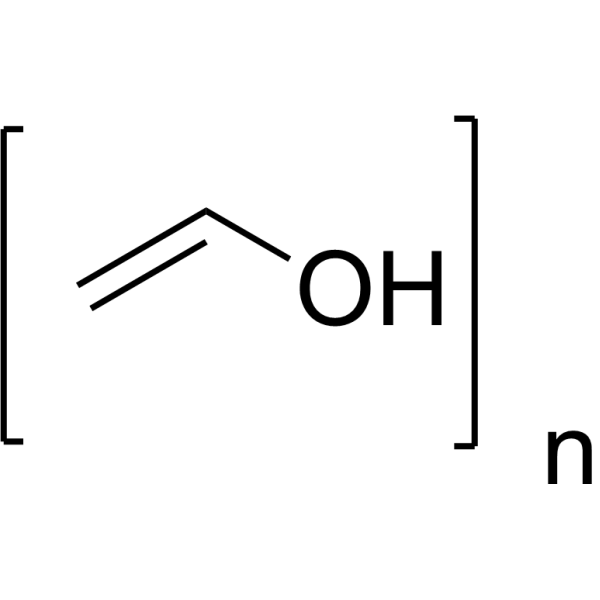
    PVA (Mw 31000-50000, 98-99% hydrolyzed); Poly(Ethenol) (Mw 31000-50000, 98-99% hydrolyzed)

    Environmental Pollutants Biochemical Assay Reagents Cancer
    Polyvinyl alcohol (Mw 31000-50000, 98-99% hydrolyzed), also known as PVA, is a vinyl water-soluble polymer that can be used as a non-ionic surfactant. It can also be used as a biodegradable polymer and can be used in adhesives, coatings, textiles, ceramics and cosmetics. Polyvinyl alcohol can be used in tissue engineering by electrospinning. Polyvinyl alcohol can achieve high cellular density, infiltration, and uniform distribution, facilitating functional connections between cells. Polyvinyl alcohol can improve cell vitality through in vitro cultivation. Polyvinyl alcohol demonstrates promising inhibition of ostersarcoma cancer cells with Doxorubicin (HY-15142A) .
    Polyvinyl alcohol (Mw 31000-50000, 98-99% hydrolyzed)
  • HY-Y0850U3

    Polyvinyl alcohol (Mw 125000, 98-99% hydrolyzed, ~2800 polymerization); Poly(Ethenol) (Mw 125000, 98-99% hydrolyzed, ~2800 polymerization)

    Biochemical Assay Reagents Others
    PVA (Polyvinyl alcohol) (Mw 125000, 98-99% hydrolyzed, ~2800 polymerization) is a water-soluble, biodegradable, biocompatible and non-immunogenic polymer. PVA (Mw 125000, 98-99% hydrolyzed, ~2800 polymerization) causes no irritation to rabbit eyes, no skin sensitization in guinea pigs, promotes the proliferation of human skin keratinocytes, and reduces the loss of corneal endothelial cells. The LD50 of PVA (Mw 125000, 98-99% hydrolyzed, ~2800 polymerization) in rats and dogs is greater than 10 g/kg. PVA (Mw 125000, 98-99% hydrolyzed, ~2800 polymerization) is hardly absorbed by the digestive system, causes no adverse effects upon long-term oral administration, and shows no mutagenicity or carcinogenicity. However, repeated intravenous or portal vein injection of PVA (Mw 125000, 98-99% hydrolyzed, ~2800 polymerization) may induce pathological changes such as glomerular lesions, anemia, hypertension or liver fibrosis in rats or dogs. Crosslinked nanofibers prepared by modifying PVA (Mw 125000, 98-99% hydrolyzed, ~2800 polymerization) can be used in studies related to wound dressings and other applications .
    PVA (Mw 125000, 98-99% hydrolyzed, ~2800 polymerization)
  • HY-133204

    IKI-7899

    Environmental Pollutants Insecticide Others
    Chlorfluazuron (IKI-7899) is a benzoylurea insecticide. Chlorfluazuron inhibts insect chitin and disrupts normal exuviation by inducing malformations, thereby preventing and controlling lepidopteran pests .
    Chlorfluazuron
  • HY-Y0850U5

    Polyvinyl alcohol (Mw 27000, 98-99% hydrolyzed, ~600 polymerization); Poly(Ethenol) (Mw 27000, 98-99% hydrolyzed, ~600 polymerization)

    Biochemical Assay Reagents Fungal Infection
    PVA (Polyvinyl alcohol) (Mw 27000, 98-99% hydrolyzed, ~600 polymerization) is a nonionic ethanol homopolymer with hydrophilicity, water solubility and biodegradability. PVA (Mw 27000, 98-99% hydrolyzed, ~600 polymerization) exhibits biocompatibility, non-toxicity and non-carcinogenicity, as well as antibacterial activity against Gram-positive bacteria, Gram-negative bacteria and fungal strains. PVA (Mw 27000, 98-99% hydrolyzed, ~600 polymerization) can serve as a solubilizer, stabilizer, mucoadhesive agent and sustained-release agent, and has a synergistic solubilizing effect on voriconazole/sulfobutyl ether β-cyclodextrin complexes. By stabilizing such complexes, PVA (Mw 27000, 98-99% hydrolyzed, ~600 polymerization) forms freeze-thaw hydrogels with high mucoadhesion, sustained drug release and ex vivo corneal permeability. When compounded with hyaluronic acid hydrogels, PVA (Mw 27000, 98-99% hydrolyzed, ~600 polymerization) supports chondrocyte growth in vitro, and also forms complexes with Cu 2+, Co 2+, Ni 2+ and Zn 2+ ions. PVA (Mw 27000, 98-99% hydrolyzed, ~600 polymerization) can be used in studies related to fungal keratitis, bacterial infections and fungal infections .
    PVA (Mw 27000, 98-99% hydrolyzed, ~600 polymerization)
  • HY-Y0850U7

    Polyvinyl alcohol (Mw 195000, 98-99% hydrolyzed, ~4300 polymerization); Poly(Ethenol) (Mw 195000, 98-99% hydrolyzed, ~4300 polymerization)

    Biochemical Assay Reagents Others
    PVA (Mw 195000, 98-99% hydrolyzed, ~4300 polymerization) is polyvinyl alcohol with a molecular weight of 195,000 and hydrolytic properties. PVA (Mw 195000, 98-99% hydrolyzed, ~4300 polymerization) is obtained by polymerizing vinyl acetate followed by hydrolysis to remove acetate groups, yielding polyvinyl alcohol .
    PVA (Mw 195000, 98-99% hydrolyzed, ~4300 polymerization)
  • HY-Y0850U8

    Polyvinyl alcohol (Mw 47000, 98-99% hydrolyzed, ~1000 polymerization); Poly(Ethenol) (Mw 47000, 98-99% hydrolyzed, ~1000 polymerization)

    Biochemical Assay Reagents Others
    PVA (Mw 47000, 98-99% hydrolyzed, ~1000 polymerization) is a polyvinyl alcohol with molecular weight of 47000 with hydrolysis properties. Hydrolysis degree refers to the conversion rate of acetic acid group hydrolysis to hydroxyl group in the original polyvinyl acetate, PVA (Mw 47000, 98-99% hydrolyzed, ~1000 polymerization). In addition, polyvinyl alcohol is obtained from polymerization of vinyl acetate to remove acetic acid group by hydrolysis. Polyvinyl alcohol with different degrees of hydrolysis can be self-crosslinked to form frozen gels and used as biological excipients .
    PVA (Mw 47000, 98-99% hydrolyzed, ~1000 polymerization)
  • HY-Y0850U1

    Polyvinyl alcohol (Mw 61000, 98-99% hydrolyzed, ~1400 polymerization); Poly(Ethenol) (Mw 61000, 98-99% hydrolyzed, ~1400 polymerization)

    Biochemical Assay Reagents Others
    PVA (Mw 61000, 98-99% hydrolyzed, ~1400 polymerization) (Polyvinyl alcohol (Mw 61000, 98-99% hydrolyzed, ~1400 polymerization); Poly(Ethenol) (Mw 61000, 98-99% hydrolyzed, ~1400 polymerization)) is a biodegradable of polymer. PVA (Mw 61000, 98-99% hydrolyzed, ~1400 polymerization) can be used to produce bio-composite films .
    PVA (Mw 61000, 98-99% hydrolyzed, ~1400 polymerization)
  • HY-P991637

    Ser/Thr Protease Metabolic Disease
    REGN7999 is a monoclonal antibody that inhibits TMPRSS6. REGN7999 inhibits TMPRSS6 activity, preventing Hemojuvelin (HJV) lysis, thereby enhancing BMP6-HJV signaling and increasing serum hepcidin. REGN7999 ameliorates iron overload and impaired erythropoiesis in a β-thalassemia mouse model by inhibiting TMPRSS6 activity. REGN7999 is indicated for research in β-thalassemia .
    REGN7999
  • HY-RI02545

    MicroRNA Cancer
    hsa-miR-9899 inhibitors are chemically-modified oligonucleotides that hybridize with mature miRNAs. The miRNA inhibitors have full-length nucleotide 2'-methoxy modification. The miRNA inhibitors strongly compete with mature miRNAs to prevent the complementary pairing of miRNAs and their target genes, thereby inhibiting miRNAs from functioning.
    hsa-miR-9899 inhibitor
    hsa-miR-9899 inhibitor
  • HY-R02545

    MicroRNA Cancer
    hsa-miR-9899 mimics are small, chemically synthesized double-stranded RNAs that mimic endogenous miRNAs and enable miRNA functional analysis by up-regulation of miRNA activity.
    hsa-miR-9899 mimic
    hsa-miR-9899 mimic
  • HY-133204R

    IKI-7899 (Standard)

    Insecticide Reference Standards Others
    Chlorfluazuron (Standard) is the analytical standard of Chlorfluazuron. This product is intended for research and analytical applications. Chlorfluazuron (IKI-7899) is a benzoylurea insecticide. Chlorfluazuron inhibts insect chitin and disrupts normal exuviation by inducing malformations, thereby preventing and controlling lepidopteran pests .
    Chlorfluazuron (Standard)
  • HY-RI02545A

    MicroRNA Cancer
    hsa-miR-9899 antagomirs are chemically-modified oligonucleotides that hybridize with mature miRNAs. The miRNA antagomirs have 2 phosphorothioates at the 5' end, 4 phosphorothioates at the 3' end, 1 cholesterol group at the 3' end, and full-length nucleotide 2'-methoxy modification. The miRNA antagomirs strongly compete with mature miRNAs to prevent the complementary pairing of miRNAs and their target genes, thereby inhibiting miRNAs from functioning. Stability of miRNA antagomirs appears to be significantly higher than miRNA inhibitors, they exhibits enhanced cellular uptake, stability and regulatory activity in vivo.
    hsa-miR-9899 antagomir
    hsa-miR-9899 antagomir
  • HY-R02545A

    MicroRNA Cancer
    hsa-miR-9899 agomirs are chemically-modified double-strand miRNA mimics with modified mature miRNA strand: 2 phosphorothioates at the 5' end, 4 phosphorothioates at the 3' end, 3' end cholesterol group, and full-length nucleotide 2'-methoxy modification. They are designed to mimic endogenous miRNAs and recommended for miRNA functional studies. Compared with miRNA mimics, they exhibits enhanced cellular uptake, stability and regulatory activity in vivo.
    hsa-miR-9899 agomir
    hsa-miR-9899 agomir

Inquiry Online

Submit your filled information, we will contact you soon.

Salutation: * Country or Region:
* Applicant Name: * Organization Name:
* Department:    
* Email Address: * Product Name:
Cat. No.: * Requested quantity:
* Phone Number:    
Remarks:

Inquiry Online

Your information is safe with us. * Required Fields.

Salutation


Country or Region *

Applicant Name *


Organization Name *

Department *


Email Address *


Product Name *

Cat. No.


Requested quantity *

Phone Number *


Remarks

Inquiry Online

Inquiry Information

Product Name:
Cat. No.:
Quantity:
MCE Japan Authorized Agent:

