



Glybuzole
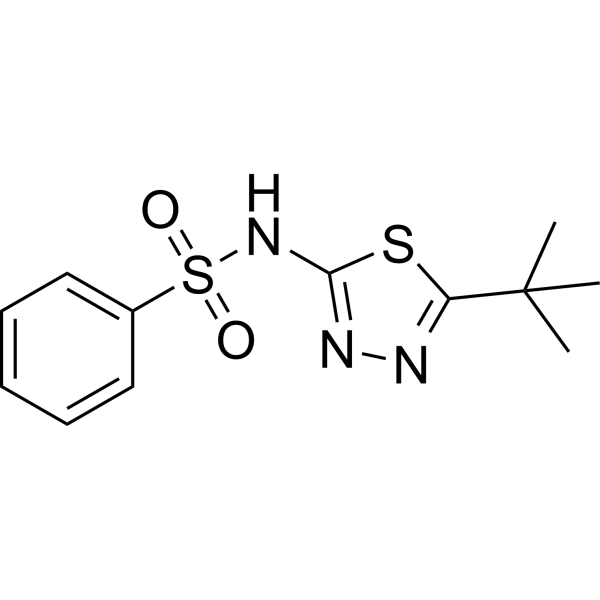
Glybuzole (Desaglybuzole) is an orally effective hypoglycemic agent. Glybuzole promotes insulin secretion by pancreatic β cells and inhibits glucagon secretion by pancreatic α cells. Glybuzole reduces blood glucose levels as well as arginine-stimulated plasma glucagon levels. Glybuzole can be used in diabetes-related research.
For research use only. We do not sell to patients.
- CAS No.: 1492-02-0
- Formula: C12H15N3O2S2
- Molecular Weight:297.40
-
Storage:
Please store the product under the recommended conditions in the Certificate of Analysis.

To place orders, for customer services and technical support, please contact: MedChemExpress USA
Tel: 609-228-6898 E-mail: [email protected] [email protected]


-
 Biological Activity
-
Chemical Information
- Protocols
- Purity & Documentation
- References
-
 Help & FAQs




Biological Activity
Description
In Vitro
Glybuzole (4-40 μg/mL; 24 h) binds to human serum albumin (HSA) with a binding constant of 15.6 μM[2].
MedChemExpress (MCE) has not independently confirmed the accuracy of these methods. They are for reference only. Further protocols information, click here.
In Vivo
Glybuzole (50-100 mg/kg; p.o.; single dose, 29 consecutive days) reduces blood glucose in normal male Wistar rats, with a plasma half-life of 7 hours after a single 50 mg/kg dose, and is primarily excreted in feces and bile[2].
Glybuzole (50 mg/kg; p.o.; single dose) has reduced blood glucose-lowering efficacy in male Wistar rats pretreated with phenobarbital, and its plasma half-life is shortened to 4.5 hours after a single 50 mg/kg dose[2].
Glybuzole (50 mg/kg; p.o.; single dose) has its plasma half-life prolonged to 28 hours after a single 50 mg/kg dose and results in sustained blood glucose reduction in male Wistar rats pretreated with SKF 525A[2].
Glybuzole (50 mg/kg; p.o.; single dose) has its plasma half-life prolonged to 34 hours after a single 50 mg/kg dose, increases urinary excretion 2.5-fold compared to normal rats, and results in sustained blood glucose reduction in male Wistar rats pretreated with Carbon tetrachloride (HY-Y0298)[2].
Glybuzole (20-100 mg/kg; p.o., i.v.; single dose) reduces blood glucose levels in normal male rabbits[2].
MedChemExpress (MCE) has not independently confirmed the accuracy of these methods. They are for reference only.
-
Animal Model:mongrel (adult, 18-28 kg, anesthetized)[1]
-
Dosage:100 mg
-
Administration:intra-arterial; over 10 minutes
-
Result:Decreased femoral artery blood glucose to 72.0 mg/100ml at 40 minutes post-infusion.
Increased pancreatic vein plasma insulin to 164.0 μU/mL at 1 minute and 352.3 μU/mL at 3 minutes post-infusion, then declined toward baseline by 40 minutes.
Decreased pancreatic vein plasma glucagon from baseline to a nadir of 0.92 mμg/mL at 6 minutes post-infusion, then returned to baseline.
-
Animal Model:Wistar (male, body weight 190-210 g)[2]
-
Dosage:50 mg/kg (single dose); 100 mg/kg (29 consecutive daily doses followed by a single 100 mg/kg dose)
-
Administration:p.o.; single dose; 29 consecutive days
-
Result:Reached peak blood concentration of ≈100 μg/mL at 1 hour, with a plasma half-life of 7 hours after a single 50 mg/kg oral dose.
Excreted 20.6% of administered radioactivity in urine and 74.2% in feces over 96 hours; excreted 91.1% of administered radioactivity in bile within 48 hours after a single 50 mg/kg oral dose.
Accounted for 88.6-94.4% of plasma radioactivity as unchanged drug over 1-24 hours, with metabolites I and II making up 1.5-3.6% and 2.3-8.5% respectively after a single 50 mg/kg oral dose.
Accounted for 97.5-97.8% of plasma radioactivity as unchanged drug over 1-24 hours, with metabolites I and II making up 0.3-1.4% and 1.1-1.9% respectively after 30 days of continuous 100 mg/kg dosing.
Reduced blood glucose levels in normal rats, with the lowest levels observed at 1-3 hours post-administration after a single 50 mg/kg oral dose.
-
Animal Model:Wistar (male, body weight 190-210 g, pretreated with phenobarbital)[2]
-
Dosage:50 mg/kg
-
Administration:p.o.; single dose
-
Result:Reached peak blood concentration at 1 hour, with a plasma half-life of 4.5 hours after a single 50 mg/kg oral dose.
Excreted 27.8% of administered radioactivity in urine over 96 hours after a single 50 mg/kg oral dose.
Accounted for 73.0-92.7% of plasma radioactivity as unchanged drug over 1-12 hours, with metabolite II increasing to 22.1% at 12 hours after a single 50 mg/kg oral dose.
Showed reduced blood glucose-lowering activity compared to normal rats after a single 50 mg/kg oral dose.
-
Animal Model:Wistar (male, body weight 190-210 g, pretreated with SKF 525A)[2]
-
Dosage:50 mg/kg
-
Administration:p.o.; single dose
-
Result:Reached peak blood concentration at 3 hours, with a plasma half-life of 28 hours after a single 50 mg/kg oral dose.
Excreted 27.8% of administered radioactivity in urine and 71.6% in feces over 96 hours after a single 50 mg/kg oral dose.
Accounted for 93.9-99.9% of plasma radioactivity as unchanged drug over 1-24 hours, with minimal metabolites detected before 24 hours after a single 50 mg/kg oral dose.
Produced a sustained blood glucose-lowering effect in pretreated rats after a single 50 mg/kg oral dose.
-
Animal Model:Wistar (male, body weight 190-210 g, pretreated with carbon tetrachloride)[2]
-
Dosage:50 mg/kg
-
Administration:p.o.; single dose
-
Result:Reached peak blood concentration at 3 hours, with a plasma half-life of 34 hours after a single 50 mg/kg oral dose.
Excreted 50% of administered radioactivity in urine and 36% in feces over 96 hours; excreted 66.3% of administered radioactivity in bile within 48 hours after a single 50 mg/kg oral dose.
Produced a sustained blood glucose-lowering effect in pretreated rats after a single 50 mg/kg oral dose.
-
Animal Model:(male, body weight 2.5 kg)[2]
-
Dosage:20-100 mg/kg (20 mg/kg i.v.; 100 mg/kg p.o.)
-
Administration:p.o.; i.v.; single dose
-
Result:Reduced blood glucose levels in normal rabbits, with the lowest levels observed at 3 hours post-administration after a single 100 mg/kg oral dose.
Reduced blood glucose levels in normal rabbits, with the lowest levels observed at 2 hours post-administration after a single 20 mg/kg intravenous dose.


Chemical Information
-
CAS No. 1492-02-0
-
Molecular Weight 297.40
-
Formula C12H15N3O2S2
-
SMILES
O=S(C1=CC=CC=C1)(NC2=NN=C(C(C)(C)C)S2)=O
-
Synonyms
Desaglybuzole
-
Shipping
Room temperature in continental US; may vary elsewhere.
-
Storage
Please store the product under the recommended conditions in the Certificate of Analysis.

Protocols
-
Research Protocol for Endocrine Diseases
Endocrine diseases often arise from disrupted hormone production, hormone signaling, or target-tissue responsiveness; for diabetes-focused endocrine disease models, insulin signaling regulates glucose uptake, hepatic glucose output, lipid metabolism, and β-cell compensation. Type 2 diabetes develops through interacting defects in insulin resistance, β-cell dysfunction, adipose inflammation, hepatic glucose overproduction, altered incretin signaling, and ectopic lipid metabolism. A major unresolved question is whether endocrine dysfunction is driven primarily by target-tissue insulin resistance, intrinsic β-cell failure, immune/inflammatory stress, or combined multi-organ failure that differs by disease stage.
-
Human Islet Cell Culture
The method of preserving islets in vitro, with purified reduced immunogenicity. The steps are islet isolation, islet cell purification, in vitro determination of islet function and islet cell culture.
-
Research Protocol for Metabolic Diseases
AMP-activated protein kinase, AMPK, is a conserved cellular energy sensor that responds to reduced cellular energy status and coordinates metabolism by increasing ATP-generating catabolic pathways while suppressing ATP-consuming anabolic processes. In metabolic disease research, the AMPK pathway is experimentally relevant because it regulates hepatic lipid synthesis, fatty acid oxidation, glucose production, skeletal-muscle glucose disposal, mTORC1-linked biosynthesis, autophagy, mitochondrial homeostasis, and whole-body energy balance. The central pathway logic is that energy stress, metformin, exercise-like stimulation, or direct AMPK activators increase AMPKα Thr172 phosphorylation and downstream substrate phosphorylation, including ACC and RAPTOR. Phosphorylation of ACC suppresses lipogenesis and supports fatty acid oxidation, whereas phosphorylation of RAPTOR suppresses mTORC1 signaling and links cellular energy status to growth and protein synthesis control. The pathway is linked


Purity & Documentation
References

Calculators
Concentration (start) × Volume (start) = Concentration (final) × Volume (final)


Glybuzole Related Classifications
HY-120401 Related Classifications
 Powered by Bioz