



K41498 TFA

Based on 1 Customer Validation
K41498 TFA is a highly selective CRF 2 receptor antagonist, with a Ki of 0.66 nM for human CRF2α receptor and a Ki of 0.62 nM for human CRF2β receptor. K41498 TFA inhibits cAMP accumulation in cells expressing CRF2. K41498 TFA antagonizes the hypotensive response induced by systemic administration of urocortin in conscious rats. K41498 TFA undergoes radioiodination without loss of activity and serves for autoradiographic studies of native CRF2 receptors in rat brain and peripheral tissues.
연구목적의 판매만을 진행합니다. 환자를 대상으로 한 판매는 하지 않습니다.
- Purity : 98.71%
- 화학식: C162H276N48O46.xC2HF3O2
- 분자량:3632.20 (free base)
-
보관:
Sealed storage, away from moisture.
Powder -80°C, 2 years , -20°C, 1 year* In solvent : -80°C, 6 months; -20°C, 1 month (sealed storage, away from moisture)

To place orders, for customer services and technical support, please contact: MedChemExpress USA
Tel: 609-228-6898 E-mail: [email protected] [email protected]


-
 Biological Activity
-
Chemical Information
-
용액&용해도
- 순도&문서
- References
-
 Help & FAQs




Biological Activity
제품 설명
In Vitro
K41498 (incubated at 22°C for 120 min) TFA exhibits highly selective and high-affinity binding to hCRF2α and hCRF2β receptors in membrane homogenates of stably transfected HEK293 cells (Ki = 0.66 nM and 0.62 nM, respectively), which is significantly superior to its binding to hCRF1 receptor[1].
K41498 (10 μM in hCRF1-expressing cells; 100 nM in hCRF2α- and hCRF2β-expressing cells; treated at 37°C for 10 min) TFA is a potent, selective antagonist that inhibits cAMP accumulation in Svg-stimulated HEK293 cells expressing hCRF2α and hCRF2β. It exhibits only extremely low intrinsic agonist activity across all three receptor subtypes and shows weak activity at the hCRF1 receptor[1].
K41498 (100 nM, 10 min at 37°C for CRF2α/CRF2β cells; 10 μM, 10 min at 37°C for CRF1 cells) TFA potently inhibits sauvagine-induced cAMP accumulation in HEK293 cells expressing human CRF2α and human CRF2β at a concentration of 100 nM, shows only weak inhibitory effect on HEK293 cells expressing human CRF1 at a concentration of 10 μM, and exhibits only extremely low intrinsic agonist activity in all three of the above-mentioned cell lines[2].
MedChemExpress (MCE) has not independently confirmed the accuracy of these methods. They are for reference only.
In Vivo
K41498 (1.84 mg; i.v.; single administration, 10 minutes prior to urocortin administration) TFA completely blocks the systemic urocortin-induced hypotensive response in conscious male Wistar-Kyoto rats, whereas K41498 (2.35 mg; i.c.v.; single administration, 10 minutes prior to urocortin administration) fails to block the pressor effect induced by urocortin[2].
MedChemExpress (MCE) has not independently confirmed the accuracy of these methods. They are for reference only.
-
Animal Model:BALB/c nude (9-week-old female, 18-25 g)[1]
-
Dosage:1 mg/kg
-
Administration:i.v.; single dose
-
Result:Reduced specific uptake of 123I-K31440 in the small intestine by 35%.
-
Animal Model:Wistar-Kyoto rats (male, 340-360 g)[2]
-
Dosage:1.84 mg (systemic administration); 2.35 mg (central administration)
-
Administration:i.v.; single dose, 10 minutes prior to urocortin; i.c.v.; single dose, 10 minutes prior to urocortin
-
Result:Completely abolished the >30 mmHg hypotensive response evoked by systemic urocortin .
Did not alter the pressor response evoked by central urocortin.


Chemical Information
-
Appearance Solid
-
분자량 3632.20 (free base)
-
화학식 C162H276N48O46.xC2HF3O2
-
Color White to off-white
-
Sequence
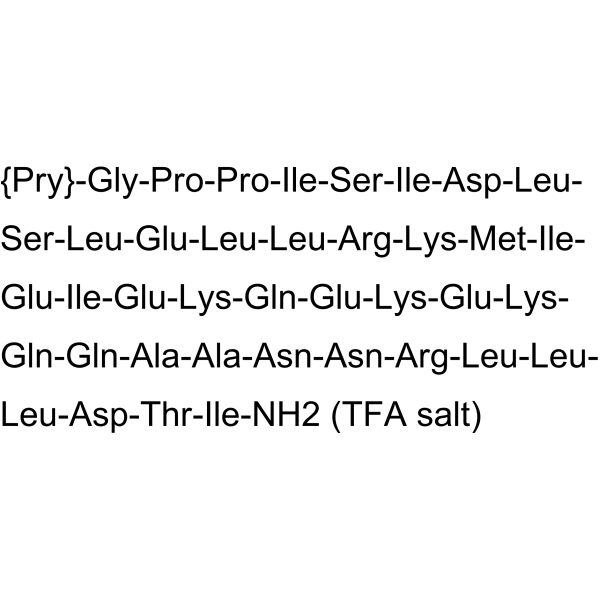
{D-Phe}-His-Leu-Leu-Arg-Lys-{Nle}-Ile-Glu-Ile-Glu-Lys-Gln-Glu-Lys-Glu-Lys-Gln-Gln-Ala-Ala-Asn-Asn-Arg-Leu-Leu-Leu-Asp-Thr-Ile-NH2
-
Sequence Shortening
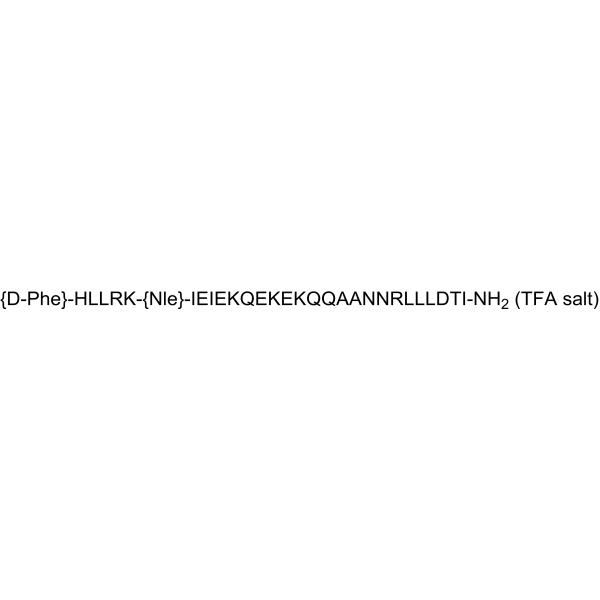
{D-Phe}-HLLRK-{Nle}-IEIEKQEKEKQQAANNRLLLDTI-NH2
-
선적
Room temperature in continental US; may vary elsewhere.
-
보관
Sealed storage, away from moisture
Powder -80°C 2 years -20°C 1 year * In solvent : -80°C, 6 months; -20°C, 1 month (sealed storage, away from moisture)


용액&용해도
In Vitro:
H2O : 8.33 mg/mL (Need ultrasonic)


순도&문서
-
Data Sheet (271 KB)
-
SDS (252 KB)
- English - EN (252 KB)
- Français - FR (252 KB)
- Deutsch - DE (252 KB)
- Norwegian - NO (252 KB)
- Español - ES (252 KB)
- Swedish - SV (252 KB)
- Italian - IT (252 KB)
- Korean - KR (252 KB)
- Portuguese - PT (252 KB)
-
Handling Instructions (2659 KB)
References
[1]. A Rühmann, et al. Design, synthesis and pharmacological characterization of new highly selective CRF(2) antagonists: development of 123I-K31440 as a potential SPECT ligand. Peptides. 2002 Mar;23(3):453-60. [Content Brief]
[2]. A J Lawrence, et al. The highly selective CRF(2) receptor antagonist K41498 binds to presynaptic CRF(2) receptors in rat brain. Br J Pharmacol [Content Brief]

Calculators
Concentration (start) × Volume (start) = Concentration (final) × Volume (final)


K41498 TFA Related Classifications
HY-P1106A Related Classifications
 Powered by Bioz