



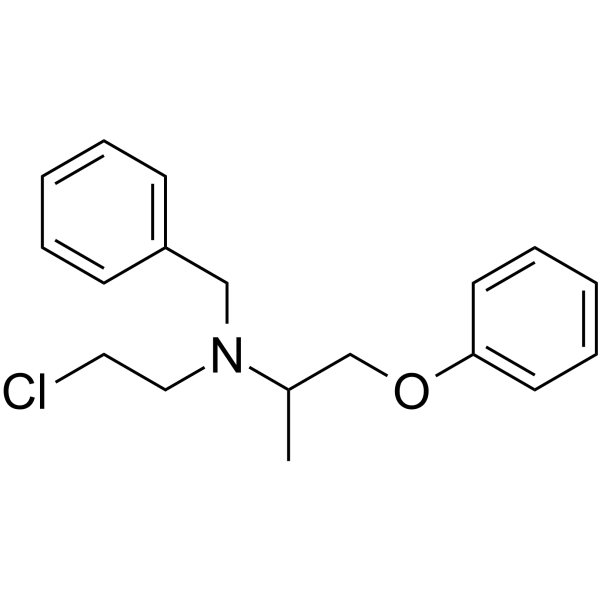
Phenoxybenzamine
Based on 1 publication(s) in Google Scholar
Phenoxybenzamine is a nonselective, irreversible, orally active α-adrenoceptor antagonist that is commonly used for the research of hypertension, specifically caused by pheochromocytoma. Phenoxybenzamine also shows antitumor activity.
연구목적의 판매만을 진행합니다. 환자를 대상으로 한 판매는 하지 않습니다.
- CAS No.: 59-96-1
- 화학식: C18H22ClNO
- 분자량:303.83
-
보관:
Please store the product under the recommended conditions in the Certificate of Analysis.

To place orders, for customer services and technical support, please contact: MedChemExpress USA
Tel: 609-228-6898 E-mail: [email protected] [email protected]


-
 Biological Activity
-
Chemical Information
-
용액&용해도
- Protocol
- 순도&문서
- References
-
 Help & FAQs


Publications Citing Use of MedChemExpress (MCE) Phenoxybenzamine
MoreAll Adrenergic Receptor Isoforms
More

Biological Activity
제품 설명
IC50 & Target
α-adrenoceptor[1]
Cellular Effect
|
Cell Line

|
Type | Value | Description | References |
|---|---|---|---|---|
| HEK293 | IC50 |
15.1 μM
Compound: phenoxybenzamine
|
Inhibition of 4-(4-(dimethylamino)styryl)-N-methylpyridinium uptake at human OCT1 expressed in HEK293 cells by confocal microscopy
Inhibition of 4-(4-(dimethylamino)styryl)-N-methylpyridinium uptake at human OCT1 expressed in HEK293 cells by confocal microscopy
|
[PMID: 18788725] |
| HEK293 | IC50 |
2.72 μM
Compound: Phenoxybenzamine
|
TP_TRANSPORTER: inhibition of MPP+ uptake (MPP+: 0.25 uM) in OCT1-expressing HEK293 cells
TP_TRANSPORTER: inhibition of MPP+ uptake (MPP+: 0.25 uM) in OCT1-expressing HEK293 cells
|
[PMID: 12110607] |
| HEK293 | IC50 |
4.9 μM
Compound: Phenoxybenzamine
|
TP_TRANSPORTER: inhibition of MPP+ uptake (MPP+: 0.25 uM) in OCT2-expressing HEK293 cells
TP_TRANSPORTER: inhibition of MPP+ uptake (MPP+: 0.25 uM) in OCT2-expressing HEK293 cells
|
[PMID: 12110607] |
| HEK293 | IC50 |
6.13 μM
Compound: Phenoxybenzamine
|
TP_TRANSPORTER: inhibition of MPP+ uptake (MPP+: 0.25 uM) in OCT3-expressing HEK293 cells
TP_TRANSPORTER: inhibition of MPP+ uptake (MPP+: 0.25 uM) in OCT3-expressing HEK293 cells
|
[PMID: 12110607] |
In Vitro
Phenoxybenzamine hydrochloride (0-100 μM; 96 h) markedly inhibits U251 and U87MG cells proliferation[2].
Phenoxybenzamine hydrochloride (10 μM; 24 h or 72 h) inhibits migration and invasion of U251 and U87MG cells[2].
Phenoxybenzamine hydrochloride (10 μM; 12 h) activates LINGO-1 and inhibits the TrkB-Akt pathway[2].
Phenoxybenzamine (0.1 μM-1 mM; 0-16 h) prevents hippocampal cell death after oxygen glucose deprivation[3].
MedChemExpress (MCE) has not independently confirmed the accuracy of these methods. They are for reference only.
-
Cell Line:U251 and U87MG cells
-
Concentration:0.1, 1, 10, 50 and 100 μM
-
Incubation Time:96 h
-
Result:Cell proliferation was inhibited markedly, the inhibition rate being 26.5 % for U251 cells and 27.3 % for U87MG cells at 10 μM.
-
Cell Line:U251 and U87MG cells
-
Concentration:10 μM
-
Incubation Time:24 h
-
Result:Apparent inhibition on migration was observed, and the inhibition rate was 28.6 and 39.8 % for U251 and U87MG, respectively.
-
Cell Line:U251 and U87MG cells
-
Concentration:10 μM
-
Incubation Time:72 h
-
Result:Attenuated the invasion properties of both U251 and U87MG markedly, as represented by the number of invaded cells per field declining from 365/field to 132/field (36.2 %) for U251 and 444/field to 298/field (67.1 %) for U87MG.
-
Cell Line:U251
-
Concentration:10 μM
-
Incubation Time:12 h
-
Result:Decreased the protein level of TrkB, p-TrkB, and p-Akt, but Akt remained unchanged significantly.
In Vivo
Phenoxybenzamine (1.0 mg/kg; i.v.; daily for 30 days) is neuroprotective in a rat model of severe traumatic brain injury[3].
MedChemExpress (MCE) has not independently confirmed the accuracy of these methods. They are for reference only.
-
Animal Model:Nude mice, U87MG tumor model[2]
-
Dosage:20 nM
-
Administration:Subcutaneous injection, 2-day interval for 26 days
-
Result:Reduced the tumor cells.
-
Animal Model:Male Wistar rats (350–500 g), traumatic brain injury (TBI) model[3]
-
Dosage:1.0 mg/kg
-
Administration:Intravenous injection, daily for 30 days
-
Result:Showed significant improvements in neurological severity score (NSS) and foot fault scoring on days 14, 21, and 30. Reduced cognitive impairment associated with severe TBI and reduced the expression of pro-inflammatory genes.


Chemical Information
-
CAS No. 59-96-1
-
분자량 303.83
-
화학식 C18H22ClNO
-
SMILES
CC(N(CCCl)CC1=CC=CC=C1)COC2=CC=CC=C2
-
선적
Room temperature in continental US; may vary elsewhere.
-
보관
Please store the product under the recommended conditions in the Certificate of Analysis.


Publications (1)
-
Journal Impact Factor
-
Most Recent
-
Protein Cell
Identification of serotonin 2A receptor as a novel HCV entry factor by a chemical biology strategy. [Abstract]2019 Mar;10(3):178-195. PMID: 29542010


용액&용해도
In Vitro:
DMSO : 5.83 mg/mL (19.19 mM; Need ultrasonic; Hygroscopic DMSO has a significant impact on the solubility of product, please use newly opened DMSO)
Concentration (start) × Volume (start) = Concentration (final) × Volume (final)


순도&문서
References
[1]. Habbe N, et al. Urapidil in the preoperative treatment of pheochromocytomas: a safe and cost-effective method. World J Surg. 2013 May;37(5):1141-6. [Content Brief]
[2]. Lin XB, et al. Anti-tumor activity of phenoxybenzamine hydrochloride on malignant glioma cells. Tumour Biol. 2016 Mar;37(3):2901-8. [Content Brief]
[3]. Rau TF, et al. Phenoxybenzamine is neuroprotective in a rat model of severe traumatic brain injury. Int J Mol Sci. 2014 Jan 20;15(1):1402-17. [Content Brief]


Complete Stock Solution Preparation Table
| Optional Solvent | Concentration Solvent Mass | 1 mg | 5 mg | 10 mg | 25 mg |
|---|---|---|---|---|---|
| DMSO | 1 mM | 3.2913 mL | 16.4566 mL | 32.9131 mL | 82.2829 mL |
| 5 mM | 0.6583 mL | 3.2913 mL | 6.5826 mL | 16.4566 mL | |
| 10 mM | 0.3291 mL | 1.6457 mL | 3.2913 mL | 8.2283 mL | |
| 15 mM | 0.2194 mL | 1.0971 mL | 2.1942 mL | 5.4855 mL |


Phenoxybenzamine Related Classifications
HY-B0431 Related Classifications
 Powered by Bioz