



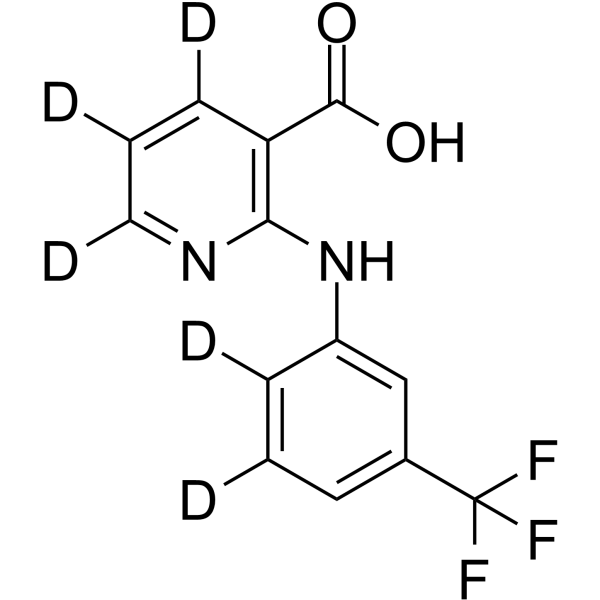
Niflumic Acid-d5
Niflumic Acid-d5 is the deuterium labeled Niflumic acid. Niflumic acid, a Ca2+-activated Cl- channel blocker, is an analgesic and anti-inflammatory agent used in the treatment of rheumatoid arthritis.
For research use only. We do not sell to patients.
- CAS No.: 1794811-58-7
- Formula: C13H4D5F3N2O2
- Molecular Weight:287.25
-
Storage:
Please store the product under the recommended conditions in the Certificate of Analysis.

To place orders, for customer services and technical support, please contact: MedChemExpress USA
Tel: 609-228-6898 E-mail: [email protected] [email protected]


-
 Biological Activity
-
Chemical Information
- Protocols
- Purity & Documentation
- References
-
 Help & FAQs




Biological Activity
Description
Cellular Effect
|
Cell Line

|
Type | Value | Description | References |
|---|---|---|---|---|
| Bone marrow cell | EC50 |
>20 μM
Compound: Niflumic acid
|
Induction of bone marrow cell differentiation isolated from ER-HOXA9 fusion protein expressed mouse harboring GFP-lysozyme assessed as upregulation of CD11b/MAC1 after 4 days by flow cytometry
Induction of bone marrow cell differentiation isolated from ER-HOXA9 fusion protein expressed mouse harboring GFP-lysozyme assessed as upregulation of CD11b/MAC1 after 4 days by flow cytometry
|
[PMID: 27994748] |
| CHO | EC50 |
30.8 μM
Compound: 8
|
Agonist activity at C-terminal beta-galactosidase tagged human recombinant GPR35 expressed in CHO cells after 90 mins by beta-arrestin recruitment assay
Agonist activity at C-terminal beta-galactosidase tagged human recombinant GPR35 expressed in CHO cells after 90 mins by beta-arrestin recruitment assay
|
[PMID: 23888932] |
| HEK293 | IC50 |
13 μM
Compound: Niflumic acid
|
Inhibition of human recombinant UGT1A1 expressed in HEK293 cells assessed as reduction in estradiol 3-glucuronidation by LC-MS/MS method
Inhibition of human recombinant UGT1A1 expressed in HEK293 cells assessed as reduction in estradiol 3-glucuronidation by LC-MS/MS method
|
[PMID: 21030469] |
| HEK293 | IC50 |
53 μM
Compound: Niflumic acid
|
Inhibition of human recombinant UGT1A1 expressed in HEK293 cells assessed as reduction in bilirubin glucuronidation by LC-MS/MS method
Inhibition of human recombinant UGT1A1 expressed in HEK293 cells assessed as reduction in bilirubin glucuronidation by LC-MS/MS method
|
[PMID: 21030469] |
| HEK-293T | EC50 |
15 μM
Compound: 8
|
Agonist activity at human GPR35 expressed in HEK293T cells at 5 uM by EYPF-based beta-arrestin-2 luciferase reporter gene assay
Agonist activity at human GPR35 expressed in HEK293T cells at 5 uM by EYPF-based beta-arrestin-2 luciferase reporter gene assay
|
[PMID: 23888932] |
| HT-29 | EC50 |
1.15 μM
Compound: Niflumic acid
|
Agonist activity at GPR35 receptor in human HT-29 cells after 10 mins by dynamic mass redistribution assay
Agonist activity at GPR35 receptor in human HT-29 cells after 10 mins by dynamic mass redistribution assay
|
[PMID: 24900447] |
| HT-29 | IC50 |
1.28 μM
Compound: Niflumic acid
|
Desensitization of GPR35 receptor in human HT-29 cells assessed as inhibition of zaprinast-induced dynamic mass redistribution after 10 mins
Desensitization of GPR35 receptor in human HT-29 cells assessed as inhibition of zaprinast-induced dynamic mass redistribution after 10 mins
|
[PMID: 24900447] |
| THP-1 | EC50 |
>20 μM
Compound: Niflumic acid
|
Induction of human THP1 cell differentiation after 4 days by flow cytometry
Induction of human THP1 cell differentiation after 4 days by flow cytometry
|
[PMID: 27994748] |
| U2OS | EC50 |
40.2 μM
Compound: Niflumic acid
|
Agonist activity at GPR35 receptor in human U2OS cells coexpressing Gal4-VP16-TEV assessed as beta arrestin translocation after 5 hrs by beta lactamase reporter gene assay
Agonist activity at GPR35 receptor in human U2OS cells coexpressing Gal4-VP16-TEV assessed as beta arrestin translocation after 5 hrs by beta lactamase reporter gene assay
|
[PMID: 24900447] |
| U-937 | EC50 |
>20 μM
Compound: Niflumic acid
|
Induction of human U937 cell differentiation after 4 days by flow cytometry
Induction of human U937 cell differentiation after 4 days by flow cytometry
|
[PMID: 27994748] |
In Vitro
Stable heavy isotopes of hydrogen, carbon, and other elements have been incorporated into drug molecules, largely as tracers for quantitation during the drug development process. Deuteration has gained attention because of its potential to affect the pharmacokinetic and metabolic profiles of drugs[1].
MedChemExpress (MCE) has not independently confirmed the accuracy of these methods. They are for reference only. Further protocols information, click here.
Application
1. This compound can be used as a tracer
2. This compound can be used as an internal standard for quantitative analysis by NMR, GC-MS, or LC-MS.


Chemical Information
-
CAS No. 1794811-58-7
-
Unlabeled CAS 4394-00-7
-
Molecular Weight 287.25
-
Formula C13H4D5F3N2O2
-
SMILES
N(C1=C(C(O)=O)C(=C(C(=N1)[2H])[2H])[2H])C2=CC(C(F)(F)F)=CC(=C2[2H])[2H]
-
Shipping
Room temperature in continental US; may vary elsewhere.
-
Storage
Please store the product under the recommended conditions in the Certificate of Analysis.

Protocols
-
Collagen-Induced Arthritis
Collagen-induced arthritis (CIA) is an autoimmune murine model of rheumatoid arthritis in which immunization with type II collagen (CII) emulsified in an adjuvant induces a T cell- and autoantibody-driven inflammatory arthritis characterized by synovial hyperplasia, immune cell infiltration, and joint destruction. The model typically relies on genetically susceptible mouse strains (e. g. , DBA/1) and reproduces key features of human rheumatoid arthritis, including anti-collagen immune responses and progressive joint inflammation. Disease onset generally occurs within ~3-4 weeks after immunization, depending on antigen/adjuvant combinations and protocol variation. The immunopathology is driven by adaptive immune activation against CII, leading to systemic and local joint inflammation mediated by pro-inflammatory cytokines and effector immune cells, making CIA a standard preclinical platform for evaluating immunomodulatory and anti-arthritic interventions.
-
Ca2+ Staining Technique
Ca2+ staining is an experimental technique that utilizes specific fluorescent probes (such as Fluo-4 AM, Fura-2, etc.) to qualitatively or quantitatively detect dynamic changes in intracellular Ca2+ concentrations; this is achieved by monitoring the changes in fluorescent signals generated when these probes bind to free intracellular calcium ions. The underlying principle relies primarily on the presence of chelating groups within the probe's molecular structure that possess high affinity for calcium ions.
-
Research Protocol for Inflammation-related Diseases
The NLRP3 inflammasome is a cytosolic innate immune signaling platform that integrates priming signals and danger-signal activation to promote caspase-1 activation, maturation of IL-1β and IL-18, and gasdermin D-mediated pyroptotic cell death. The core experimental logic is to determine whether inflammatory disease phenotypes are driven by increased NLRP3 expression, ASC-containing inflammasome assembly, caspase-1 cleavage, GSDMD cleavage, and extracellular release of IL-1β/IL-18 rather than by nonspecific cell injury alone. The pathway is strongly linked to inflammation-related disease phenotypes because monosodium urate crystals activate NALP3/NLRP3 inflammasome signaling in gout-like crystal inflammation, cholesterol crystals activate NLRP3 inflammasomes in atherogenesis models, and DSS-induced intestinal inflammation has been reported to involve NLRP3 inflammasome activity. However, experimental colitis studies also show context-dependent protective effects of NLRP3 inflammasome co


Purity & Documentation
References
[1]. Russak EM, et al. Impact of Deuterium Substitution on the Pharmacokinetics of Pharmaceuticals. Ann Pharmacother. 2019;53(2):211-216. [Content Brief]
[2]. Criddle, D.N., et al., Inhibitory action of niflumic acid on noradrenaline- and 5-hydroxytryptamine-induced pressor responses in the isolated mesenteric vascular bed of the rat. Br J Pharmacol, 1997. 120(5): p. 813-8. [Content Brief]
[3]. Jabeen, T., et al., Non-steroidal anti-inflammatory drugs as potent inhibitors of phospholipase A2: structure of the complex of phospholipase A2 with niflumic acid at 2.5 Angstroms resolution. Acta Crystallogr D Biol Crystallogr, 2005. 61(Pt 12): p. 1579-86. [Content Brief]
[4]. Picollo, A., et al., Mechanism of interaction of niflumic acid with heterologously expressed kidney CLC-K chloride channels. J Membr Biol, 2007. 216(2-3): p. 73-82. [Content Brief]

Calculators
Concentration (start) × Volume (start) = Concentration (final) × Volume (final)


Niflumic Acid-d5 Related Classifications
HY-B0493S Related Classifications
 Powered by Bioz