



MDC/CCL22 Protein, Human
Based on 2 publication(s) in Google Scholar
MDC/CCL22 Protein, Human is a CC chemokine that acts as a ligand for the CCR4 receptor and is a chemoattractant for CCR4-expressing cells such as Th2 cells, playing an important role in homeostatic and inflammatory responses. MDC/CCL22 Protein, Human is a recombinant human MDC/CCL22 (G25-Q93) protein expressed by E. coli.
- Species: Human
- Source: E. coli
-
Storage:Stored at -20°C for 2 years from date of receipt. After reconstitution, it is stable at 4°C for 1 week or -20°C for longer (with carrier protein). It is recommended to freeze aliquots at -20°C or -80°C for extended storage.


To place orders, for customer services and technical support, please contact: MedChemExpress USA
Tel: 609-228-6898 E-mail: [email protected] [email protected]


-
 Biological Activity
-
Technical Parameters
-
Product Properties
- Documentation
- References
- Help & FAQs




Biological Activity
Description
MDC/CCL22 Protein, Human is a CC chemokine that acts as a ligand for the CCR4 receptor and is a chemoattractant for CCR4-expressing cells such as Th2 cells, playing an important role in homeostatic and inflammatory responses. MDC/CCL22 Protein, Human is a recombinant human MDC/CCL22 (G25-Q93) protein expressed by E. coli[1][2].
Background
CCL22, also known as macrophage-derived chemokine (MDC), a CC chemokine located on chromosome 16 in the human genome, is a protein encoded by the CCL22 gene that shares 37% identity with CCL17 at the amino acid level. CCL22 is secreted by dendritic cells and macrophages and can be upregulated by a variety of stimulatory factors, such as lipopolysaccharides, cytokines. Among them, the Th2 cytokines IL-4 and IL-13 induce CCL22 production in myeloid cells and can be inhibited by the Th1 cytokine IFN-γ. In addition to acting as a potent chemotactic agent for CCR4-expressing Th2 lymphocytes, monocytes, monocyte-derived dendritic cells, and natural killer cells, CCL22 can also affect its target cells by interacting with the chemokine receptor CCR4. CCL22 is a potent inducer of CCR4 internalization, and CCL22 binding to CCR4 reduces the subsequent functional response of CCR4. The interaction of CCL22 with CCR4 is involved in a variety of pathologies, ranging from allergic reactions and autoimmunity to tumor growth. In contrast, small molecule compounds and antibodies capable of blocking CCL17 and CCL22-mediated recruitment of Th2 and Treg cells have been shown to have positive effects in various disease models of asthma, atopic disease and tumor growth. In addition, an important role of CCL22 and its receptors in TH2 lymphocyte recruitment has been shown in models of allergic airway inflammation. It can also be involved in thymopoiesis by regulating the migration of mature thymocytes through this organ[1][2].
In Vitro
CCL22/MDC (100 ng/mL, 24 h) treatment alone dose not result in increased production of chemokine IL-8, and treatment of hBEC with TNF-α increased IL-8 secretion. In addition, treatment of hBEC with both TNF-α and MDC results in increased IL-8 production than treatment with TNF-α alone in human bronchial epithelial cells (hBEC)[3].
Verified Bioactivity
1.The biological activity determined by a chemotaxis bioassay using human T-lymphocytes is in a concentration range of 10-100 ng/mL.
2.Measured by its ability to chemoattract Jurkat cells. The ED50 for this effect is ≤50.88 ng/mL, corresponding to a specific activity is ≥1.965×10⁴ U/mg.
3. Measured by its ability to chemoattract BaF3 mouse pro-B cells transfected with human CCR4. The ED50 for this effect is <3 ng/mL, corresponding to a specific activity is >3.33×10⁵ U/mg.
MCE Validation Data
-
Purity - SDS-PAGE
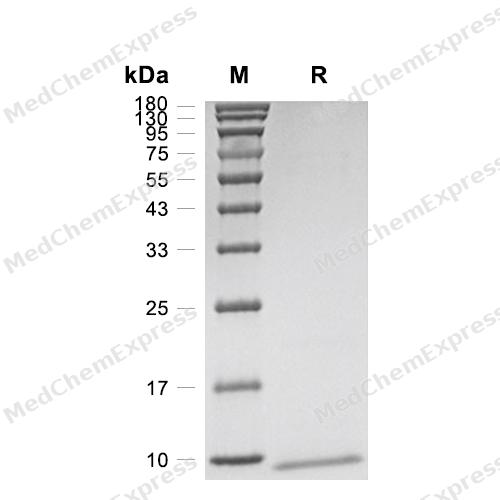
Purity - SDS-PAGE
-
Bioactivity - Cell-Based Assay
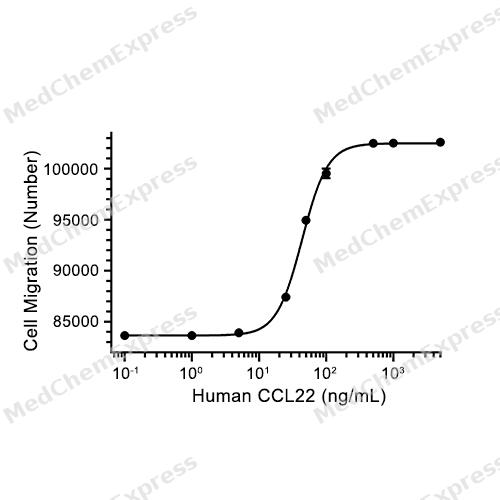
Bioactivity - Cell-Based Assay


Publications (2)
-
Journal Impact Factor
-
Most Recent
-
J Transl Med
GM-CSF potentiates macrophages to retain an inflammatory feature from their circulating monocyte precursors in rheumatoid arthritis. [Abstract]2025 Aug 7;23(1):883. PMID: 40775724 -
bioRxiv
Three immunoregulatory signatures define non-productive HIV infection in CD4+ T memory stem cells. [Abstract]2026 Mar 21:2026.03.20.713012. PMID: 41889968


Technical Parameters
-
Species Human
-
Source E. coli
-
Tag Tag Free
-
Accession
O00626 (G25-Q93)
-
Molecular Construction
-
N-term
-
CCL22 (G25-Q93)
Accession # O00626 -
C-term
-
-
Protein Length
Full Length of C-C motif chemokine 22 Chain
-
Synonyms
CCL22; Macrophage-Derived Chemokine; Prev. SCYA22; CC Chemokine STCP-1; MDC; MDC(1-69); A-152E5.1; MGC34554; DC/B-CK; Stimulated T Cell Chemotactic Protein 1; STCP-1; Stimulated T-Cell Chemotactic Protein 1; ABCD-1; Small Inducible Cytokine A22; Small Ind
-
AA Sequence
GPYGANMEDSVCCRDYVRYRLPLRVVKHFYWTSDSCPRPGVVLLTFRDKEICADPRVPWVKMILNKLSQ
-
Predicted Molecular Mass
8.1 kDa
-
Molecular Weight
Approximately 9 kDa, based on SDS-PAGE under reducing conditions.
-
Purity
≥ 95%, as determined by reducing SDS-PAGE.


Product Properties
Lyophilized powder
1.Lyophilized from a 0.22 μm filtered solution of PBS, pH 7.4.
2.Lyophilized from a 0.22 μm filtered solution of PBS, pH 7.4, 8% trehalose.
Please refer to the lot-specific COA for specific buffer information.
<1 EU/μg; determined by LAL method.
It is not recommended to reconstitute to a concentration less than 100 μg/mL in ddH2O. For long term storage it is recommended to add a carrier protein (0.1% BSA, 5% HSA, 10% FBS or 5% Trehalose).
Stored at -20°C for 2 years from date of receipt. After reconstitution, it is stable at 4°C for 1 week or -20°C for longer (with carrier protein). It is recommended to freeze aliquots at -20°C or -80°C for extended storage.
Room temperature in continental US; may vary elsewhere.


Documentation
-
Data Sheet (263 KB)
-
SDS (251 KB)
- English - EN (251 KB)
- Français - FR (251 KB)
- Deutsch - DE (251 KB)
- Norwegian - NO (251 KB)
- Español - ES (251 KB)
- Swedish - SV (251 KB)
- Italian - IT (251 KB)
- Korean - KR (251 KB)
- Portuguese - PT (251 KB)
-
Handling Instructions (2659 KB)


References
[1]. Jan Korbecki, et al. CC Chemokines in a Tumor: A Review of Pro-Cancer and Anti-Cancer Properties of the Ligands of Receptors CCR1, CCR2, CCR3, and CCR4. Int J Mol Sci. 2020 Nov 9;21(21):8412. [Content Brief]
[2]. Stefanie Scheu, et al. The C-C Chemokines CCL17 and CCL22 and Their Receptor CCR4 in CNS Autoimmunity. Int J Mol Sci. 2017 Nov 2;18(11):2306. [Content Brief]
[3]. Jillian R Richter, et al. Macrophage-derived chemokine (CCL22) is a novel mediator of lung inflammation following hemorrhage and resuscitation. Shock. 2014 Dec;42(6):525-31. [Content Brief]

Calculators
Concentration (start) × Volume (start) = Concentration (final) × Volume (final)


 Powered by Bioz

