



SAR441255 TFA

Based on 1 Customer Validation
SAR441255 TFA is a GLP-1R/GCGR/GIPR agonist, with human EC50 values of 1.03 pM, 1.01 pM, and 0.73 pM, respectively. SAR441255 TFA stimulates receptor activity and drives cAMP accumulation. SAR441255 TFA can be used for the research of type 2 diabetes, obesity.
For research use only. We do not sell to patients.
- Purity : 99.93%
- Formula: C225H3555N57O63.xC2HF3O2
- Molecular Weight:4866.56 (free base)
-
Storage:
Sealed storage, away from moisture and light.
Powder -80°C, 2 years , -20°C, 1 year* In solvent : -80°C, 6 months; -20°C, 1 month (sealed storage, away from moisture and light)

To place orders, for customer services and technical support, please contact: MedChemExpress USA
Tel: 609-228-6898 E-mail: [email protected] [email protected]


-
 Biological Activity
-
Chemical Information
-
Solvent & Solubility
- Protocols
- Purity & Documentation
- References
-
 Help & FAQs




Biological Activity
Description
IC50 & Target
|
GLP-1 1.03 pM (EC50) |
In Vitro
SAR441255 (30 min) TFA acts as a potent, balanced agonist of human GLP-1R, GCGR, and GIPR in recombinant HEK293 cells, with EC50 values of 1.03 pM, 1.01 pM, and 0.73 pM respectively[1].
SAR441255 TFA potently activates endogenous human GLP-1R in 1.1B4 pancreatic cells (EC50 27 pM), GCGR in primary human hepatocytes (EC50 2100 pM), and GIPR in human adipocytes (EC50 42 pM)[1].
MedChemExpress (MCE) has not independently confirmed the accuracy of these methods. They are for reference only.
In Vivo
SAR441255 (3-11 μg/kg; s.c.; once daily; 42 days) TFA induces significant body weight loss and improves glycemic control in obese, diabetic Macaca fascicularis monkeys over 42 days of treatment[1].
SAR441255 (11 μg/kg; s.c.; single dose) TFA achieves significant in vivo occupancy of GLP-1 receptors in the pancreas and glucagon receptors in the liver of lean cynomolgus monkeys[1].
SAR441255 (3-300 μg/kg; s.c.; once daily; 4 days) TFA causes transient, dose-related increases in heart rate and slight, sustained decreases in systolic blood pressure in lean telemetered cynomolgus monkeys[1].
SAR441255 (0.3-30 μg/kg; s.c.) TFA reduces body weight in a dose-dependent manner[2].
MedChemExpress (MCE) has not independently confirmed the accuracy of these methods. They are for reference only.
-
Animal Model:C57BL/6NHsd (female, 25-week-old obese, diet-induced obesity model)[1]
-
Dosage:0.3 μg/kg; 1 μg/kg; 3 μg/kg; 10 μg/kg; 30 μg/kg
-
Administration:s.c.; twice daily; 28 days
-
Result:Produced body weight changes versus baseline of +9.7% (0.3 μg/kg), +6.9% (1 μg/kg), +5.8% (3 μg/kg), -4.8% (10 μg/kg), and -14.1% (30 μg/kg), compared to +11.5% for vehicle controls.
Achieved statistically significant weight reduction at doses of 3 μg/kg or greater versus vehicle.
Lowered nonfasted blood glucose significantly at doses of 1 μg/kg or greater versus vehicle.
Reduced liver weight significantly in the 10 μg/kg (p < 0.001) and 30 μg/kg (p < 0.0001) groups versus vehicle.
Decreased mean serum ALT levels by 73% (10 μg/kg, p < 0.001) and 81% (30 μg/kg, p < 0.0001) versus obese controls.
Reduced mean AST levels by 46% (3 μg/kg, p < 0.001), 55% (10 μg/kg, p < 0.0001), and 58% (30 μg/kg, p < 0.0001) versus obese controls.
-
Animal Model:Macaca fascicularis (male, obese, diabetic)[1]
-
Dosage:3 μg/kg; 5 μg/kg; 8 μg/kg; 11 μg/kg
-
Administration:s.c.; once daily; 42 days
-
Result:Produced a mean body weight reduction of -12.6% versus stable weight in vehicle-treated monkeys over 42 days (p < 0.05).
Decreased HbA1c levels by -1.37% (p < 0.05), reaching normoglycemic levels (<5%) at study end.
Lowered fasting plasma glucose and ALT levels significantly versus vehicle.
Showed a non-significant trend toward increased total ketones and 3-hydroxybutyrate levels at study end.
Caused a non-significant increase in FGF21 levels versus vehicle.
-
Animal Model:Macaca fascicularis (lean)[1]
-
Dosage:11 μg/kg
-
Administration:s.c.; single dose
-
Result:Produced a mean 40.6% decrease in liver radiotracer binding (indicating GCGR occupancy) versus baseline scans.
Achieved a mean 72.5% decrease in pancreatic radiotracer binding (indicating GLP-1R occupancy) versus baseline scans.
-
Animal Model:Macaca fascicularis (4 males, 2 females, 3.12-6.10 kg, 37-51 months old, lean, telemetered)[1]
-
Dosage:3 μg/kg; 30 μg/kg; 300 μg/kg
-
Administration:s.c.; once daily; 4 days
-
Result:Induced a dose-related increase in heart rate on day 1, lasting 10-11 hours for 3 μg/kg and 30 μg/kg doses, and up to 20 hours for 300 μg/kg dose.
Resolved heart rate increase in 3 μg/kg and 30 μg/kg groups by day 4, while it remained slightly elevated in 300 μg/kg group until day 5.
Caused no significant dose-related systolic blood pressure changes on day 1.
Induced a statistically significant, slight (<10 mmHg) decrease in systolic blood pressure lasting over 24 hours across all doses on day 4, with values remaining significantly below vehicle in 30 μg/kg and 300 μg/kg groups on day 5.
-
Animal Model:Mice (diet-induced obese)[2]
-
Dosage:0.3 μg/kg; 1 μg/kg; 3 μg/kg; 10 μg/kg; 30 μg/kg
-
Administration:s.c.
-
Result:Produced dose-dependent changes in body weight relative to vehicle-treated mice (which had a +11.5% body weight change): +9.7% at 0.3 μg/kg, +6.9% at 1 μg/kg, +5.8% at 3 μg/kg, -4.8% at 10 μg/kg, and -14.1% at 30 μg/kg.
Lowered non-fasted blood glucose levels significantly in mice treated at doses of ≥1 μg/kg compared with vehicle-treated controls.


Chemical Information
-
Appearance Solid
-
Molecular Weight 4866.56 (free base)
-
Formula C225H3555N57O63.xC2HF3O2
-
Color White to off-white
-
Sequence Shortening
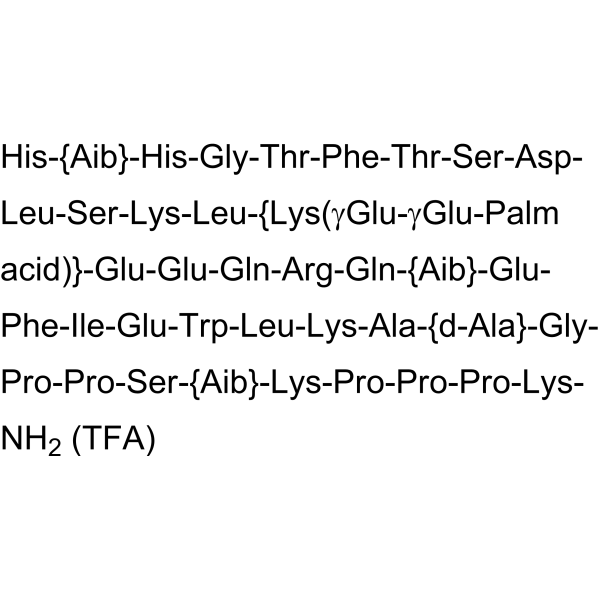
H-{Aib}-HGTFTSDLSKL-{Lys(γGlu-γGlu-Palm acid)}-EEQRQ-{Aib}-EFIEWLKA-{d-Ala}-GPPS-{Aib}-KPPPK-NH2
-
Shipping
Room temperature in continental US; may vary elsewhere.
-
Storage
Sealed storage, away from moisture and light
Powder -80°C 2 years -20°C 1 year * In solvent : -80°C, 6 months; -20°C, 1 month (sealed storage, away from moisture and light)


Solvent & Solubility
In Vitro:
DMSO : 66.67 mg/mL (Need ultrasonic; Hygroscopic DMSO has a significant impact on the solubility of product, please use newly opened DMSO)
H2O : 50 mg/mL (Need ultrasonic)


Purity & Documentation
-
Data Sheet (296 KB)
-
SDS (252 KB)
- English - EN (252 KB)
- Français - FR (252 KB)
- Deutsch - DE (252 KB)
- Norwegian - NO (252 KB)
- Español - ES (252 KB)
- Swedish - SV (252 KB)
- Italian - IT (252 KB)
- Korean - KR (252 KB)
- Portuguese - PT (252 KB)
-
Handling Instructions (2659 KB)
References
[1]. Bossart M, et al. Effects on weight loss and glycemic control with SAR441255, a potent unimolecular peptide GLP-1/GIP/GCG receptor triagonist. Cell Metab. 2022;34(1):59-74.e10. [Content Brief]
[2]. Araki E, et al. Potential of a glucagon-like peptide-1 receptor/glucose-dependent insulinotropic polypeptide receptor/glucagon receptor triagonist for the treatment of obesity and type 2 diabetes. J Diabetes Investig. 2022 Dec;13(12):1958-1960. [Content Brief]

Calculators
Concentration (start) × Volume (start) = Concentration (final) × Volume (final)


SAR441255 TFA Related Classifications
HY-P10031A Related Classifications
 Powered by Bioz