
1. Search Result
Search Result
Results for "

ABCB1-IN-2

" in MedChemExpress (MCE) Product Catalog:
Cat. No. Product Name Target Research Areas Chemical Structure
  • HY-16749
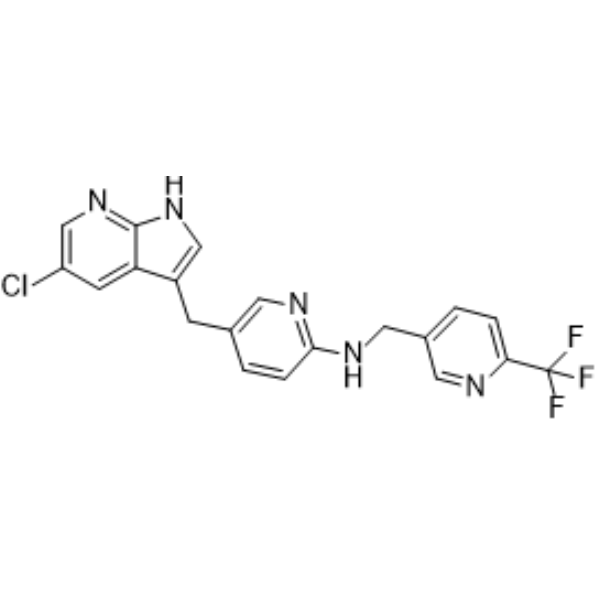
    Pexidartinib
    Maximum Cited Publications
    145 Publications Verification

    PLX-3397

    c-Fms c-Kit Apoptosis Cancer
    Pexidartinib (PLX-3397) is a potent, orally active, selective, and ATP-competitive colony stimulating factor 1 receptor (CSF1R or M-CSFR) and c-Kit inhibitor, with IC50s of 20 and 10 nM, respectively. Pexidartinib (PLX-3397) exhibits 10- to 100-fold selectivity for c-Kit and CSF1R over other related kinases. Pexidartinib (PLX-3397) induces cell apoptosis and has anti-tumor activity. Pexidartinib has limited permeability to the blood-brain barrier, primarily through ABCB1 .
    Pexidartinib
  • HY-109061
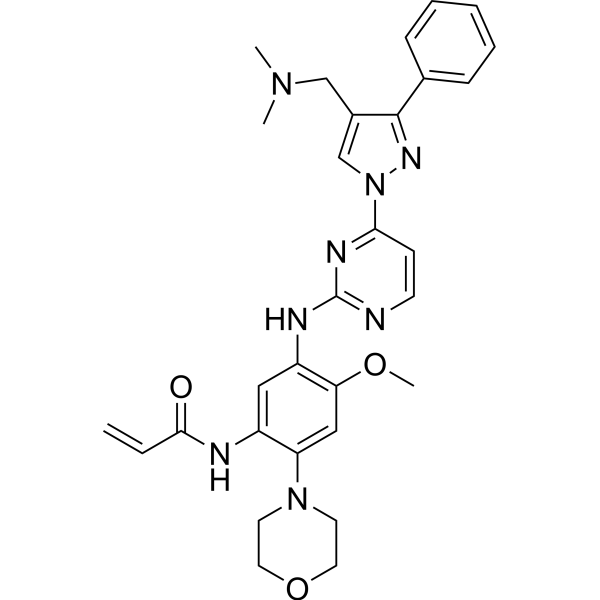
    Lazertinib
    3 Publications Verification

    YH25448; GNS-1480

    Apoptosis Akt TRP Channel EGFR ERK Infection Neurological Disease Metabolic Disease Cancer
    Lazertinib (YH25448; GNS-1480) is an orally active, blood-brain barrier permeable third-generation EGFR tyrosine kinase inhibitor, as well as an ABCB1/ABCG2 inhibitor and a TRPA1 activator. Lazertinib exhibits IC50 values of 0.4 mM and 0.2 mM against human ABCB1 and ABCG2, respectively. By inhibiting mutant EGFR signaling, EGFR phosphorylation and the downstream ERK/AKT pathway, as well as upregulating surface expression of EGFR/MET, Lazertinib induces cell cycle arrest, apoptosis, spontaneous calcium responses, hyperexcitability of dorsal root ganglion (DRG) neurons, and TRPA1-dependent pain-like behaviors. Lazertinib competitively binds to the substrate-binding sites of ABCB1/ABCG2, stimulates their ATPase activity without altering their expression or plasma membrane localization, thereby enhancing ADCC activity, acting as a chemosensitizer, and reversing ABCB1-mediated multidrug resistance. It exerts antitumor activity as a single agent or in combination with other drugs. Lazertinib is applicable to research related to non-small cell lung cancer, multidrug-resistant cancers, and paresthesia .
    Lazertinib
  • HY-10873
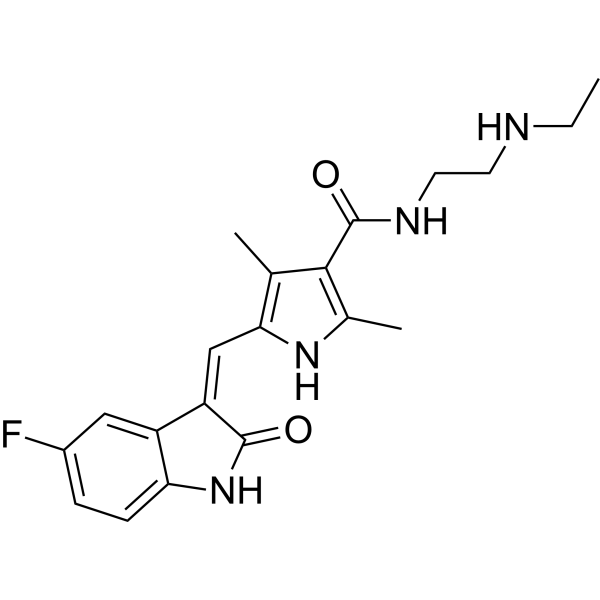
    N-Desethyl Sunitinib
    5+ Cited Publications

    SU-12662

    Drug Metabolite Cancer
    N-Desethyl Sunitinib (SU-12662) is a metabolite of Sunitinib (HY-10255A). N-Desethyl Sunitinib serves as a good transport substrate for human ABCB1, ABCG2 and murine ABCG2 .
    N-Desethyl Sunitinib
  • HY-109061B
    Lazertinib mesylate
    3 Publications Verification

    YH25448 mesylate; GNS-1480 mesylate

    TRP Channel EGFR Akt ERK Apoptosis Cancer
    Lazertinib (YH25448; GNS-1480) mesylate is an orally active, blood-brain barrier permeable third-generation EGFR tyrosine kinase inhibitor, as well as an ABCB1/ABCG2 inhibitor and a TRPA1 activator. Lazertinib mesylate exhibits IC50 values of 0.4 mM and 0.2 mM against human ABCB1 and ABCG2, respectively. By inhibiting mutant EGFR signaling, EGFR phosphorylation and the downstream ERK/AKT pathway, as well as upregulating surface expression of EGFR/MET, Lazertinib mesylate induces cell cycle arrest, apoptosis, spontaneous calcium responses, hyperexcitability of dorsal root ganglion (DRG) neurons, and TRPA1-dependent pain-like behaviors. Lazertinib mesylate competitively binds to the substrate-binding sites of ABCB1/ABCG2, stimulates their ATPase activity without altering their expression or plasma membrane localization, thereby enhancing ADCC activity, acting as a chemosensitizer, and reversing ABCB1-mediated multidrug resistance. It exerts antitumor activity as a single agent or in combination with other drugs. Lazertinib mesylate is applicable to research related to non-small cell lung cancer, multidrug-resistant cancers, and paresthesia .
    Lazertinib mesylate
  • HY-113805

    P-glycoprotein Cancer
    MC70 is a potent and non-selective P-glycoprotein (P-gp) inhibitor with an EC50 of 0.69 µM. MC70 is an ABC transporters inhibitor and anticancer agent. MC70 interacts with ABCB1, ABCG2 and ABCC1 .
    MC70
  • HY-163981

    P-glycoprotein Cancer
    ABCB1-IN-2 (compound 16q) is a functional inhibitor that can directly bind to the ABCB1 protein and stabilize its structure without affecting the expression and subcellular localization of ABCB1. ABCB1-IN-2 can increase the sensitivity of MCF-7/ADR cells to paclitaxel (PTX), increase the accumulation of PTX, and prevent the accumulation and excretion of luciferin Rh123 mediated by ABCB1. ABCB1-IN-2, as an ABCB1-mediated multidrug resistance (MDR) reversal agent, shows a strong ability to reverse MDR .
    ABCB1-IN-2
  • HY-174435

    P-glycoprotein Cancer
    ABCB1/ABCG2-IN-1 (Compound (S,Z)-4b) is an inhibitor of ABCB1 and ABCB2 transporters. ABCB1/ABCG2-IN-1 shows moderate activity in SW620M, -V, and –Mito variants (IC50 ≈ 50 μM). ABCB1/ABCG2-IN-1 affects methotrexate resistance in vitro. ABCB1/ABCG2-IN-1 can be studied in anticancer research .
    ABCB1/ABCG2-IN-1
  • HY-109061A

    YH25448 mesylate hydrate; GNS-1480 mesylate hydrate

    Apoptosis Akt TRP Channel EGFR ERK Cancer
    Lazertinib (YH25448; GNS-1480) mesylate hydrate is an orally active, blood-brain barrier permeable third-generation EGFR tyrosine kinase inhibitor, as well as an ABCB1/ABCG2 inhibitor and a TRPA1 activator. Lazertinib mesylate hydrate exhibits IC50 values of 0.4 mM and 0.2 mM against human ABCB1 and ABCG2, respectively. By inhibiting mutant EGFR signaling, EGFR phosphorylation and the downstream ERK/AKT pathway, as well as upregulating surface expression of EGFR/MET, Lazertinib mesylate hydrate induces cell cycle arrest, apoptosis, spontaneous calcium responses, hyperexcitability of dorsal root ganglion (DRG) neurons, and TRPA1-dependent pain-like behaviors. Lazertinib mesylate hydrate competitively binds to the substrate-binding sites of ABCB1/ABCG2, stimulates their ATPase activity without altering their expression or plasma membrane localization, thereby enhancing ADCC activity, acting as a chemosensitizer, and reversing ABCB1-mediated multidrug resistance. It exerts antitumor activity as a single agent or in combination with other drugs. Lazertinib mesylate hydrate is applicable to research related to non-small cell lung cancer, multidrug-resistant cancers, and paresthesia .
    Lazertinib mesylate hydrate

Inquiry Online

Your information is safe with us. * Required Fields.

Salutation


Country or Region *

Applicant Name *


Organization Name *

Department *


Email Address *


Product Name *

Cat. No.


Requested quantity *

Phone Number *


Remarks

Inquiry Online

Inquiry Information

Product Name:
Cat. No.:
Quantity:
MCE Japan Authorized Agent:

