1. Search Result
Search Result
Results for "

ECL

" in MedChemExpress (MCE) Product Catalog:

19

Inhibitors & Agonists

2

Fluorescent Dye

3

Biochemical Assay Reagents

3

Peptides

4

MCE Kits

2

Inhibitory Antibodies

2

Recombinant Proteins

1

Antibodies

1

Oligonucleotides

Cat. No. Product Name Target Research Areas Chemical Structure
  • HY-W074143

    Fluorescent Dye Others
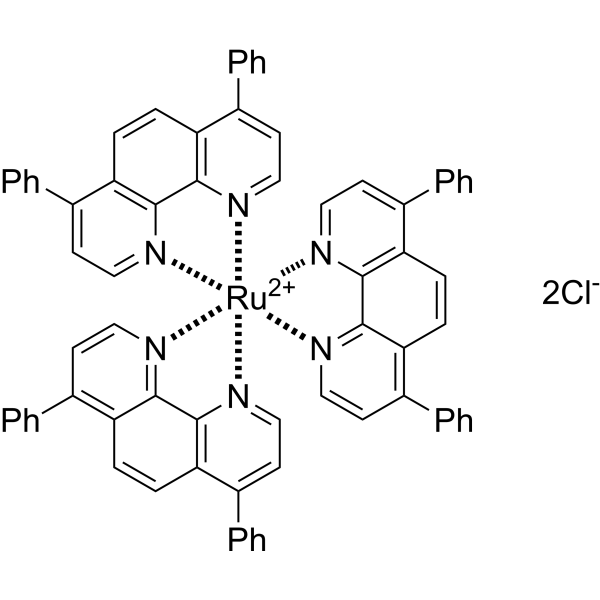
    Tris(4,7-diphenyl-1,10-phenanthroline)ruthenium(II) dichloride ([Ru(dpp)3] 2+) is an electrochemiluminescent (ECL) probe and oxygen-sensitive sensor. Tris(4,7-diphenyl-1,10-phenanthroline)ruthenium(II) dichloride can be used to modify electrode surfaces for the detection of sulfates (S2O8 2-) and oxalates, based on electrochemical reactions that generate excited-state species, releasing photons through irreversible redox reactions. Tris(4,7-diphenyl-1,10-phenanthroline)ruthenium(II) dichloride utilizes the oxygen quenching of fluorescence mechanism, where fluorescence intensity reflects the metabolic rate of living microorganisms or oxygen levels within cells/tumors, allowing for real-time detection. Tris(4,7-diphenyl-1,10-phenanthroline)ruthenium(II) dichloride's main applications include microbial detection, antibacterial activity studies, and tumor microenvironment research .
    Tris(4,7-diphenyl-1,10-phenanthroline)ruthenium(II) dichloride
  • HY-115822

    Amino Acid Decarboxylase Neurological Disease Metabolic Disease
    α-Fluoromethylhistidine dihydrochloride is an orally active histidine decarboxylase inhibitor. α-Fluoromethylhistidine dihydrochloride depletes histamine in enterochromaffin-like (ECL) cells, reduces the number and volume density of secretory vesicles in ECL cells, and does not affect histamine storage in mast cells. α-Fluoromethylhistidine dihydrochloride abolishes Omeprazole (HY-B0113)-induced vacuolization of ECL cells and decreases gastrin-induced histamine efflux from ECL cells. α-Fluoromethylhistidine dihydrochloride does not alter the granular characteristics of ECL cells, omeprazole-induced hypertrophy of ECL cells, gastrin-induced pancreastatin-like immunoreactivity efflux, nor does it affect gastric acid secretion induced by histamine or vagal stimulation. α-Fluoromethylhistidine dihydrochloride inhibits basal and gastrin-stimulated gastric acid secretion, reduces acid output induced by gastrin+IBMX (HY-12318), but does not directly affect acid generation in isolated parietal cells .
    α-Fluoromethylhistidine dihydrochloride
  • HY-W127716
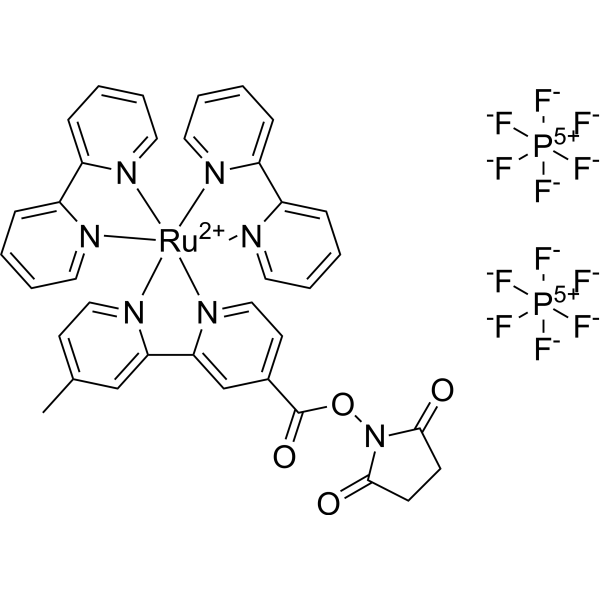
    Ru(bpy)2(mcbpy-O-Su-ester)(PF6)2
    1 Publications Verification

    Fluorescent Dye Cancer
    Ru(bpy)2(mcbpy-O-Su-ester)(PF6)2 is a potent ruthenium-based dye. Ru(bpy)2(mcbpy-O-Su-ester)(PF6)2 can bu used as an effective quencher of quantum dots (QDs) fluorescence and the capture probe of virus antigen EV71. Ru(bpy)2(mcbpy-O-Su-ester)(PF6)2 can be used sensitive electrogenerated chemiluminescence (ECL) labels for detection of matrix metalloproteinases (MMPs) .
    Ru(bpy)2(mcbpy-O-Su-ester)(PF6)2
  • HY-W1015419

    α-Fluoromethylhistidine

    Amino Acid Decarboxylase Cardiovascular Disease Neurological Disease
    α-FMH (α-Fluoromethylhistidine) is an orally active histidine decarboxylase inhibitor. α-FMH depletes histamine in enterochromaffin-like (ECL) cells, reduces the number and volume density of secretory vesicles in ECL cells, and does not affect histamine storage in mast cells. α-FMH abolishes Omeprazole (HY-B0113)-induced vacuolization of ECL cells and decreases gastrin-induced histamine efflux from ECL cells. α-FMH does not alter the granular characteristics of ECL cells, omeprazole-induced hypertrophy of ECL cells, gastrin-induced pancreastatin-like immunoreactivity efflux, nor does it affect gastric acid secretion induced by histamine or vagal stimulation. α-FMH inhibits basal and gastrin-stimulated gastric acid secretion, reduces acid output induced by gastrin+IBMX (HY-12318), but does not directly affect acid generation in isolated parietal cells .
    α-FMH
  • HY-129359

    ADC Linker Cancer
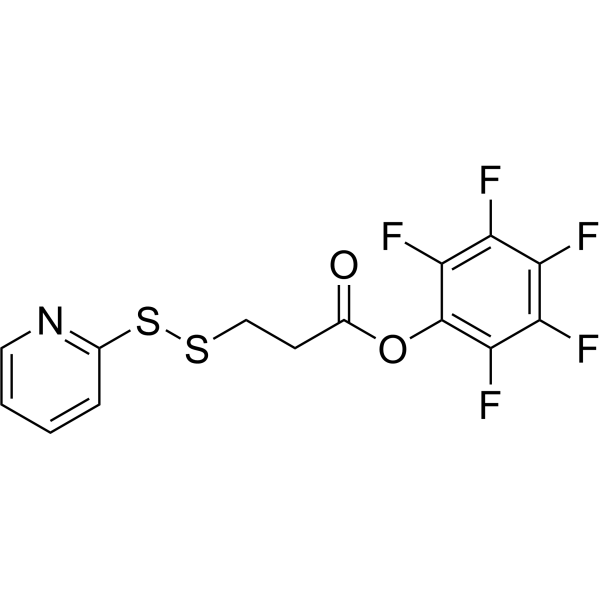
    PDP-Pfp is a reducible ADC linker used for the agents that target for the extracellular loop 1 (ECL1) of TM4SF1 (transmembrane 4 L6 family member 1) .
    PDP-Pfp
  • HY-W697935

    Drug Intermediate Others
    Sulfo-TAG COOH trisodium (Example 2) is a catalyst ligand that can be used for the synthesis of electrochemiluminescence (ECL) labels.
    Sulfo-TAG COOH trisodium
  • HY-P11553

    CCR Inflammation/Immunology
    ECL1i is an allosteric, selective CCR2 inhibitor. ECL1i specifically inhibits CCL2-/CCR2-mediated chemotaxis. ECL1i interferes with CCR2-positive cell recruitment and attenuates disease progression in experimental autoimmune encephalomyelitis .
    ECL1i
  • HY-P11553A

    CCR Infection Inflammation/Immunology
    ECL1i TFA is an allosteric, selective CCR2 inhibitor. ECL1i TFA specifically inhibits CCL2-/CCR2-mediated chemotaxis. ECL1i TFA interferes with CCR2-positive cell recruitment and attenuates disease progression in experimental autoimmune encephalomyelitis .
    ECL1i TFA
  • HY-11074

    Cholecystokinin Receptor Metabolic Disease
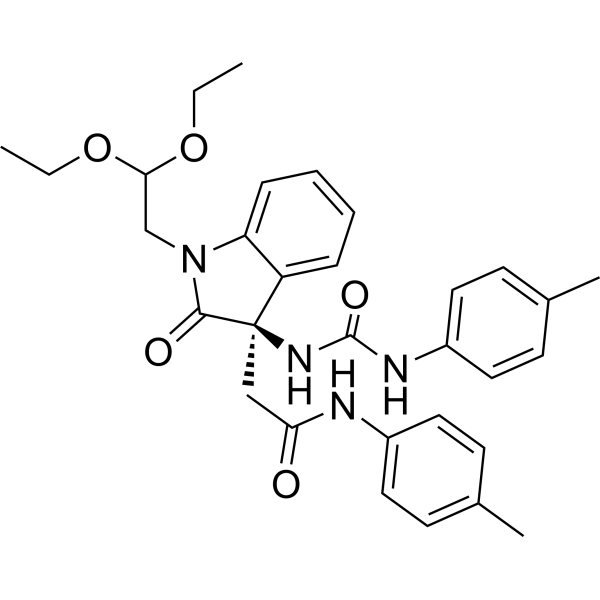
    CE-326597 is a small molecule agonist of the cholecystokinin A receptor (CCKAR). CE-326597 occupies only the lower half of the TMD pocket and cannot mimic the crucial interaction between CCK-8 and ECL1-3. CE-326597 can be used to study metabolic diseases and gastrointestinal dysfunction .
    CE-326597
  • HY-P991541

    CCR HIV Infection
    HGS101 is a fully human CCR5 monoclonal antibody with high affinity to CCR5. HGS101 binds to the 2nd extracellular loop (ECL-2) and acts as a signal antagonist. HGS101 restores Maraviroc (HY-13004) inhibition of Maraviroc-resistant HIV-1 infection of PBMCs. HGS101 shows anti-HIV activity by inhibiting CCR5 signaling in simian immunodeficiency virus-uninfected RMs models .
    HGS101
  • HY-129372

    ADC Linker Cancer
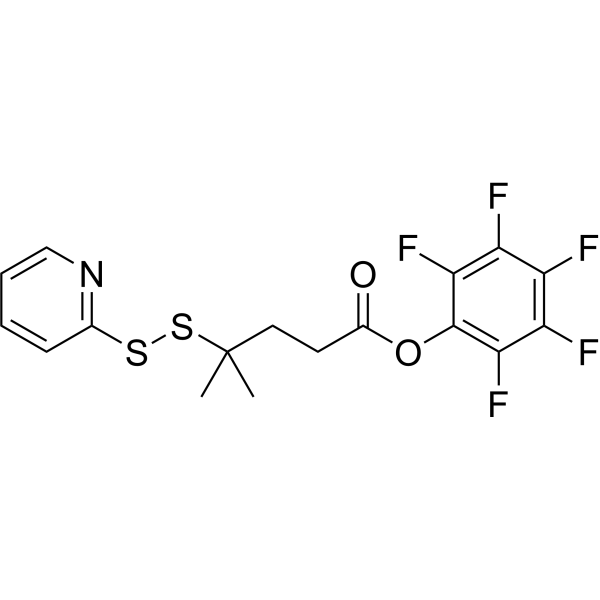
    PDdB-Pfp is a cleavable ADC linker used for the agents that target for the extracellular loop 1 (ECL1) of TM4SF1 (transmembrane 4 L6 family member 1) .
    PDdB-Pfp
  • HY-125314

    Cholecystokinin Receptor Endocrinology Cancer
    AG-041R is a potent and selective CCK2 Receptor/Gastrin antagonist. AG-041R inhibits gastrin-evoked secretion of pancreastatin with an IC50 of 2.2 nM. AG-041R inhibits cell growth of Mastomys ECL carcinoid tumor cells .
    AG-041R
  • HY-NP066

    ECL

    Fluorescent Dye Others
    Erythrina Cristagalli Lectin (ECL) is a plant lectin that can be used as a probe to specifically bind biomolecules (such as polysaccharides, peptides, etc.).Erythrina Cristagalli Lectin (ECL) is a biological material or organic compound that can be used in life science research .
    Erythrina Cristagalli Lectin
  • HY-NP0177

    ECL (Biotinylated)

    Fluorescent Dye Others
    Erythrina Cristagalli Lectin (ECL) Biotinylated is a plant lectin that can be used as a probe to specifically bind biomolecules (such as polysaccharides, peptides, etc.).Erythrina Cristagalli Lectin (ECL) Biotinylated is a biological material or organic compound that can be used in life science research .
    Erythrina Cristagalli Lectin (Biotinylated)
  • HY-NP099

    ECL (Fluorescein)

    Fluorescent Dye Others
    Erythrina Cristagalli Lectin (ECL) Fluorescein is a plant lectin that can be used as a probe to specifically bind biomolecules (such as polysaccharides, peptides, etc.).Erythrina Cristagalli Lectin (ECL) Fluorescein is a biological material or organic compound that can be used in life science research .
    Erythrina Cristagalli Lectin (Fluorescein)
  • HY-RS02091

    Small Interfering RNA (siRNA) Others

    CCL21 Human Pre-designed siRNA Set A contains three designed siRNAs for CCL21 gene (Human), as well as a negative control, a positive control, and a FAM-labeled negative control.

    CCL21 Human Pre-designed siRNA Set A
    CCL21 Human Pre-designed siRNA Set A
  • HY-P11553B

    Radionuclide-Drug Conjugates (RDCs) CCR Cardiovascular Disease Inflammation/Immunology Cancer
    DOTA-ECL1i is a conjugate of the CCR2 inhibitor ECL1i (HY-P11553) and DOTA. When radiolabeled with 68Ga, DOTA-ECL1i serves as a PET tracer that targets CCR2 expression. DOTA-ECL1i can be used in research related to pulmonary fibrosis, cardiac injury, abdominal aortic aneurysm inflammation, atherosclerosis, head and neck cancer, and pancreatic cancer .
    DOTA-ECL1i
  • HY-118962

    CCR HIV Infection
    E913 is a CCR5 antagonist that competes with the binding of antibodies to CCR5 which recognize the C-terminal half of the second extracellular loop (ECL2B) of CCR5. E913 can specifically block the binding of macrophage inflammatory protein-1alpha (MIP-1alpha) to CCR5 (IC50 = 0.002 μM) and MIP-1alpha-elicited cellular Ca 2+ mobilization (IC50 = 0.02 μM). E913 inhibits the replication of laboratory and primary R5 HIV-1 strains as well as various multidrug-resistant monocyte/macrophage tropic (R5) HIV-1 (IC50 = 0.03-0.06 μM). E913 can be used for the research of infection, such as HIV-1 infection .
    E913
  • HY-P992405

    CXCR Cancer
    MEDI-3185 is a potent CXCR4 antagonist. MEDI-3185 binds CXCR4 via CDR3H and ECL2 β-strand/β-strand interaction, blocks SDF-1 access and displaces SDF-1. MEDI-3185 can be used for the research of hematologic tumors, ovarian tumors .
    MEDI-3185

Inquiry Online

Your information is safe with us. * Required Fields.

Salutation


Country or Region *

Applicant Name *


Organization Name *

Department *


Email Address *


Product Name *

Cat. No.


Requested quantity *

Phone Number *


Remarks

Inquiry Online

Inquiry Information

Product Name:
Cat. No.:
Quantity:
MCE Japan Authorized Agent:

