1. Search Result
Search Result
Results for "

FabA

" in MedChemExpress (MCE) Product Catalog:

10

Inhibitors & Agonists

3

Natural
Products

1

Isotope-Labeled Compounds

Targets Recommended:
Cat. No. Product Name Target Research Areas Chemical Structure
  • HY-W068212

    Juniperic acid

    Drug Intermediate Metabolic Disease
    16-Hydroxyhexadecanoic acid (Juniperic acid) is one of the main monomers of cutin in Vicia faba flower petals. 16-Hydroxyhexadecanoic acid can be used as an internal standard for the measurement of hydroxy and hydroperoxy fatty acids in plasma .
    16-Hydroxyhexadecanoic acid
  • HY-W004297

    Endogenous Metabolite Bacterial Infection
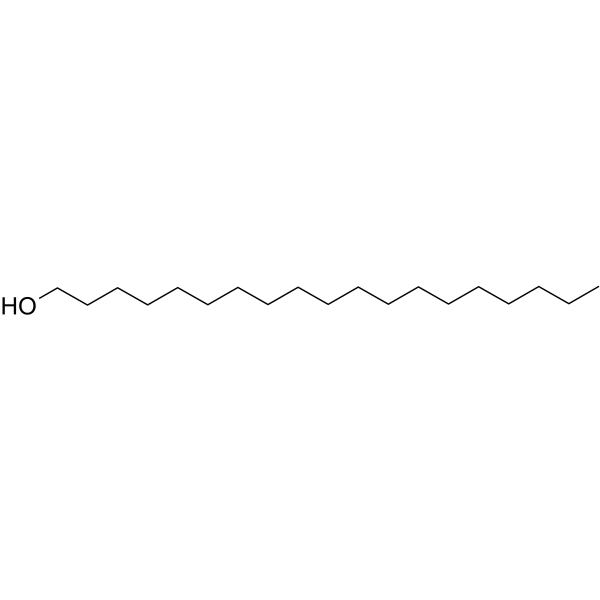
    1-Nonadecanol is an endogenous metabolite that can be produced by Pantoea agglomerans from Medicago sativa rhizosphere, present in Neotinea ustulata scent and Heracleum thomsonii essential oil. 1-Nonadecanol exerts antimicrobial activity against Streptococcus pneumonia, Klebsiella, and S. aureus. 1-Nonadecanol can be used for the research of bacterial infections and pea aphid infestation .
    1-Nonadecanol
  • HY-135738

    Drug Intermediate Others
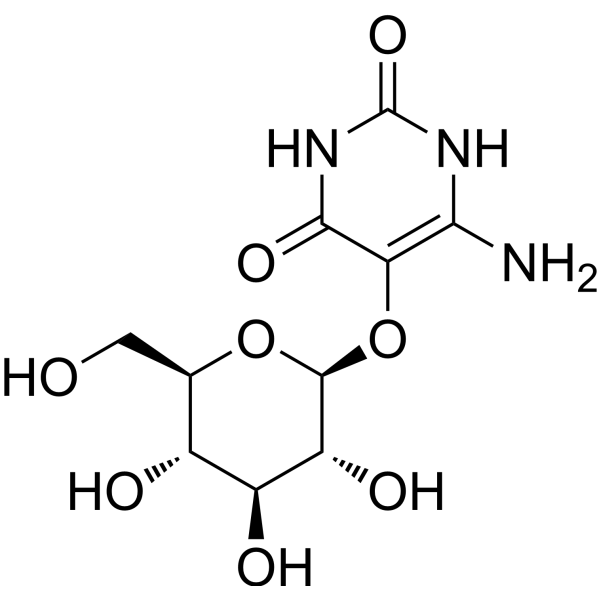
    Convicine is a pyrimidine glycoside. Convicine, as well as Vicine, is the precursor of the aglycones Divicine and Isouramil. Convicine is the main factors of favism, which is a genetic condition leading to severe hemolysis after faba bean ingestion. Convicine can be isolated from the faba bean .
    Convicine
  • HY-N16391

    (-)-9,10-Dihydrojasmonic acid

    Endogenous Metabolite Others
    (-)-Dihydrojasmonic acid ((-)-9,10-Dihydrojasmonic acid) is a compound that can be isolated from the immature fruits of Vicia faba L. and belongs to plant endogenous cyclopentanoid metabolites .
    (-)-Dihydrojasmonic acid
  • HY-135243

    DNA/RNA Synthesis Cancer
    Ypenyl is a cytostatic. Ypenyl hydrochloride, belonging to the alkylating agent class, exhibits clear genotoxicity and cell cycle disruption properties. Ypenyl induces chromosomal aberrations in broad bean root tip meristem cells and leads to a decrease in the mitotic index. Ypenyl may be used in cancer research .
    Ypenyl
  • HY-186235

    Bacterial Biochemical Assay Reagents Others
    3-Hydroxydecanoyl-NAC is a substrate mimetic of the bacterial fatty acid biosynthetic pathway, and exhibits activity against FabA and FabG of Pseudomonas aeruginosa. 3-Hydroxydecanoyl-NAC acts as a stable mimetic of acyl carrier protein-linked fatty acids, which are key intermediates in the bacterial FASII pathway. 3-Hydroxydecanoyl-NAC serves as a substrate for Pseudomonas aeruginosa FabA, enabling the measurement of the dehydration activity of this enzyme .
    3-Hydroxydecanoyl-NAC
  • HY-186236

    Bacterial Infection
    N42FTA is a non-covalent, non-suicidal inhibitor of FabA from Pseudomonas aeruginosa and Escherichia coli, with IC50 values of 3.27 μM and 2.31 μM, respectively. As a natural substrate mimetic, N42FTA blocks the cross-linking between acyl carrier protein and FabA in Escherichia coli. N42FTA shows no significant antibacterial activity due to poor permeability. N42FTA can be used in studies related to Pseudomonas aeruginosa and Escherichia coli infections .
    N42FTA
  • HY-W068212S

    Juniperic acid-13C2

    Isotope-Labeled Compounds Drug Intermediate Metabolic Disease
    16-Hydroxyhexadecanoic acid- 13C2 (Juniperic acid- 13C2) is the 13C-labeled 16-Hydroxyhexadecanoic acid (HY-W068212). 16-Hydroxyhexadecanoic acid (Juniperic acid) is one of the main monomers of cutin in Vicia faba flower petals. 16-Hydroxyhexadecanoic acid can be used as an internal standard for the measurement of hydroxy and hydroperoxy fatty acids in plasma
    16-Hydroxyhexadecanoic acid-13C2
  • HY-W068212R

    Juniperic acid (Standard)

    Biochemical Assay Reagents Reference Standards Metabolic Disease
    16-Hydroxyhexadecanoic acid (Juniperic acid) is an ester product.
    16-Hydroxyhexadecanoic acid (Standard)
  • HY-122145

    DNA/RNA Synthesis Cancer
    Ypenyl hydrochloride is a cytostatic. Ypenyl hydrochloride, belonging to the alkylating agent class, exhibits clear genotoxicity and cell cycle disruption properties. Ypenyl hydrochloride induces chromosomal aberrations in broad bean root tip meristem cells and leads to a decrease in the mitotic index. Ypenyl hydrochloride may be used in cancer research .
    Ypenyl hydrochloride

Inquiry Online

Your information is safe with us. * Required Fields.

Salutation


Country or Region *

Applicant Name *


Organization Name *

Department *


Email Address *


Product Name *

Cat. No.


Requested quantity *

Phone Number *


Remarks

Inquiry Online

Inquiry Information

Product Name:
Cat. No.:
Quantity:
MCE Japan Authorized Agent:

