13 Results for "

GSTO1

" in MedChemExpress (MCE) Product Catalog:
Products (13)

13 Results for "GSTO1" in MCE Product Catalog:

4
4 Cited Publications
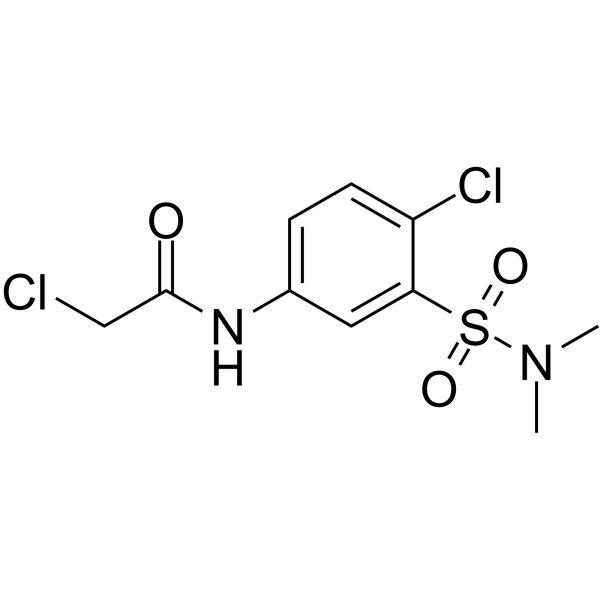
Cat. No.: HY-111530
CAS No.: 568544-03-6
Purity:  99.11%
Research Areas:  

Cancer

GSTO1-IN-1 is a potent glutathione S-transferase omega 1 (GSTO1) inhibitor with an IC50 of 31 nM.
loading...
    loading...
Cat. No.: HY-115674
CAS No.: 610263-01-9
ML175 is a specific glutathione transferase Omega 1-1 (GSTO1-1) inhibitor. ML175 can significantly activate Akt and MEK1/2 kinases. ML175 can be used in the research of diseases such as Parkinson's disease [1].
loading...
    loading...
Cat. No.: HY-177695
CAS No.: 2290641-22-2
Research Areas:  

Cancer

GSTO1-IN-5 is a potent and selective glutathione S-transferase omega 1 (GSTO1) inhibitor with an IC50of 0.22 nM. GSTO1-IN-5 can be used for the researches of cancer and inflammation, such as colon cancer [1].
loading...
    loading...
Cat. No.: HY-RS05884
Research Areas:  

Others

GSTO1 Human Pre-designed siRNA Set A contains three designed siRNAs for GSTO1 gene (Human), as well as a negative control, a positive control, and a FAM-labeled negative control.

loading...
    loading...
Cat. No.: HY-RS23922
Research Areas:  

Others

Gsto1 Rat Pre-designed siRNA Set A contains three designed siRNAs for Gsto1 gene (Rat), as well as a negative control, a positive control, and a FAM-labeled negative control.

loading...
    loading...
Cat. No.: HY-W615446
CAS No.: 158890-32-5
GSTO1-IN-3 is a potent GSTO1-1 inhibitor with an IC50 of 0.11 μM, and shows selectivity over GSTO2-2, GSTA1-1 and GSTP1-1 (IC50 > 100 μM). GSTO1-IN-3 enhances the cytotoxicity of Cisplatin (HY-17394) against human breast cancer cells. GSTO1-IN-3 inhibits IL-1β release in mouse bone marrow-derived macrophage (BMDM) cells. GSTO1-IN-3 attenuates inflammation in mice. GSTO1-IN-3 can be used for breast cancer and inflammation research [1].
loading...
    loading...
Cat. No.: HY-RS17464
Research Areas:  

Others

Gsto1 Mouse Pre-designed siRNA Set A contains three designed siRNAs for Gsto1 gene (Mouse), as well as a negative control, a positive control, and a FAM-labeled negative control.

loading...
    loading...
Cat. No.: HY-178261
CAS No.: 1338494-49-7
Research Areas:  

Cancer

KT53 is a highly active, selective, and cell penetrable GSTO1 inhibitor. KT53 can effectively inhibit GSTO1 activity in MDA-MB-435 (IC50 = 35 nM) cells. KT53 significantly enhances the killing effect of cisplatin (HY-17394) on MDA-MB-435 cancer cells. KT53 can be used for cancer research [1].
loading...
    loading...
Cat. No.: HY-178372
CAS No.: 158890-33-6
Research Areas:  

Inflammation/Immunology Cancer

GSTO1-IN-4 is a selective, potent GSTO1-1 inhibitor (IC50 = 0.04 μM; KI = 0.16 μM). GSTO1-IN-4 shows low inhibition to GSTO2-2, GSTA1-1 and GSTP1-1. GSTO1-IN-4 shows a capacity to attenuate inflammation in mice and to significantly enhance the cytotoxicity of Cisplatin (HY-17394). GSTO1-IN-4 can be used for the study of inflammation and breast cancer [1].
loading...
    loading...
Cat. No.: HY-161876
CAS No.: 3020776-77-3
Research Areas:  

Cancer

GSTO1-IN-2 (Compound B-9) is a dual covalent inhibitor of GSTO1/BTK with IC50 values of 441 nM and 6.2 nM respectively [1].
loading...
    loading...
Cat. No.: HY-179635
CAS No.: 3114128-67-2
GSTO1-IN-6 is an allosteric and covalent GSTO1 inhibitor with an IC50 of 457 nM. GSTO1-IN-6 markedly reduces Lipopolysaccharides (LPS) (HY-D1056)-induced IL-1β (IC50 of 1.9 μM) and IL-18 (IC50 of 10. μM) secretion in human monocyte-derived macrophages. GSTO1-IN-6 covalently modifies GSTO1-Cys32, inducing conformational changes and protein destabilization. GSTO1-IN-6 can be used for the research of inflammatory diseases [1].
loading...
    loading...
Cat. No.: HY-P82350
Synonyms: GSTO1 1; GSTO1; GSTTLp28; GSTX; Gtsttl; p28; SPG-R

Host:  

Rabbit

Application:  

WB, IHC-P, ICC/IF

Reactivity:  

Human, Rat

loading...
    loading...
Cat. No.: HY-182059
GSTP1-IN-1 is a selective GSTP1 inhibitor with an IC50 of 0.79 μM and a Kd of 0.63 μM. GSTP1-IN-1 inhibits the proliferation of gastric cancer cells, induces ROS production and depletes glutathione. GSTP1-IN-1 achieves systemic exposure and is well tolerated in xenograft mouse models, while inhibiting tumor growth. GSTP1-IN-1 can be used in gastric cancer-related research [1].
loading...
    loading...
  • 1

