14 Results for "

HUVEC+cells

" in MedChemExpress (MCE) Product Catalog:
Products (14)

14 Results for "HUVEC+cells" in MCE Product Catalog:

1
1 Cited Publications
Cat. No.: HY-P2196A
Target:  

Apelin Receptor (APJ)

Research Areas:  

Cancer

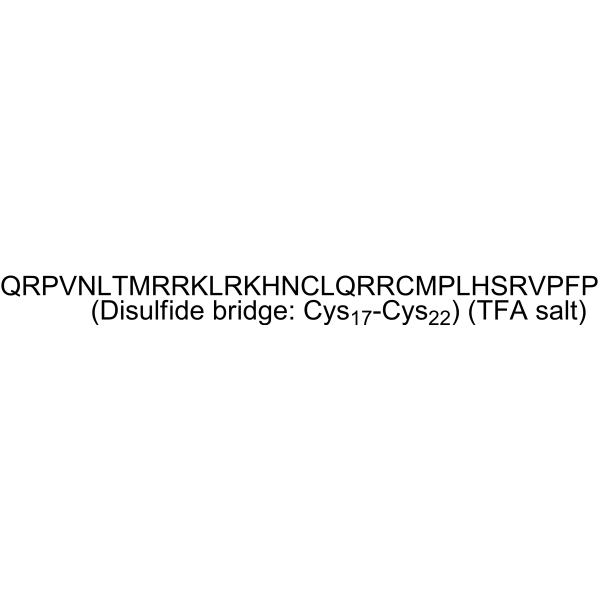
ELA-32(human) TFA is a potent, high affinity apelin receptor agonist (IC50=0.27 nM; Kd=0.51 nM). ELA-32(human) TFA exhibits no binding GPR15 and GPR25. ELA-32(human) TFA activates the PI3K/AKT pathway and promotes self-renewal of hESCs via cell-cycle progression and protein translation. ELA-32(human) TFA also potentiates the TGFβ pathway, priming hESCs toward the endoderm lineage. ELA-32(human) TFA stimulates angiogenesis in HUVEC cells.
loading...
    loading...
Cat. No.: HY-121605
CAS No.: 1195795-93-7
Purity:  97.44%
Target:  

Apoptosis

Research Areas:  

Cancer

RL71 is a curcuminoid anticancer agent that exhibits potent cytotoxicity against a variety of ER-negative breast cancer cells. RL71 (1 μM) induces cell cycle arrest in the G2/M phase and induces apoptosis in SKBr3 cells. RL7 also decreases HER2/neu phosphorylation and increases p27. RL71 also significantly reduced the phosphorylation of Akt and transiently increased the stress kinases JNK1/2 and p38 MAPK. Furthermore, RL71 exhibited anti-angiogenic potential in vitro, inhibiting the migration of HUVEC cells and the ability of these cells to form tubular networks .
loading...
    loading...
Cat. No.: HY-101015
CAS No.: 221632-26-4
Target:  

Phospholipase Apoptosis

Research Areas:  

Inflammation/Immunology

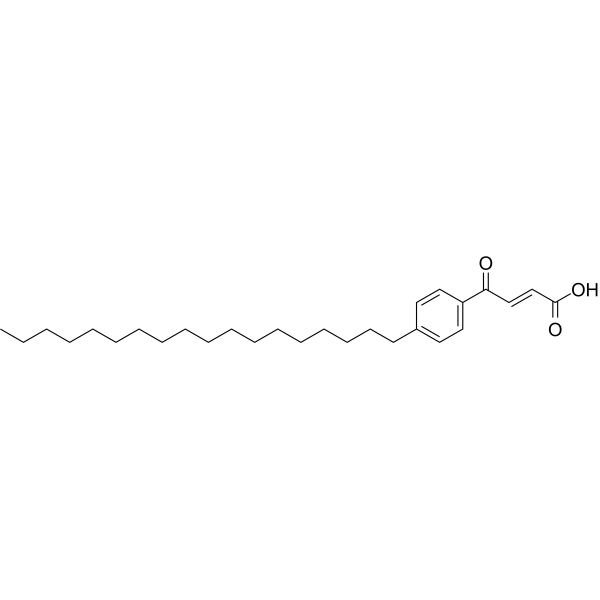
(2E)-OBAA is a potent phospholipase A2 (PLA2) inhibitor, with an IC50 of 70 nM. (2E)-OBAA induces apoptosis of HUVEC cells. (2E)-OBAA blocks Melittin-induced Ca 2+ influx in Trypanosoma brucei, with an IC50 of 0.4 μM .
loading...
    loading...
Cat. No.: HY-176234
PDE4-IN-28 (Compound G1) is a PDE4D inhibitor (IC50: 29 nM). PDE4-IN-28 inhibits the production of TNF-α and NO (IC50: 13.32 and 2.32 μM, respectively). PDE4-IN-28 exhibits anti-inflammatory, antibacterial and analgesic effects in a rat pressure ulcer (PU) model and promotes HUVEC cell migration, thereby accelerating wound healing .
loading...
    loading...
Cat. No.: HY-176740
CAS No.: 2930759-37-6
PROTAC Bcl-xL degrader-4 (Compound 2-38-III) is a Bcl-xL PROTAC degrader. PROTAC Bcl-xL degrader-4 has strong anti-tumor activity against HepG2 cells and HUVEC cells. PROTAC Bcl-xL degrader-4 induces cells apoptosis by decreasing mitochondrial membrane potential and activating the MAPK signaling pathway. PROTAC Bcl-xL degrader-4 significantly inhibits tumor growth in xenograft tumor mouse models .
loading...
    loading...
Cat. No.: HY-124918
CAS No.: 107585-69-3
Target:  

VEGFR

Research Areas:  

Cancer

Cremastranone is an antiangiogenic homoisoflavone. Cremastranone can inhibit HUVECs cell proliferation, with a GI50 value of 1.5 uM .
loading...
    loading...
Cat. No.: HY-155174
CAS No.: 2974488-31-6
Target:  

Akt

Research Areas:  

Cancer

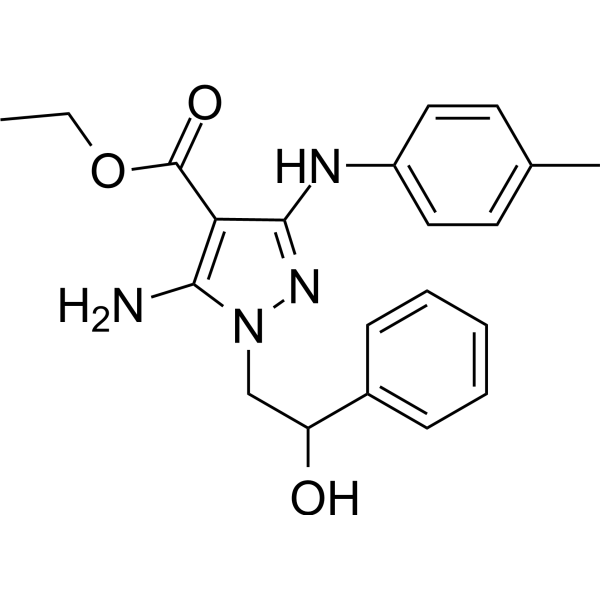
Antiangiogenic agent 4 (Compound 3b) inhibits Akt phosphorylation in HFF and HUVEC cells. Antiangiogenic agent 4 can be used for cancer research .
loading...
    loading...
Cat. No.: HY-112353
CAS No.: 949164-80-1
Target:  

Endogenous Metabolite

Research Areas:  

Others

NP603 is a potent inhibitor of FGF receptor 1, exhibiting remarkable activity against endothelial proliferation in HUVEC cells stimulated by rhFGF-2, with a minimum effective dose of 0.4 microM.
loading...
    loading...
Cat. No.: HY-169520
CAS No.: 342785-98-2
Target:  

VEGFR

Research Areas:  

Cancer

VEGFR/PDGFR-IN-1 (Compound 1) is the inhibitor for VEGFR with an IC50 of 0.4 μM. VEGFR/PDGFR-IN-1 inhibits angiogenesis in HUVEC cell, exhibiting potential in tumor growth and metastasis inhibition .
loading...
    loading...
Cat. No.: HY-163881
Target:  

VEGFR

Research Areas:  

Cancer

VEGFR-IN-5 (compound 9k) is a potent inhibitor of VEGFR2, with the IC50 of 8.4 nM and an acceptable oral bioavailability. VEGFR-IN-5 inhibits migration and invasion of human umbilical vein endothelial cells (HUVEC) cells and induces apoptosis .
loading...
    loading...
Cat. No.: HY-156081
Target:  

Keap1-Nrf2 Apoptosis

Research Areas:  

Metabolic Disease

Nrf2 activator-9 (compound D-36) is an Nrf2 activator that inhibits oxidized low-density lipoprotein (oxLDL) and high glucose (HG)-induced apoptosis in HUVEC cells. Nrf2 activator-9 inhibits oxLDL and HG-induced vascular endothelial cell (VEC) injury and can effectively prevent and treat atherosclerosis .
loading...
    loading...
Cat. No.: HY-121605S
RL71-d6 is a deuterium labeled RL71 (HY-121605). RL71 is a curcuminoid anticancer agent that exhibits potent cytotoxicity against a variety of ER-negative breast cancer cells. RL71 (1 μM) induces cell cycle arrest in the G2/M phase and induces apoptosis in SKBr3 cells. RL7 also decreases HER2/neu phosphorylation and increases p27. RL71 also significantly reduced the phosphorylation of Akt and transiently increased the stress kinases JNK1/2 and p38 MAPK. Furthermore, RL71 exhibited anti-angiogenic potential in vitro, inhibiting the migration of HUVEC cells and the ability of these cells to form tubular networks .
loading...
    loading...
Cat. No.: HY-168127
Target:  

VEGFR

Research Areas:  

Cancer

VEGFR-2-IN-57 (compound 6n) exhibited significant cytotoxicity in HUVEC cells (IC50 = 28.77 nM).
loading...
    loading...
Cat. No.: HY-183768
Target:  

PROTACs FAK

Research Areas:  

Cancer

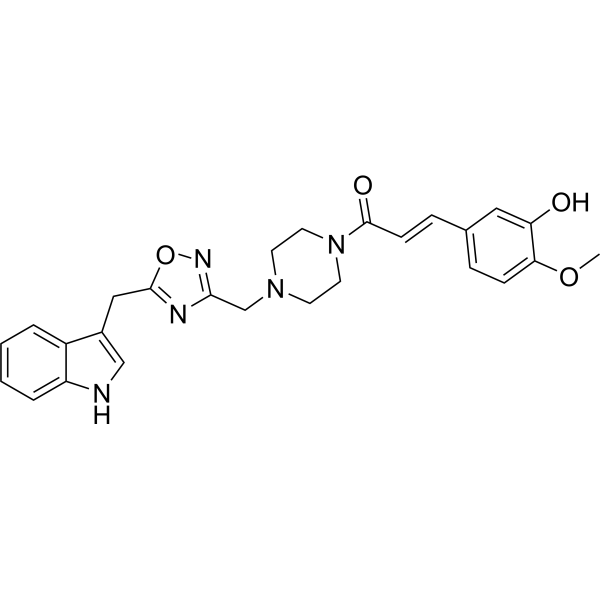
PROTAC FAK degrader 5 is a potent PROTAC degrader targeting FAK, with a DC50 of 11.65 nM. PROTAC FAK degrader 5 induces FAK protein degradation, selectively inhibits colony formation of human colorectal cancer HCT116 cells, and blocks the proliferation of human umbilical vein endothelial HUVEC cells, exhibiting anti-angiogenic activity. PROTAC FAK degrader 5 can be used in the research of colorectal cancer and angiogenesis .
loading...
    loading...
  • 1

