11 Results for "

Huh 7.5 cells

" in MedChemExpress (MCE) Product Catalog:
Products (11)

11 Results for "Huh 7.5 cells" in MCE Product Catalog:

1
1 Cited Publications
Cat. No.: HY-30234A
CAS No.: 1163-36-6
Target:  

TRP Channel Apoptosis

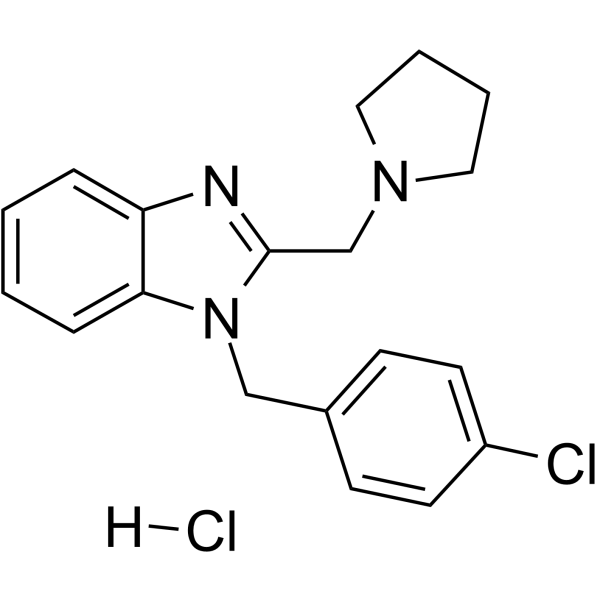
Clemizole hydrochloride is an orally active, blood-brain barrier permeable TRPC5 inhibitor, with an IC50 value of 1.05-1.34 μM against mouse TRPC5. Clemizole hydrochloride blocks TRPC1:TRPC5, TRPC3, TRPC4, TRPC6, TRPC7, hERG, hKCNQ1/hKCNE1 and hKv1.5 channels, and activates TRPA1; it modulates 5HT-2B and HTR2A receptors; it inhibits HCV RNA replication, CrtN enzymatic activity, oxidative stress, neuroinflammation, cell apoptosis and bacterial virulence; it maintains blood-brain barrier (BBB) integrity; it enhances DNA repair capacity; it improves cell viability; and it alters cardiac electrophysiological properties. Clemizole hydrochloride can be used in the research of Dravet syndrome, hepatitis C virus infection, Staphylococcus aureus skin infection, Cisplatin (HY-17394)-induced nephrotoxicity, STXBP1-related diseases, traumatic brain injury and xeroderma pigmentosum type C .
loading...
    loading...
1
1 Cited Publications
Cat. No.: HY-30234
CAS No.: 442-52-4
Target:  

TRP Channel Apoptosis

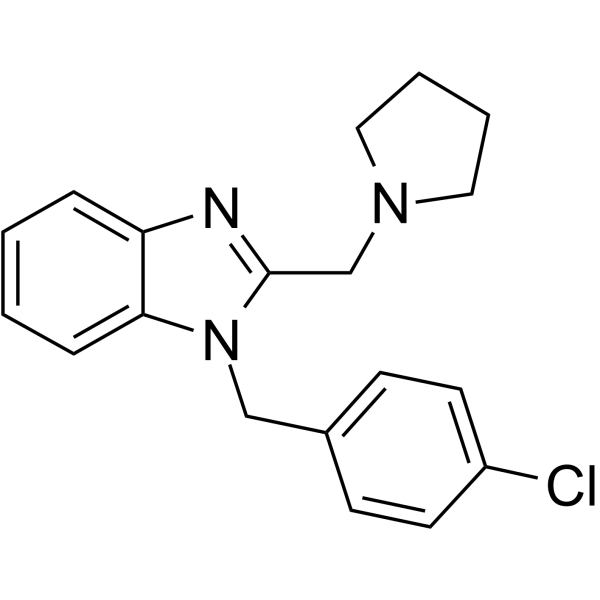
Clemizole is an orally active, blood-brain barrier permeable TRPC5 inhibitor, with an IC50 value of 1.05-1.34 μM against mouse TRPC5. Clemizole blocks TRPC1:TRPC5, TRPC3, TRPC4, TRPC6, TRPC7, hERG, hKCNQ1/hKCNE1 and hKv1.5 channels, and activates TRPA1; it modulates 5HT-2B and HTR2A receptors; it inhibits HCV RNA replication, CrtN enzymatic activity, oxidative stress, neuroinflammation, cell apoptosis and bacterial virulence; it maintains blood-brain barrier (BBB) integrity; it enhances DNA repair capacity; it improves cell viability; and it alters cardiac electrophysiological properties. Clemizole can be used in the research of Dravet syndrome, hepatitis C virus infection, Staphylococcus aureus skin infection, Cisplatin (HY-17394)-induced nephrotoxicity, STXBP1-related diseases, traumatic brain injury and xeroderma pigmentosum type C .
loading...
    loading...
Cat. No.: HY-158073
CAS No.: 2943213-62-3
Target:  

SARS-CoV

Research Areas:  

Infection

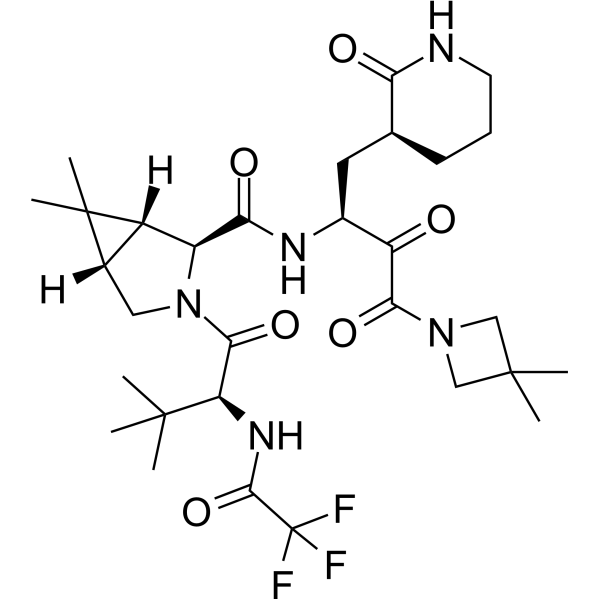
ML2006a4 is an orally active inhibitor for SARS-CoV-2 main protease (M pro) with IC50 in picomolare value. ML2006a4 is cell permeable and antiviral active, that inhibits replication in SARS-CoV-2 in cells Huh7.5.1-ACE2-TMPRSS2 (Huh7.5.1++) in picomolare level
loading...
    loading...
Cat. No.: HY-161806
Target:  

PROTACs Dengue Virus

Research Areas:  

Infection

ZXH-8-004 is a DENV E PROTAC degrader with a DC50 value of 0.21 µM in Huh7.5 cells. ZXH-8-004 induces CRBN- and proteasome-dependent degradation of intracellular dengue virus envelope protein. ZXH-8-004 inhibits envelope-mediated membrane fusion during viral entry and reduces the production of infectious dengue virus particles. ZXH-8-004 can be used in studies related to dengue virus infection, Zika virus infection, Japanese encephalitis virus infection, West Nile virus infection, and yellow fever virus infection .
loading...
    loading...
Cat. No.: HY-161804
Target:  

PROTACs Dengue Virus

Research Areas:  

Infection

GNF-2-deg is a PROTAC degrader targeting the dengue virus envelope protein (DENV E protein), with a DC50 of 0.83 μM in Huh7.5 cells. GNF-2-deg induces CRBN- and proteasome-dependent proteolysis of intracellular E protein. GNF-2-deg inhibits E protein-mediated membrane fusion and blocks viral particle production. GNF-2-deg reduces viral yield in infected cells and retains activity against E protein βOG pocket mutant virus-like particles (VLP). GNF-2-deg can be used in the research of dengue virus infection, Zika virus infection, Japanese encephalitis, West Nile virus infection and yellow fever .
loading...
    loading...
Cat. No.: HY-29866
CAS No.: 5325-66-6
Target:  

Microtubule/Tubulin

Research Areas:  

Cancer

Tubulin polymerization-IN-75 (Compound 6) is an inhibitor for tubulin polymerization with an IC50 of 30 μM. Tubulin polymerization-IN-75 inhibits the proliferation of cancer cell Huh7 and 293T with IC50 of 14.3 μM and 13.8 μM .
loading...
    loading...
Cat. No.: HY-161628
Target:  

Topoisomerase

Research Areas:  

Cancer

Tapcin is a dual inhibitor for topoisomerase I and topoisomerase II, with IC50 of 203 and 71 nM. Tapcin inhibits proliferations of cancer cells A-375, HeLa, Huh7.5, U2-OS, A549, Caco-2 and HT29, with IC50s of 441, 1.04, 40.5, 0.002, 0.006, 0.287 and 0.842 nM, respectively. Tapcin exhibits antitumor activity in HT29 xenograft model .
loading...
    loading...
Cat. No.: HY-113860
CAS No.: 101784-44-5
Target:  

HCV

Research Areas:  

Infection

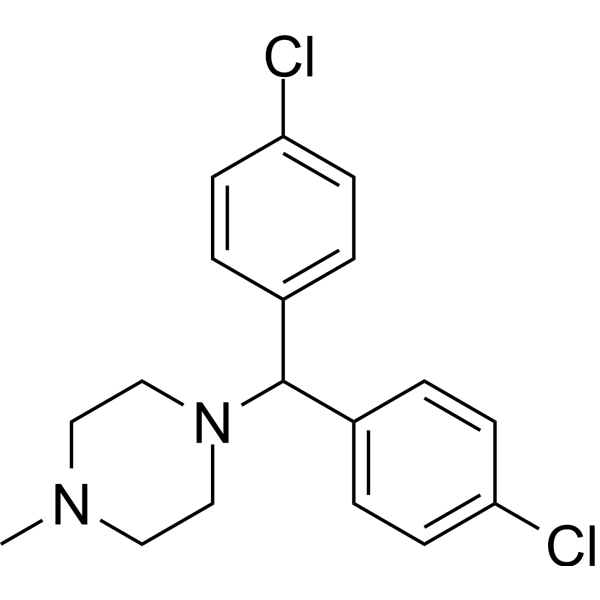
Antiviral agent 52 (Compound 30) is a Chlorcyclizine (HY-112067) derivative that exhibits antiviral activity against hepatitic C virus (HCV) with an EC50 of 17 nM. Antiviral agent 52 reveals cytotoxicity in cell Huh7.5.1 with CC50 of 21.3 μM .
loading...
    loading...
Cat. No.: HY-30234S
CAS No.: 1251554-64-9
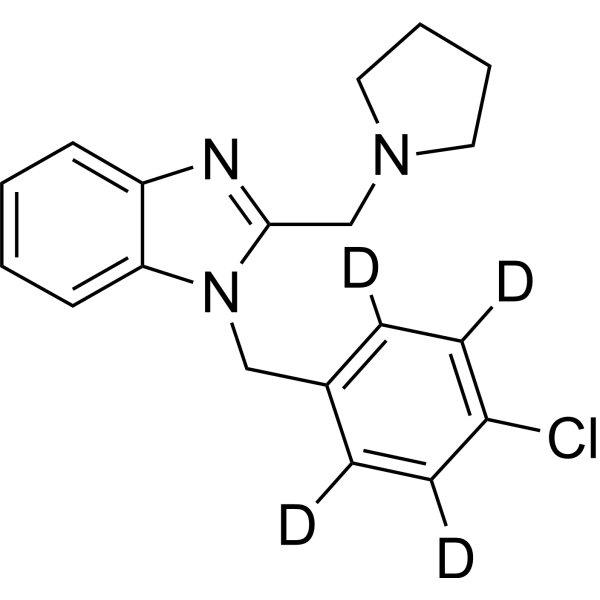
Clemizole-d4 is the deuterated-labeled Clemizole (HY-30234). Clemizole is an orally active, blood-brain barrier permeable TRPC5 inhibitor, with an IC50 value of 1.05-1.34 μM against mouse TRPC5. Clemizole blocks TRPC1:TRPC5, TRPC3, TRPC4, TRPC6, TRPC7, hERG, hKCNQ1/hKCNE1 and hKv1.5 channels, and activates TRPA1; it modulates 5HT-2B and HTR2A receptors; it inhibits HCV RNA replication, CrtN enzymatic activity, oxidative stress, neuroinflammation, cell apoptosis and bacterial virulence; it maintains blood-brain barrier (BBB) integrity; it enhances DNA repair capacity; it improves cell viability; and it alters cardiac electrophysiological properties. Clemizole can be used in the research of Dravet syndrome, hepatitis C virus infection, Staphylococcus aureus skin infection, Cisplatin (HY-17394)-induced nephrotoxicity, STXBP1-related diseases, traumatic brain injury and xeroderma pigmentosum type C .
loading...
    loading...
Cat. No.: HY-181927
Target:  

SARS-CoV Virus Protease

Research Areas:  

Infection

SARS-CoV-2 PLpro-IN-7 (Compound 18) is a selective SARS-CoV-2 PLpro inhibitor with an IC50 of 13.3 μM. SARS-CoV-2 PLpro-IN-7 exerts antiviral activity against SARS-CoV-2 (with an EC50 of 11 μM for SARS-CoV-2 in Huh7.5 cells). SARS-CoV-2 PLpro-IN-7 is applicable to research related to COVID-19 .
loading...
    loading...
Cat. No.: HY-30234B
CAS No.: 17162-20-8
Clemizole sulfate is an orally active, blood-brain barrier permeable TRPC5 inhibitor, with an IC50 value of 1.05-1.34 μM against mouse TRPC5. Clemizole sulfate blocks TRPC1:TRPC5, TRPC3, TRPC4, TRPC6, TRPC7, hERG, hKCNQ1/hKCNE1 and hKv1.5 channels, and activates TRPA1; it modulates 5HT-2B and HTR2A receptors; it inhibits HCV RNA replication, CrtN enzymatic activity, oxidative stress, neuroinflammation, cell apoptosis and bacterial virulence; it maintains blood-brain barrier (BBB) integrity; it enhances DNA repair capacity; it improves cell viability; and it alters cardiac electrophysiological properties. Clemizole sulfate can be used in the research of Dravet syndrome, hepatitis C virus infection, Staphylococcus aureus skin infection, Cisplatin (HY-17394)-induced nephrotoxicity, STXBP1-related diseases, traumatic brain injury and xeroderma pigmentosum type C .
loading...
    loading...
  • 1

