3 Results for "

LM8

" in MedChemExpress (MCE) Product Catalog:
Products (3)

3 Results for "LM8" in MCE Product Catalog:

8
8 Cited Publications
Cat. No.: HY-13442A
CAS No.: 441045-17-6
Purity:  99.91%
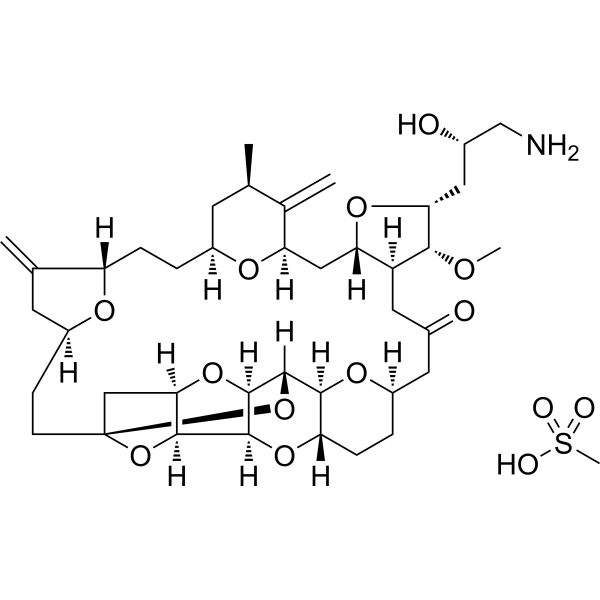
Synonyms: B1939 mesylate; E7389 mesylate; ER-086526 mesylate
Research Areas:  

Cancer

Eribulin mesylate is an inhibitor for microtubule. Eribulin mesylate inhibits the proliferation of cancer cell LM8 and Dunn, inhibits the cell migration of LM8, arrests the cell cycle at G2/M phase, and induces apoptosis in LM8. Eribulin mesylate exhibits antitumor efficacy in mouse model .
loading...
    loading...
Cat. No.: HY-13442C
CAS No.: 441045-17-6
Synonyms: B1939 mesylate (purity>99%, single impurity ≤ 0.15%); E7389 mesylate (purity>99%, single impurity ≤ 0.15%); ER-086526 mesylate (purity>99%, single impurity ≤ 0.15%)
Research Areas:  

Cancer

Eribulin (B1939; E7389; ER-086526) mesylate (purity>99%, single impurity ≤ 0.15%) is an inhibitor for microtubule. Eribulin mesylate (purity>99%, single impurity ≤ 0.15%) inhibits the proliferation of cancer cell LM8 and Dunn, inhibits the cell migration of LM8, arrests the cell cycle at G2/M phase, and induces apoptosis in LM8. Eribulin mesylate (purity>99%, single impurity ≤ 0.15%) exhibits antitumor efficacy in mouse model .
loading...
    loading...
Cat. No.: HY-N11231
CAS No.: 7176-02-5
Fucoxanthinol, a carotenoid, is a deacetylated Fucoxanthin (HY-N2302) metabolite with oral activity, and inhibits rat pancreatic lipase with an IC50 of 764 nM. Fucoxanthinol reduces expression of Bcl-2, Bcl-xL, survivin, XIAP, cIAP2, cyclin D1, cyclin D2, cyclin E, CDK4, CDK6, β-catenin, JunD, PPARγ, and induces GADD45α expression. Fucoxanthinol activates caspase-3, caspase-8, caspase-9, Nrf2/Keap1/ARE pathway, and inhibits activation of Akt, NF-κB, AP-1, PDPK1, GSK3β phosphorylation. Fucoxanthinol induces apoptosis, G0/G1 cell cycle arrest, inhibits cancer cell viability, proliferation, migration, invasiveness, tumour growth, adipocyte differentiation, oxidative stress, neurotoxicity, triglyceride absorption, angiogenesis, and obesity-induced inflammation. Fucoxanthinol can be used for the research of osteosarcoma, leukemia, lymphoma, adult T-cell leukemia, prostate cancer, colon cancer, breast cancer, hypertriglyceridaemia, Alzheimer’s disease, Parkinson’s disease, obesity, insulin resistance, malignant melanoma, and type II diabetes .
loading...
    loading...

