1. Search Result
Search Result
Results for "

MDMA

" in MedChemExpress (MCE) Product Catalog:
Cat. No. Product Name Target Research Areas Chemical Structure
  • HY-B0764
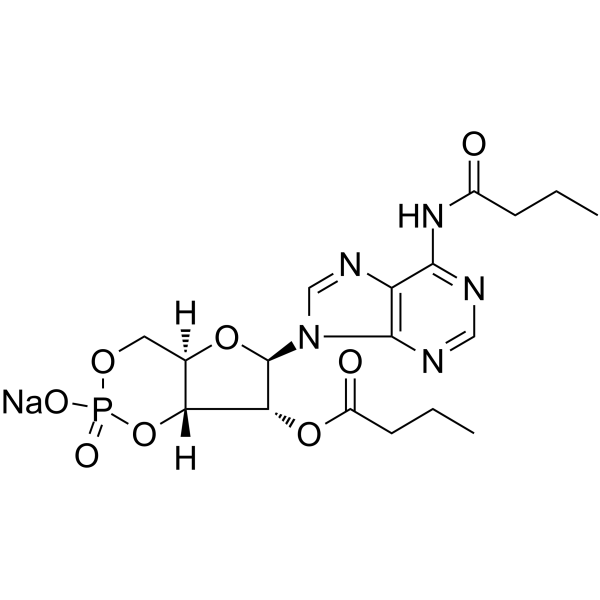
    Bucladesine sodium
    Maximum Cited Publications
    41 Publications Verification

    Dibutyryl cAMP sodium; DBcAMP sodium

    PKA Reactive Oxygen Species (ROS) Apoptosis Neurological Disease Inflammation/Immunology Cancer
    Bucladesine (Dibutyryl cAMP; DBcAMP) sodium is a membrane-permeable 3′, 5′-cyclic adenosine monophosphate (cAMP) analog. Bucladesine selectively activates cAMP dependent protein kinase (PKA) by increasing the intracellular level of cAMP. Bucladesine significantly attenuates MDMA-induced increases in hippocampal mitochondrial ROS formation, mitochondrial outer membrane damage, cytochrome c release, and hippocampal ADP/ATP ratio, thereby improving spatial learning and memory impairments. Bucladesine exhibit anti-nociceptive and anti-inflammation effect. Bucladesine can inhibit cancer cells proliferation, induce apoptosis. Bucladesine can be used for the researches of neurological disease, cancer, inflammation .
    Bucladesine sodium
  • HY-B0764A
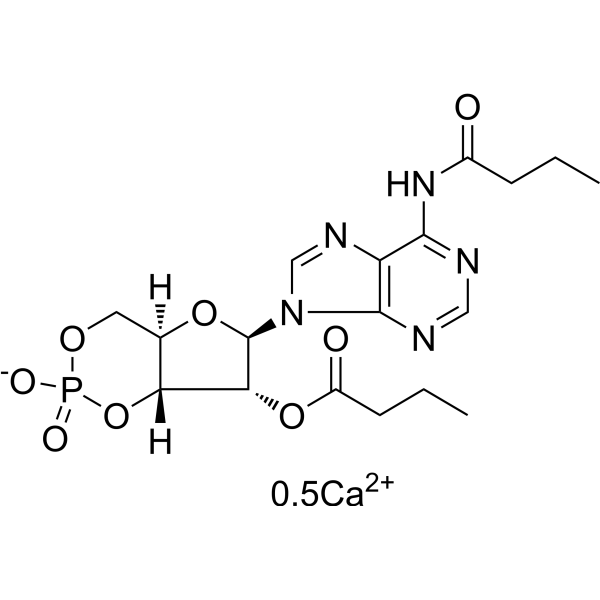
    Bucladesine hemicalcium
    Maximum Cited Publications
    41 Publications Verification

    Dibutyryl cAMP hemicalcium; DBcAMP hemicalcium

    PKA Apoptosis Reactive Oxygen Species (ROS) Neurological Disease Cancer
    Bucladesine (Dibutyryl cAMP; DBcAMP) hemicalcium is a membrane-permeable 3′, 5′-cyclic adenosine monophosphate (cAMP) analog. Bucladesine selectively activates cAMP dependent protein kinase (PKA) by increasing the intracellular level of cAMP. Bucladesine significantly attenuates MDMA-induced increases in hippocampal mitochondrial ROS formation, mitochondrial outer membrane damage, cytochrome c release, and hippocampal ADP/ATP ratio, thereby improving spatial learning and memory impairments. Bucladesine exhibit anti-nociceptive and anti-inflammation effect. Bucladesine can inhibit cancer cells proliferation, induce apoptosis. Bucladesine can be used for the researches of neurological disease, cancer, inflammation .
    Bucladesine hemicalcium
  • HY-B0764B

    Dibutyryl cAMP; DBcAMP

    PKA Reactive Oxygen Species (ROS) Apoptosis Neurological Disease Inflammation/Immunology Cancer
    Bucladesine (Dibutyryl cAMP; DBcAMP) is a membrane-permeable 3′, 5′-cyclic adenosine monophosphate (cAMP) analog. Bucladesine selectively activates cAMP dependent protein kinase (PKA) by increasing the intracellular level of cAMP. Bucladesine significantly attenuates MDMA-induced increases in hippocampal mitochondrial ROS formation, mitochondrial outer membrane damage, cytochrome c release, and hippocampal ADP/ATP ratio, thereby improving spatial learning and memory impairments. Bucladesine exhibit anti-nociceptive and anti-inflammation effect. Bucladesine can inhibit cancer cells proliferation, induce apoptosis. Bucladesine can be used for the researches of neurological disease, cancer, inflammation .
    Bucladesine
  • HY-B0764G

    Dibutyryl cAMP sodium; DBcAMP sodium

    PKA Reactive Oxygen Species (ROS) Apoptosis Neurological Disease Inflammation/Immunology Cancer
    Bucladesine (Dibutyryl cAMP; DBcAMP) sodium (GMP) is a Bucladesine sodium (HY-B0764) produced by using GMP guidelines. Bucladesine (Dibutyryl cAMP; DBcAMP) is a membrane-permeable 3′, 5′-cyclic adenosine monophosphate (cAMP) analog. Bucladesine selectively activates cAMP dependent protein kinase (PKA) by increasing the intracellular level of cAMP. Bucladesine significantly attenuates MDMA-induced increases in hippocampal mitochondrial ROS formation, mitochondrial outer membrane damage, cytochrome c release, and hippocampal ADP/ATP ratio, thereby improving spatial learning and memory impairments. Bucladesine exhibit anti-nociceptive and anti-inflammation effect. Bucladesine can inhibit cancer cells proliferation, induce apoptosis. Bucladesine can be used for the researches of neurological disease, cancer, inflammation .
    Bucladesine sodium
  • HY-W012426

    MDBP

    Biochemical Assay Reagents Neurological Disease
    1-Piperonylpiperazine (MDBP) is metabolized by demethylenation and subsequent methylation to N-(4-hydroxy-3-methoxybenzyl)piperazine followedby partial glucuronidation or sulfation. 1-Piperonylpiperazine can alter the disposition and metabolism of 3,4-methylenedioxymethamphetamine (MDMA) in the brain and in peripheral organs. 1-Piperonylpiperazine can inhibit the MDMA-induced neurotoxicity .
    1-Piperonylpiperazine
  • HY-B0764R

    Dibutyryl cAMP sodium (Standard); DBcAMP sodium (Standard)

    Reference Standards PKA Reactive Oxygen Species (ROS) Apoptosis Neurological Disease Inflammation/Immunology Cancer
    Bucladesine (Dibutyryl cAMP; DBcAMP) sodium (Standard) is the analytical standard of Bucladesine sodiumn (HY-B0764). This product is intended for research and analytical applications. Bucladesine is a membrane-permeable 3′, 5′-cyclic adenosine monophosphate (cAMP) analog. Bucladesine selectively activates cAMP dependent protein kinase (PKA) by increasing the intracellular level of cAMP. Bucladesine significantly attenuates MDMA-induced increases in hippocampal mitochondrial ROS formation, mitochondrial outer membrane damage, cytochrome c release, and hippocampal ADP/ATP ratio, thereby improving spatial learning and memory impairments. Bucladesine exhibit anti-nociceptive and anti-inflammation effect. Bucladesine can inhibit cancer cells proliferation, induce apoptosis. Bucladesine can be used for the researches of neurological disease, cancer, inflammation .
    Bucladesine sodium (Standard)
  • HY-172346

    N-OH MDMA hemioxalate; FLEA hemioxalate

    Drug Derivative Neurological Disease Metabolic Disease
    N-Hydroxy MDMA (N-OH MDMA) hemioxalate is an N-hydroxy analogue of 3,4-methylenedioxymethamphetamine (MDMA). N-Hydroxy MDMA hemioxalate can be rapidly metabolized to MDMA and MDA in rats, which are mainly excreted in urine, and can also be detected in hair .
    N-Hydroxy MDMA hemioxalate
  • HY-W725213

    BL-3912; alpha-EH DOM

    Biochemical Assay Reagents Others
    α-ethyl 2C-D (BL-3912) hydrochloride is a phenethylamine and amphetamine compound. In drug discrimination studies, α-ethyl 2C-D hydrochloride can serve as a reference standard for MDMA .
    α-ethyl 2C-D hydrochloride
  • HY-W506356

    Adrenergic Receptor Neurological Disease
    2,3-MDMA hydrochloride is a noradrenalin transporter and serotonin transporter inhibitor with IC50 values of 6.2 μM and 82 μM, respectively .
    2,3-MDMA hydrochloride
  • HY-139265

    Drug Derivative Neurological Disease
    3,4-Mdma tert-butyl carbamate is an amphetamine.
    3,4-Mdma tert-butyl carbamate
  • HY-W106785

    Drug Derivative Others
    N-Benzylcyclohexylamine hydrochloride, an arylcyclohexylamine, is a cutting agent in 3,4-MDMA samples.
    N-Benzylcyclohexylamine hydrochloride
  • HY-158806

    3,4-Dihydroxymethamphetamine TFA; N-Methyl-α-methyldopamine TFA; HHMA TFA

    Drug Derivative Neurological Disease
    3,4-DHMA (3,4-Dihydroxymethamphetamine) TFA is an active metabolite of 3,4-MDMA .
    3,4-DHMA TFA
  • HY-116441

    Drug Metabolite Neurological Disease
    4-Hydroxy-3-methoxyamphetamine hydrochloride is a metabolite of 3,4-Methylenedioxymethamphetamine (MDMA). 4-Hydroxy-3-methoxyamphetamine hydrochloride can be used for forensic analysis .
    4-Hydroxy-3-methoxyamphetamine hydrochloride
  • HY-186170A

    Drug Isomer Neurological Disease
    S-MDMA is an isomer of 4-methylenedioxymethamphetamine (MDMA) isomer. S-MDMA can promotes cortical neurons growth .
    S-MDMA
  • HY-W701743

    α-Methyldopamine hydrochloride; α-MeDA hydrochloride

    Drug Metabolite Cardiovascular Disease Neurological Disease
    3,4-Dihydroxyamphetamine (α-Methyldopamine) (hydrochloride) is a secondary metabolite of 3,4-Methylenedioxymethamphetamine (MDMA). 3, 4-dihydroxyamphetamine (hydrochloride) is cytotoxic to rat hepatocytes. 3, 4-dihydroxyamphetamine (hydrochloride) is also used in the study of high blood pressure .
    3,4-Dihydroxyamphetamine hydrochloride
  • HY-186170

    5-HT Receptor Neurological Disease
    R-MDMA, 4-methylenedioxymethamphetamine (MDMA) isomer, is a 5-HT2A/5-HT2C receptor antagonist with an IC50 of 629 and 61.4 nM. R-MDMA promotes cortical neuron growth. R-MDMA facilitates fear extinction learning and produces antidepressant-like effects in preclinical rodent models. R-MDMA can be used for the researches of post-traumatic stress disorder and depression .
    R-MDMA
  • HY-186170B

    5-HT Receptor Neurological Disease
    (R,S)-MDMA acts as a partial agonist of 5-HT2A, 5-HT2B and 5-HT2C receptors. (R,S)-MDMA belongs to psychoactive substances. (R,S)-MDMA exhibits antidepressant activity. (R,S)-MDMA can be used for research on mental disorders such as post-traumatic stress disorder and depression .
    (R,S)-MDMA
  • HY-W783844

    Drug Isomer Neurological Disease
    (R)-Nantenine ((R)-(-)-nantenine) is the levorotatory isomer of Nantenine (HY-N9141). (R)-Nantenine has high affinity and selectivity for the α1A adrenergic receptor. (R)-Nantenine can block the behavioral suppression induced by MDMA. (R)-Nantenine is mainly used for the research related to diseases caused by MDMA abuse .
    (R)-Nantenine
  • HY-186169B

    Serotonin Transporter Dopamine Transporter Neurological Disease
    (R,S)-MDDMA is an MDMA analog that lacks the psychostimulant effects of its parent compound. (R,S)-MDDMA still retains partial serotonin-releasing activity .
    (R,S)-MDDMA
  • HY-172763

    Drug Derivative Serotonin Transporter Dopamine Transporter 5-HT Receptor Neurological Disease
    EDMA hydrochloride is a derivative of MDMA. EDMA hydrochloride is a substrate for multiple neurotransmitter transporters, including serotonin transporter (SERT), dopamine transporter (DAT), and norepinephrine transporter (NET). EDMA hydrochloride has 5-HT releasing activity at SERT (EC50 = 117 nM) and MPP + releasing activity at DAT (EC50 = 597 nM) and NET (EC50 = 325 nM) .
    EDMA hydrochloride
  • HY-186169

    5-HT Receptor Drug Derivative Neurological Disease
    R-MDDMA, 4-methylenedioxymethamphetamine (MDMA) analogue, is a 5-HT2A/5-HT2C receptor modulator. R-MDDMA shows antagonistic activity against 5-HT2A/5-HT2C with IC50 values of 642 and 137 nM, and also shows partial agonist activity with EC50 values of 24.5 and 14.4 nM, but does not activate 5-HT2B receptors. R-MDDMA promotes cortical neuron growth. R-MDDMA facilitates fear extinction learning and produces antidepressant-like effects in preclinical rodent models. R-MDDMA can be used for the researches of post-traumatic stress disorder and depression .
    R-MDDMA
  • HY-W680886

    Monoamine Transporter Serotonin Transporter Dopamine Transporter 5-HT Receptor Neurological Disease
    6-APDB is a class of monoamine neurotransmitter releaser and Monoamine Transporter modulator that exerts selective effects on human monoamine transporters and acts as a partial agonist at 5-HT2 family receptors. For NET, 6-APDB has an IC50 of 0.56 μM and a Ki of 18 μM; for SERT, it has an IC50 of 2.3 μM and a Ki of 23 μM; for DAT, it has an IC50 of 33 μM and a Ki of >30 μM, and affinity for rat and mouse TAAR1, with Ki values of 1.0 μM and 0.21 μM, respectively. 6-APDB inhibits norepinephrine and 5-HT reuptake, mediates the release of three types of monoamine neurotransmitters, shows a dose-dependent biphasic locomotor effect in mice, and fully substitutes the discriminative stimulus effect of MDMA. 6-APDB shows no significant cytotoxicity at high concentrations, and possesses empathogenic psychoactivity, potential hallucinogenic effects, and behavioral effects associated with intermittent abuse .
    6-APDB

Inquiry Online

Your information is safe with us. * Required Fields.

Salutation


Country or Region *

Applicant Name *


Organization Name *

Department *


Email Address *


Product Name *

Cat. No.


Requested quantity *

Phone Number *


Remarks

Inquiry Online

Inquiry Information

Product Name:
Cat. No.:
Quantity:
MCE Japan Authorized Agent:

