7 Results for "

Microvasculature

" in MedChemExpress (MCE) Product Catalog:
Products (7)

7 Results for "Microvasculature" in MCE Product Catalog:

32
32 Cited Publications
Cat. No.: HY-P0023
CAS No.: 161552-03-0
Target:  

Integrin

Research Areas:  

Cancer

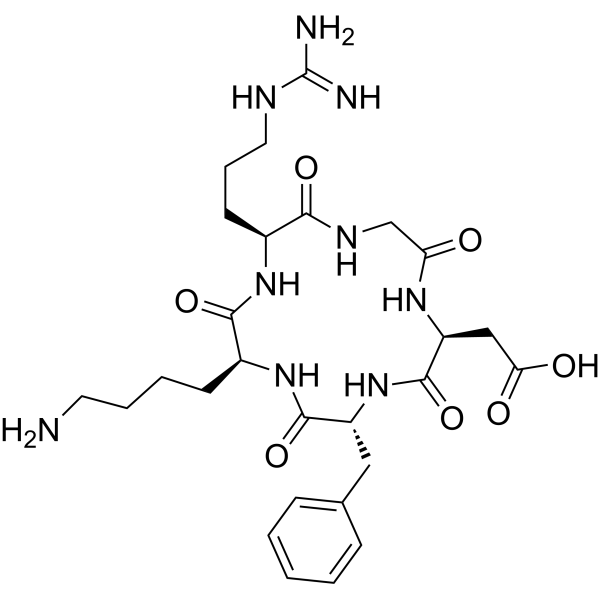
Cyclo(-RGDfK) is a potent and selective inhibitor of the αvβ3 integrin, with an IC50 of 0.94 nM. Cyclo(-RGDfK) potently targets tumor microvasculature and cancer cells through the specific binding to the αvβ3 integrin on the cell surface .
loading...
    loading...
32
32 Cited Publications
Cat. No.: HY-P0023A
CAS No.: 500577-51-5
Target:  

Integrin

Research Areas:  

Cancer

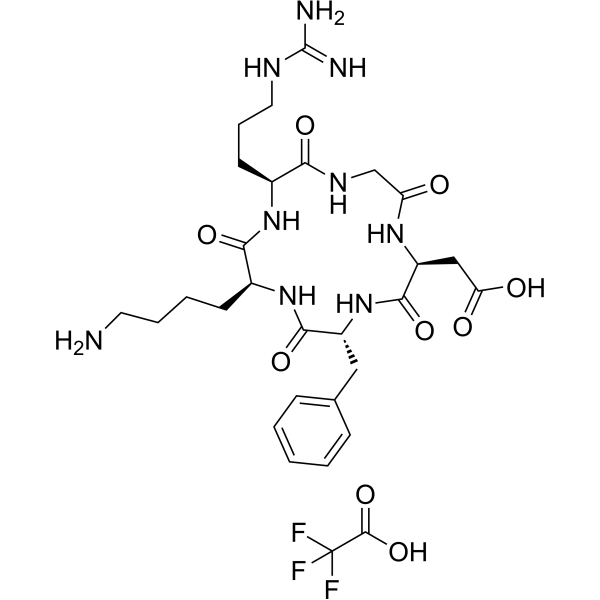
Cyclo(-RGDfK) TFA is a potent and selective inhibitor of the αvβ3 integrin, with an IC50 of 0.94 nM . Cyclo(-RGDfK) TFA potently targets tumor microvasculature and cancer cells through the specific binding to the αvβ3 integrin on the cell surface .
loading...
    loading...
Cat. No.: HY-19916
CAS No.: 1263384-43-5
Synonyms: BAL-101553
Research Areas:  

Cancer

Lisavanbulin (BAL-101553) is the prodrug of the microtubule targeting agent Avanbulin (BAL 27862) (HY-106008). Lisavanbulin is a BBB-penetrant and orally active antitumor agent, especially in tumors that express high levels of end-binding protein 1. Lisavanbulin has ability to target tumor cell proliferation and affects the tumor microenvironment by reducing tumor microvasculature. Lisavanbulin is also a spindle assembly checkpoint activator. Lisavanbulin induces cell cycle arrest and subsequent death or aberrant chromosome segregation. Lisavanbulin can be studied in research for diffuse large B cell lymphoma (DLBCL) and glioblastoma .
loading...
    loading...
Cat. No.: HY-19916A
CAS No.: 1387574-54-0
Synonyms: BAL-101553 dihydrochloride
Research Areas:  

Cancer

Lisavanbulin (BAL-101553) dihydrochloride is the prodrug of the microtubule targeting agent Avanbulin (BAL 27862) (HY-106008). Lisavanbulin dihydrochloride exhibits antitumor activity, especially in tumors that express high levels of end-binding protein 1. Lisavanbulin dihydrochloride has ability to target tumor cell proliferation and affects the tumor microenvironment by reducing tumor microvasculature. Lisavanbulin dihydrochloride is also a spindle assembly checkpoint activator. Lisavanbulin dihydrochloride induces cell cycle arrest and subsequent death or aberrant chromosome segregation. Lisavanbulin dihydrochloride can be studied in research for diffuse large B cell lymphoma (DLBCL) and glioblastoma .
loading...
    loading...
Cat. No.: HY-111170
CAS No.: 906481-23-0
Target:  

Microtubule/Tubulin

Research Areas:  

Cancer

STA-9584 is a potent vascular disrupting agent (VDA) that targets tubulin. STA-9584 exhibits potent antitumor activity in mouse xenograft model by selectively targeting microvasculature at both the center and periphery of tumors. STA-9584 can be used for research in prostate and breast cancer .
loading...
    loading...
Cat. No.: HY-P11799
CAS No.: 344611-99-0
Research Areas:  

Inflammation/Immunology

cLABL is a cyclic peptide that specifically binds to ICAM‑1. cLABL mediates targeted enrichment and rapid endocytosis of nanoparticles. cLABL is applicable to researches such as precise drug delivery at inflammatory sites .
loading...
    loading...
Cat. No.: HY-L919
27,503 compounds

With the aging population and increasing competitive pressures, neurodegenerative diseases of the central nervous system (CNS) have become a serious medical challenge in modern society, including Parkinson's disease, Alzheimer's disease, brain tumors, and multiple sclerosis. However, the success rate of CNS drug development remains remarkably low, primarily due to the blood-brain barrier (BBB). The blood-brain barrier (BBB) is a semipermeable barrier structure that surrounds the microvasculature of the CNS. In capillaries, the wedged endothelial cells are tightly packed and wedge-shaped, lining the interior of the vessels to form extensive tight junctions. Along with a range of receptors, transporters, efflux pumps, and other cellular components, this barrier regulates the entry and exit of molecules between the bloodstream and the brain. The intact BBB blocks the passage of most blood-borne substances into the brain, preventing nearly 100% of large-molecule drugs and over 98% of small-molecule drugs from entering. Compared to non-CNS drugs, physicochemical properties such as hydrogen bonds, lipophilicity, and molecular weight significantly influence a compound's ability to cross the BBB. Using artificial intelligence (AI) algorithms to predict BBB permeability, a predicted value greater than 0.75 indicates that the compound has strong potential to cross the BBB, providing a promising starting point for CNS drug discovery.

