5 Results for "

NUGC-3

" in MedChemExpress (MCE) Product Catalog:
Products (5)

5 Results for "NUGC-3" in MCE Product Catalog:

Cat. No.: HY-U00447
CAS No.: 38275-34-2
Research Areas:  

Cancer

PK11000 is an alkylating agent, and stabilizes the DNA-binding domain of both WT and mutant p53 proteins by covalent cysteine modification without compromising DNA binding. PK11000 has anti-tumor activities .
loading...
    loading...
Cat. No.: HY-175318S
CAS No.: 3069395-29-2
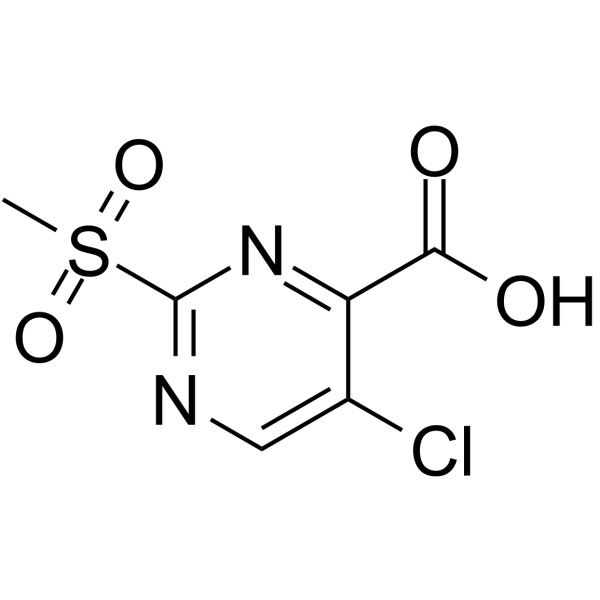
p53 Activator 15 is an orally active p53 Y220C activator. p53 Activator 15 enhances the DNA binding of p53 Y220C (SC50 = 0.58 nM) and significantly inhibits NUGC-3 cell proliferation. p53 Activator 15 effectively inhibits tumor growth in NUGC-3 xenograft mouse and rat models. p53 Activator 15 can be used to study gastric cancer .
loading...
    loading...
Cat. No.: HY-144744
CAS No.: 1873311-82-0
Target:  

NF-κB

Research Areas:  

Cancer

NF-κB-IN-3 (Compound 2) is a NF-κB inhibitor with an IC50 of 0.70 µM. NF-κB-IN-3 can be used as an antitumor agent .
loading...
    loading...
Cat. No.: HY-N21920
CAS No.: 796062-77-6
Dehydrotrametenonic acid is a DNA topoisomerase II (DNA topoisomerase II) inhibitor with an IC50 of 37.5 μM. Dehydrotrametenonic acid inhibits DNA polymerase α and β, with IC50 values of 45.5 μM and 86.5 μM, respectively. Dehydrotrametenonic acid does not intercalate into DNA and exhibits a topoisomerase II inhibitory mechanism similar to that of an inhibitor. Dehydrotrametenonic acid suppresses the growth of NUGC-3 gastric cancer cells with an LD50 of 63.6 μM, and inhibits TPA-induced EBV-EA activation in Raji cells. Dehydrotrametenonic acid can be used in studies related to DNA replication, cell cycle and cancer [3] .
loading...
    loading...
Cat. No.: HY-184397
Target:  

MDM-2/p53

Research Areas:  

Cancer

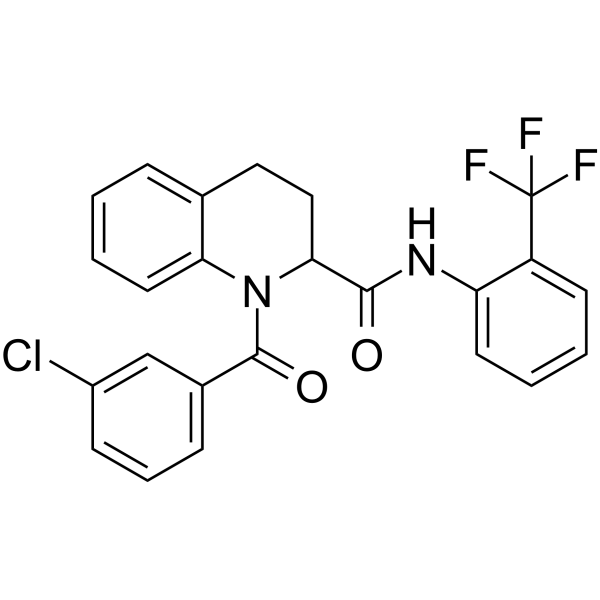
P53-Y220C stabilizer-1 as an indole-based p53-Y220C stabilizer (EC50 = 0.46 μM) that engages the mutation-induced cavity. P53-Y220C stabilizer-1 binds the p53-Y220C mutant with high affinity (KD = 56 nM) and acts as a selective indole-based p53-Y220C stabilizer that engages the mutation-induced cavity. P53-Y220C stabilizer-1 increases mutant protein thermal stability and restores p53 transcriptional activity, mainly triggering cell cycle arrest instead of acute apoptosis. P53-Y220C stabilizer-1 can be applied to cancers harboring the p53-Y220C mutation, such as gastric cancer .
loading...
    loading...

