9 Results for "

PLCγ2

" in MedChemExpress (MCE) Product Catalog:
Products (9)

9 Results for "PLCγ2" in MCE Product Catalog:

Cat. No.: HY-163962
CAS No.: 2451070-32-7
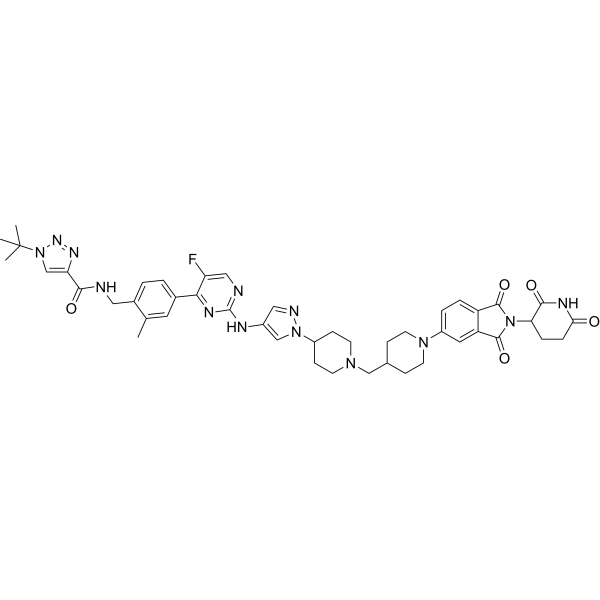
L18I is a Bruton's tyrosine kinase (BTK) PROTAC degrader that targets wild-type and BTK C481, and recruits the cereblon E3 ligase to mediate proteasomal degradation. L18I regulates the BCR, TLR, FcγR and NLRP3 inflammasome signaling pathways, inhibits the phosphorylation of PLCγ-2, ERK1/2 and p38, and reduces the levels of B cell activation markers CD25, CD69 and CD86. L18I downregulates the NF-κB, TNF and TLR signaling pathways, reduces the production of pro-inflammatory cytokines, and decreases immune cell infiltration and immune complex deposition. L18I inhibits the proliferation of BTK-expressing lymphoma cells, induces tumor regression in xenograft models, and exhibits synergistic activity when combined with inhibitors of SYK, PI3K or Lyn. L18I can be used in research related to lupus, diffuse alveolar hemorrhage and B-cell lymphoma [2] .
loading...
    loading...
Cat. No.: HY-155513
CAS No.: 2568963-01-7
Target:  

Syk

Research Areas:  

Cancer

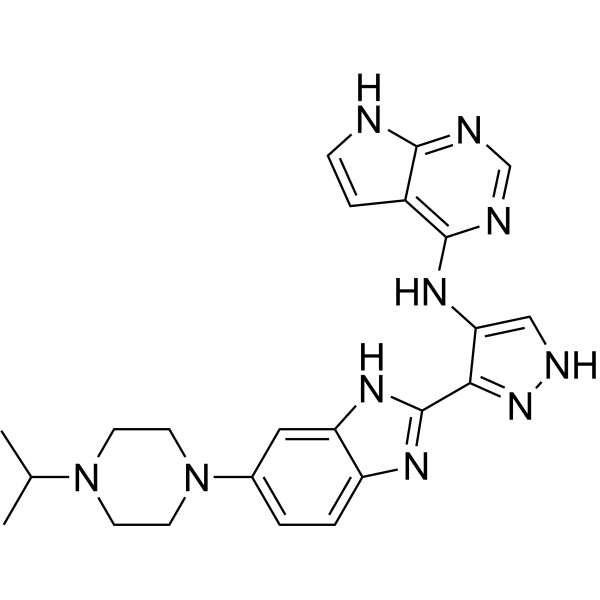
Syk-IN-8 (compound 19q) is a Syk inhibitor, with antiproliferative activity against multiple hematological tumour cells. Syk-IN-8 inhibits PLCγ2 phosphorylation, can be used for research in blood cancers .
loading...
    loading...
Cat. No.: HY-162280
CAS No.: 3034024-77-3
PROTAC BTK Degrader-9 is a potent BTK PROTAC degrader with a DC50 of 1.29 nM (in Mino cells at 4 h). PROTAC BTK Degrader-9 induces the formation of a stable ternary complex with BTK and the CRBN E3 ubiquitin ligase, thereby mediating proteasomal degradation of BTK in a CRBN-dependent manner. PROTAC BTK Degrader-9 downregulates the RANKL-activated BTK-PLCγ2-Ca 2+-NFATc1 signaling pathway. PROTAC BTK Degrader-9 alleviates alveolar bone resorption in periodontitis models of Mus musculus (house mouse). PROTAC BTK Degrader-9 can be used in research related to periodontitis .
loading...
    loading...
Cat. No.: HY-120406
CAS No.: 1431727-04-6
Research Areas:  

Cancer

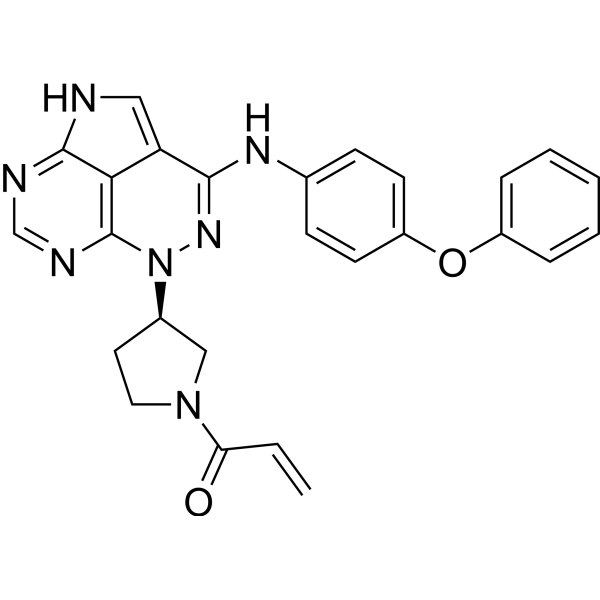
LPS-123 is a covalently irreversible BTK inhibitor with an IC50 of < 5 nM. LPS-123 simultaneously inhibits the catalytic activity of BTK at Tyr551 and its self-activation at Tyr223. LPS-123 inhibits phosphorylation of the AKT/mTOR and MAPK signaling pathways, activation of PLCγ2, ERK1/2, p38, AKT, and mTOR, and blocks the production of CCL3 and CCL4 chemokines. LPS-123 exhibits significant anti-proliferative activity against various B-cell lymphoma cell lines and effectively induces apoptosis via a caspase-dependent pathway. LPS-123 also demonstrates significant antitumor activity in the OCI-Ly7 xenograft model. LPS-123 can be used for lymphoma research .
loading...
    loading...
Cat. No.: HY-151920
Target:  

Btk

Research Areas:  

Inflammation/Immunology

BTK-IN-17 (compound 36R) is a selective and orally activeBTK inhibitor with an IC50 value of 13.7 nM. BTK-IN-17 decreases the expression of p-BTK Y223 and p-PLCγ2 Y1217. BTK-IN-17 shows anti-inflammatory effects .
loading...
    loading...
Cat. No.: HY-P87838
Synonyms: Phosphoinositide phospholipase C-gamma-2, Phospholipase C-IV, Phospholipase C-gamma-2, PLC-IV, PLC-gamma-2, PLCG2

Host:  

Rabbit

Application:  

WB, IHC-P, ICC/IF, ELISA

Reactivity:  

Human, Mouse, Rat

loading...
    loading...
Cat. No.: HY-184940
Target:  

Btk Glycoprotein VI PKC

Research Areas:  

Cardiovascular Disease

BTK-IN-50 is a covalent BTK inhibitor with an IC50 of 6 nM. BTK-IN-50 blocks collagen-induced platelet aggregation by inhibiting the GPVI-mediated BTK-PLCγ2-PKC signaling cascade, and attenuates CRP-XL-induced phosphorylation of BTK, PLCγ2 and PKC substrates in platelets. BTK-IN-50 can be used for research related to thrombosis .
loading...
    loading...
Cat. No.: HY-P84135
Synonyms: FCAS3; APLAID; PLC-IV; PLC-gamma-2

Host:  

Mouse

Application:  

WB, ICC/IF, FC, ELISA

Reactivity:  

Human

loading...
    loading...
Cat. No.: HY-P84135A
Synonyms: FCAS3; APLAID; PLC-IV; PLC-gamma-2

Host:  

Mouse

Application:  

WB, ICC/IF, FC, ELISA

Reactivity:  

Human

loading...
    loading...

