



PROTAC BTK Degrader-9
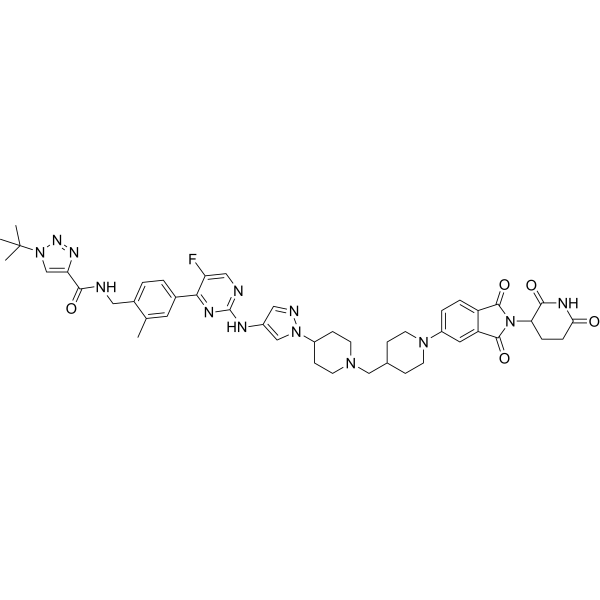
PROTAC BTK Degrader-9 is a potent BTK PROTAC degrader with a DC50 of 1.29 nM (in Mino cells at 4 h). PROTAC BTK Degrader-9 induces the formation of a stable ternary complex with BTK and the CRBN E3 ubiquitin ligase, thereby mediating proteasomal degradation of BTK in a CRBN-dependent manner. PROTAC BTK Degrader-9 downregulates the RANKL-activated BTK-PLCγ2-Ca2+-NFATc1 signaling pathway. PROTAC BTK Degrader-9 alleviates alveolar bone resorption in periodontitis models of Mus musculus (house mouse). PROTAC BTK Degrader-9 can be used in research related to periodontitis.
(Pink: Btk ligand (HY-175909); Blue: Cereblon ligand (HY-14658); Black: linker (HY-W209253)).
For research use only. We do not sell to patients.
- CAS No.: 3034024-77-3
- Formula: C46H52FN13O5
- Molecular Weight:885.99
-
Storage:
Please store the product under the recommended conditions in the Certificate of Analysis.

To place orders, for customer services and technical support, please contact: MedChemExpress USA
Tel: 609-228-6898 E-mail: [email protected] [email protected]


-
 Biological Activity
-
Chemical Information
- Protocols
- Purity & Documentation
- References
-
 Help & FAQs


All PROTACs Isoforms
More

Biological Activity
Description
IC50 & Target
[1]|
Cereblon |
BTK 1.29 nM (DC50) |
In Vitro
PROTAC BTK Degrader-9 (Compound 23) (0.01-3000 nM; 4 h) efficiently and rapidly degrades BTK in Mino cells via the CRBN-dependent proteasomal pathway, with a DC50 of 1.29 nM at 4 h[1].
MedChemExpress (MCE) has not independently confirmed the accuracy of these methods. They are for reference only.
-
Cell Line:human Mino cells
-
Concentration:0.01-3000 nM
-
Incubation Time:0.08-24 h
-
Result:Degraded 99% of BTK protein at 100 nM for 24 h.
Achieved maximum BTK degradation within 2 h at 20 nM, with a degradation half-life (t1/2) of 0.59 h.
Exhibited a DC50 (concentration causing 50% BTK degradation) of 1.29 nM after 4 h incubation, with no hook effect at high concentrations.
Had BTK degradation activity blocked by pre-treatment with ibrutinib, pomalidomide, or MG132.
Parmacokinetics
In Vivo
MedChemExpress (MCE) has not independently confirmed the accuracy of these methods. They are for reference only.
-
Animal Model:C57BL/6 (male, 8 weeks old, ligature-induced periodontitis model)[1]
-
Dosage:10 mg/kg; 30 mg/kg
-
Administration:i.p.; days 1, 4, and 7 after modeling
-
Result:Mitigated alveolar bone loss compared to periodontitis-only model mice.
Reduced the expanded distance between the cemento-enamel junction (CEJ) and alveolar bone crest (ABC) in model mice.
Rescued the decrease in bone volume per tissue volume (BV/TV%) in model mice; increased BV/TV% to ~17% at 10 mg/kg dose, and to ~21% at 30 mg/kg dose.


Chemical Information
-
CAS No. 3034024-77-3
-
Molecular Weight 885.99
-
Formula C46H52FN13O5
-
SMILES
CC1=CC(C2=NC(NC3=CN(C4CCN(CC4)CC5CCN(C6=CC=C7C(C(N(C7=O)C8C(NC(CC8)=O)=O)=O)=C6)CC5)N=C3)=NC=C2F)=CC=C1CNC(C9=CN(C(C)(C)C)N=N9)=O
-
Shipping
Room temperature in continental US; may vary elsewhere.
-
Storage
Please store the product under the recommended conditions in the Certificate of Analysis.


Purity & Documentation
References

Calculators
Concentration (start) × Volume (start) = Concentration (final) × Volume (final)


PROTAC BTK Degrader-9 Related Classifications
HY-162280 Related Classifications
 Powered by Bioz
Keywords
- PROTAC BTK Degrader-9
- 3034024-77-3
- PROTAC BTK Degrader9
- PROTAC BTK Degrader 9
- PROTACs
- RANKL/RANK
- Nuclear Factor of activated T Cells (NFAT)
- Btk
- cereblon
- Bruton’s tyrosine kinase
- CRBN
- RANKL-activated BTK-PLCγ2-Ca2+-NFATc1 signaling pathway
- BTK
- Mino cells
- alveolar bone resorption
- E3 ubiquitin ligase
- mouse periodontitis model
- osteoclastogenesis
- Inhibitor
- inhibitor
- inhibit