1. Search Result
Search Result
Results for "

PLK1 degradation

" in MedChemExpress (MCE) Product Catalog:

10

Inhibitors & Agonists

4

Peptides

Targets Recommended:
Cat. No. Product Name Target Research Areas Chemical Structure
  • HY-150259

    PROTACs c-Myc Cancer
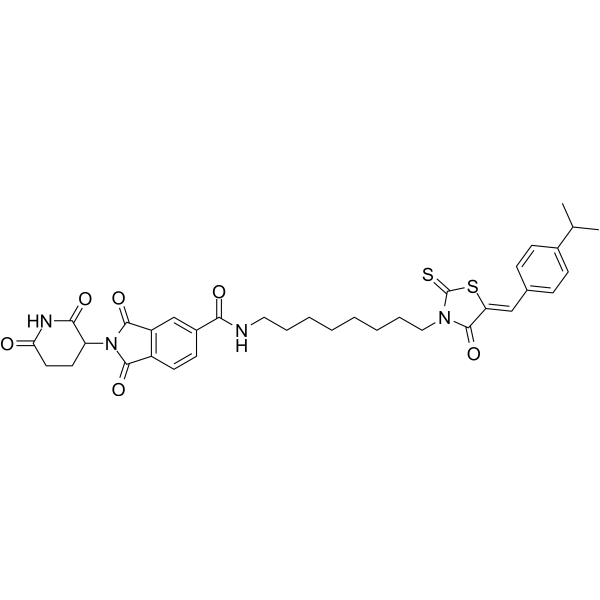
    MDEG-541 is a potent MYC-MAX degrader. MDEG-541 is a PROTAC that based on the MYC-MAX dimerization inhibitor 10058-F4 derivative 28RH and Thalidomide (HY-14658). MDEG-541 shows antiproliferative activity. MDEG-541 decreases the expression of GSPT1, MYC, GSPT2, PLK1 protein .
    MDEG-541
  • HY-129265

    Polo-like Kinase (PLK) Cancer
    Poloxin-2 is a small molecule Plk1 PBD inhibitor that can effectively induce cell mitotic arrest with an EC50 of approximately 15 μM in HeLa cells. Poloxin-2HT was developed by conjugating a hydrophobic tag (HT) to Poloxin-2, a new application of inhibitors targeting protein-protein interactions. Poloxin-2HT significantly enhanced the effects on cell viability and apoptosis by selectively degrading Plk1 protein, and its effect was stronger than that of untagged Poloxin-2. These data validate hydrophobic tags as a new strategy for targeting and disrupting disease-associated proteins.
    Poloxin-2
  • HY-175000

    Ferroptosis Polo-like Kinase (PLK) MDM-2/p53 Endocrinology Cancer
    L14-8 is a potent ferroptosis inducer. L14-8 promotes PLK1 degradation via ubiquitination, increasing TP53 phosphorylation to enhance SAT1 transcription, thereby triggering ferroptosis and cancer cell death. L14-8 can be used for the study of advanced prostate cancer .
    L14-8
  • HY-153519

    Epigenetic Reader Domain Cancer
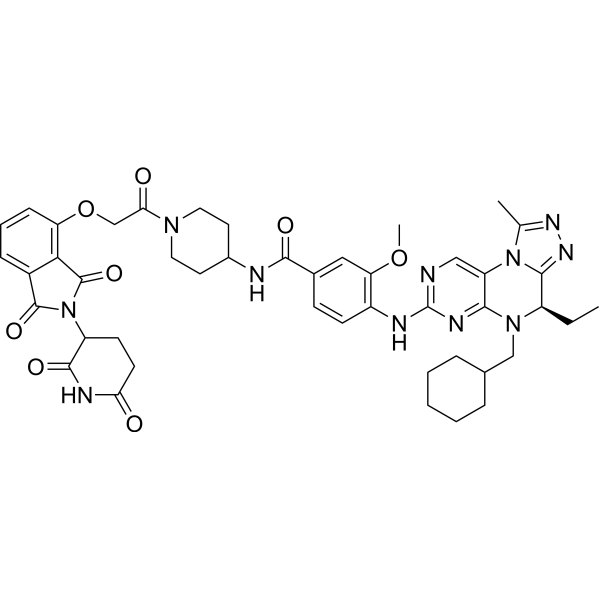
    WWL0245 is a potent and seletive BRD4 PROTAC. WWL0245 selectively degrades BRD4 with sub-nanomolar DC50 (<1 nM) than BRD2/3 and PLK1 ( DC50>1 μM). WWL0245 shows excellent selective cytotoxicity in the BETi sensitive cancer cell lines, including AR-positive prostate cancer cell lines. WWL0245 is a promising drug candidate for AR-positive prostate cancer research and a valuable tool compound to study the biological function of BRD4 .
    WWL0245
  • HY-180989

    PROTACs Polo-like Kinase (PLK) Apoptosis Cancer
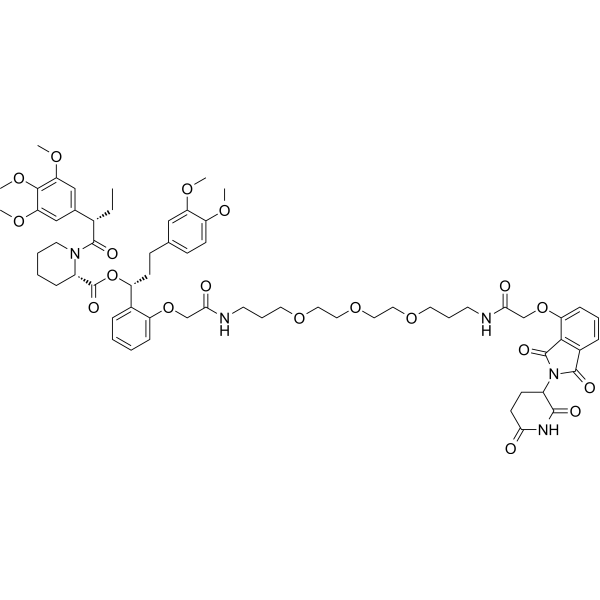
    PROTAC PLK1 Degrader-2 (Compound NC1) is a PLK1 PROTAC degrader with an Kd of 6.06 μM. PROTAC PLK1 Degrader-2 significantly inhibits the proliferation of HeLa cells, induces cell cycle arrest and apoptosis. PROTAC PLK1 Degrader-2 exhibits significant anti-tumor activity in a HeLa cell xenograft tumor mouse model. PROTAC PLK1 Degrader-2 can be used for the study of cervical cancer.
    PROTAC PLK1 Degrader-2
  • HY-181000

    PROTACs Polo-like Kinase (PLK) Cancer
    PROTAC PLK1 Degrader-3 (Compound DD-1) is a PLK1 PROTAC degrader based on the N-deglycosylation pathway, with a Kd value of 2.2 μM. The cell penetration ability of PROTAC PLK1 Degrader-3 is limited and a higher concentration is required to achieve significant degradation effects. PROTAC PLK1 Degrader-3 can be used for research on non-small cell lung cancer .
    PROTAC PLK1 Degrader-3
  • HY-180991

    E3 Ligase Ligand-Linker Conjugates Cancer
    Arg12-AHX is a synthetic E3 ligase-ligand conjugate that can be used for the synthesis of PROTACs, such as PROTAC PLK1 Degrader-2 (HY-180989). PROTAC PLK1 Degrader-2 is a PLK1 PROTAC degrader with anti-tumor activity .
    Arg12-AHX
  • HY-181001

    Ligands for Target Protein for PROTAC Polo-like Kinase (PLK) Cancer
    POI ligand-4 is a PLK1 ligand and can be used for the synthesis of PROTACs, such as PROTAC PLK1 Degrader-3 (HY-181000) .
    POI ligand-4
  • HY-180990

    Ligands for Target Protein for PROTAC Polo-like Kinase (PLK) Cancer
    POI ligand-3 (Compound 4j) is a type of peptide-based PLK1 PBD inhibitor. POI ligand-3 can act as a target protein ligand and be used for the synthesis of PROTACs, such as PROTAC PLK1 Degrader-2 (HY-180989) .
    POI ligand-3
  • HY-P11631

    Ligands for E3 Ligase Cancer
    Arg12, a 12-amino acid peptide sequence, is an E3 ubiquitin ligase ligand. Arg12 can be used to synthesize PROTACs, such as PROTAC PLK1 Degrader-2 (HY-180989). Arg12 can also act as a cell transmembrane peptide (CPP), facilitating the entire molecule to enter the cell .
    Arg12

Inquiry Online

Your information is safe with us. * Required Fields.

Salutation


Country or Region *

Applicant Name *


Organization Name *

Department *


Email Address *


Product Name *

Cat. No.


Requested quantity *

Phone Number *


Remarks

Inquiry Online

Inquiry Information

Product Name:
Cat. No.:
Quantity:
MCE Japan Authorized Agent:

