



FKBP12 PROTAC dTAG-7
Based on 4 publication(s) in Google Scholar
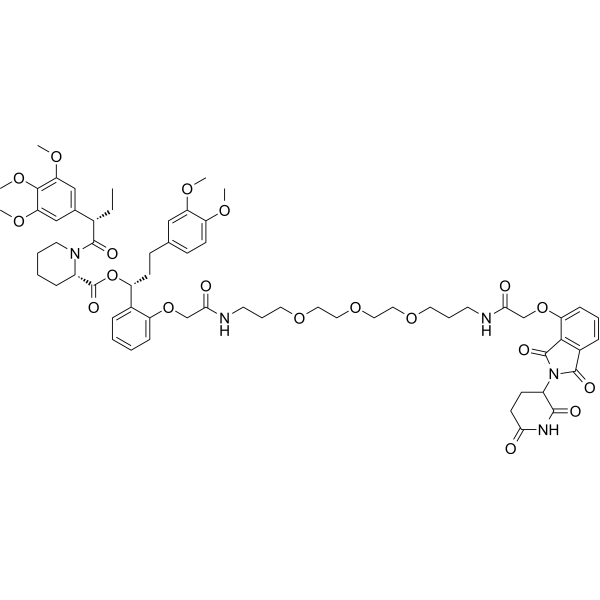
FKBP12 PROTAC dTAG-7 (dTAG-7) is a FKBP12F36V PROTAC degrader. FKBP12 PROTAC dTAG-7 binds FKBP12F36V and CRBN to form a complex, mediating degradation via the ubiquitin-proteasome system. FKBP12 PROTAC dTAG-7 mediates the degradation of FKBP12F36V-tagged nuclear and cytoplasmic proteins, including BRD4, HDAC1, EZH2, MYC, PLK1, KRASG12V, and antigen fusion proteins. FKBP12 PROTAC dTAG-7 enhances MHC class I antigen presentation. FKBP12 PROTAC dTAG-7 is applicable to leukemia-related research.
(Pink: FKBP12 ligand (HY-114420); Blue: Cereblon ligand (HY-103597); Black: linker (HY-128844)).
For research use only. We do not sell to patients.
- Purity : 99.47%
- CAS No.: 2064175-32-0
- Formula: C63H79N5O19
- Molecular Weight:1210.32
-
Storage:
-20°C, sealed storage, away from moisture
* In solvent : -80°C, 6 months; -20°C, 1 month (sealed storage, away from moisture)

To place orders, for customer services and technical support, please contact: MedChemExpress USA
Tel: 609-228-6898 E-mail: [email protected] [email protected]


-
 Biological Activity
-
Chemical Information
-
Solvent & Solubility
- Purity & Documentation
- References
-
 Help & FAQs


Publications Citing Use of MedChemExpress (MCE) FKBP12 PROTAC dTAG-7
MoreAll PROTACs Isoforms
MoreAll Histone Methyltransferase Isoforms
More

Biological Activity
Description
IC50 & Target
[1]|
FKBP12 |
BRD4 |
Cereblon |
In Vitro
The FKBP12 PROTAC dTAG-7 effectively induces heterodimerization of purified CRBN-DDB1 and FKBP12F36V proteins in cell-free AlphaScreen assays[1].
The FKBP12 PROTAC dTAG-7 (100 nM) induces CRBN-dependent degradation of the FKBP12F36V-Nluc fusion protein in 293FTWT cells, but has no effect on endogenous FKBP12WT or the FKBP12WT-Nluc fusion protein, and shows no activity in CRBN-deficient 293FTCRBN−/− cells[1].
The FKBP12 PROTAC dTAG-7 (50 nM) efficiently degrades a variety of FKBP12F36V fusion proteins (FKBP12F36V-KRASG12V, FKBP12F36V-EZH2, HDAC1-FKBP12F36V, MYC-FKBP12F36V, PLK1-FKBP12F36V, BRD4 (short)-FKBP12F36V) in MV4;11 cells, and degrades the endogenously tagged FKBP12F36V-BRD4 fusion protein in homozygous knock-in 293T cells[1].
The FKBP12 PROTAC dTAG-7 (0.01-5 μM; 18 h) induces proteasome-dependent, concentration- and time-dependent degradation of GFP-S8L-F12 in mouse macrophage BMC-2 cells[2].
The FKBP12 PROTAC dTAG-7 (0.015-5 μM; 18 h) specifically reduces GFP-specific fluorescence in mouse macrophage BMC-2 cells in a concentration-dependent manner (indicating degradation of mature GFP-S8L-F12), and its effect is fully reversible within 8 h after compound washout[2].
The FKBP12 PROTAC dTAG-7 (1 μM; 0-24 h) induces antigen-specific, FKBP12-dependent enhancement of H-2Kb/S8L MHC class I presentation in mouse macrophage BMC-2 cells, with the peak of presentation observed at 2 h after treatment with 1 μM dTAG-7[2].
The FKBP12 PROTAC dTAG-7 (1 μM; 0-30 h) induces rapid degradation of GFP-S8L-F12 and enhances the presentation of H-2Kb/S8L class I MHC molecules in mouse dendritic cell line DC2.4 and mouse fibrosarcoma cell line MC57G[2].
The FKBP12 PROTAC dTAG-7 (1 μM; 2-6 h) enhances the presentation of H-2Kb/S8L class I MHC molecules in GFP-S8L-F12-expressing mouse macrophage BMC-2 cells and mouse fibrosarcoma MC57G cells[2].
MedChemExpress (MCE) has not independently confirmed the accuracy of these methods. They are for reference only. .
-
Cell Line:GFP-S8L-F12-expressing murine macrophage BMC-2 cells
-
Concentration:0.01, 0.1, 0.5, 1, 5 μM (18 h incubation); 1 μM (cycloheximide chase; 6 h incubation with/without proteasome inhibitor)
-
Incubation Time:18 h (0.01-5 μM); 0-6 h (cycloheximide chase with 1 μM); 6 h (1 μM with/without proteasome inhibitor)
-
Result:Triggered concentration-dependent degradation of GFP-S8L-F12, with only 1% residual protein detected at 5 μM after 18 h.
Reduced residual GFP-S8L-F12 protein to 23% after 6 h of 1 μM treatment, compared to 90% residual with DMSO control.
Reversed dTAG-7-mediated degradation of GFP-S8L-F12 when co-treated with 10 μM proteasome inhibitor MG132.


Chemical Information
-
CAS No. 2064175-32-0
-
Appearance Solid
-
Molecular Weight 1210.32
-
Formula C63H79N5O19
-
Color Off-white to light yellow
-
SMILES
O=C([C@H]1N(C([C@H](C2=CC(OC)=C(OC)C(OC)=C2)CC)=O)CCCC1)O[C@@H](C3=CC=CC=C3OCC(NCCCOCCOCCOCCCNC(COC4=CC=CC(C(N5C(CC6)C(NC6=O)=O)=O)=C4C5=O)=O)=O)CCC7=CC=C(OC)C(OC)=C7
-
Synonyms
dTAG-7
-
Shipping
Room temperature in continental US; may vary elsewhere.
-
Storage
-20°C, sealed storage, away from moisture
* In solvent : -80°C, 6 months; -20°C, 1 month (sealed storage, away from moisture)


Publications (4)
-
Journal Impact Factor
-
Most Recent
-
Nat Commun
Footprint-C reveals transcription factor modes in local clusters and long-range chromatin interactions. [Abstract]2024 Dec 30;15(1):10922. PMID: 39738122 -
Mol Cell
Deciphering the dual effects of transcription on DNA replication elongation by replication-associated Micro-C. [Abstract]2026 May 21;86(10):1870-1880.e5. PMID: 42019499 -
Sci Adv
Architectural transcription factors collectively shape nuclear radial positioning of chromatin contacts. [Abstract]2025 Aug 29;11(35):eadw8040. PMID: 40880471 -
Stem Cell Res Ther
PROTAC-mediated vimentin degradation promotes terminal erythroid differentiation of pluripotent stem cells. [Abstract]2024 Sep 18;15(1):310. PMID: 39294765


Solvent & Solubility
In Vitro:
DMSO : ≥ 100 mg/mL (82.62 mM; Hygroscopic DMSO has a significant impact on the solubility of product, please use newly opened DMSO)
* "≥" means soluble, but saturation unknown.
Please refer to the solubility information to select the appropriate solvent. Once prepared, please aliquot and store the solution to prevent product inactivation from repeated freeze-thaw cycles.
Storage method and period of stock solution: -80°C, 6 months; -20°C, 1 month (sealed storage, away from moisture). When stored at -80°C, please use it within 6 months. When stored at -20°C, please use it within 1 month.
Please refer to the solubility information to select the appropriate solvent. Once prepared, please aliquot and store the solution to prevent product inactivation from repeated freeze-thaw cycles.
Storage method and period of stock solution: -80°C, 6 months; -20°C, 1 month (sealed storage, away from moisture). When stored at -80°C, please use it within 6 months. When stored at -20°C, please use it within 1 month.
Concentration (start) × Volume (start) = Concentration (final) × Volume (final)
In Vivo:
Select the appropriate dissolution method based on your experimental animal and administration route.
- For the following dissolution methods, please ensure to first prepare a clear stock solution using an In Vitro approach and then sequentially add co-solvents:
- To ensure reliable experimental results, the clarified stock solution can be appropriately stored based on storage conditions. As for the working solution for In Vivo experiments, it is recommended to prepare freshly and use it on the same day.
- The percentages shown for the solvents indicate their volumetric ratio in the final prepared solution. If precipitation or phase separation occurs during preparation, heat and/or sonication can be used to aid dissolution.
Add each solvent one by one: 10% DMSO 40% PEG300 5% Tween-80 45% Saline
Solubility: 3.75 mg/mL (3.10 mM); Clear solution; Need ultrasonic
This protocol yields a clear solution of 3.75 mg/mL.
Taking 1 mL working solution as an example, add 100 μL DMSO stock solution (37.5 mg/mL) to 400 μL PEG300, and mix evenly; then add 50 μL Tween-80 and mix evenly; then add 450 μL Saline to adjust the volume to 1 mL.
Preparation of Saline: Dissolve 0.9 g sodium chloride in ddH₂O and dilute to 100 mL to obtain a clear Saline solution.
Add each solvent one by one: 10% DMSO 90% (20% SBE-β-CD in Saline)
Solubility: 3.75 mg/mL (3.10 mM); Suspended solution; Need ultrasonic
This protocol yields a suspended solution of 3.75 mg/mL. Suspended solution can be used for oral and intraperitoneal injection.
Taking 1 mL working solution as an example, add 100 μL DMSO stock solution (37.5 mg/mL) to 900 μL 20% SBE-β-CD in Saline, and mix evenly.
Preparation of 20% SBE-β-CD in Saline (4°C, storage for one week): 2 g SBE-β-CD powder is dissolved in 10 mL Saline, completely dissolve until clear.
In Vivo Dissolution Calculator
Please enter the basic information of animal experiments:
-
-
-
-
Recommended: Prepare an additional quantity of animals to account for potential losses during experiments.
Please enter your animal formula composition:
-
%DMSO +
Recommended: Keep the proportion of DMSO in working solution below 2% if your animal is weak.
-
%+
-
+%Tween-80 + +
-
%Saline +
The co-solvents required include: DMSO, . All of co-solvents are available by MedChemExpress (MCE). , Tween 80. All of co-solvents are available by MedChemExpress (MCE).
Working solution concentration: 0.22 mg/mL
Method for preparing stock solution: mg drug dissolved in μL DMSO. Stock solution concentration: mg/mL. * In solvent : -80°C, 6 months; -20°C, 1 month (sealed storage, away from moisture)
1. Take μL DMSO stock solution;
2. Add μL .
μL , mix evenly;
3. Then add μL Tween 80, mix evenly;
4. Then add μL
Please ensure that the stock solution in the first step is dissolved to a clear state, and add co-solvents in sequence. You can use ultrasonic heating (ultrasonic cleaner, recommended frequency 20-40 kHz), vortexing, etc. to assist dissolution.


Purity & Documentation
-
Data Sheet (278 KB)
-
SDS (252 KB)
- English - EN (252 KB)
- Français - FR (252 KB)
- Deutsch - DE (252 KB)
- Norwegian - NO (252 KB)
- Español - ES (252 KB)
- Swedish - SV (252 KB)
- Italian - IT (252 KB)
- Korean - KR (252 KB)
- Portuguese - PT (252 KB)
-
Handling Instructions (2659 KB)
References
[1]. Nabet B, et al. The dTAG system for immediate and target-specific protein degradation. Nature chemical biology. 2018 May;14(5):431-441. [Content Brief]
[2]. Moser SC, et al. Acute Pharmacologic Degradation of a Stable Antigen Enhances Its Direct Presentation on MHC Class I Molecules. Frontiers in immunology. 2017;8:1920. [Content Brief]


Complete Stock Solution Preparation Table
Please refer to the solubility information to select the appropriate solvent. Once prepared, please aliquot and store the solution to prevent product inactivation from repeated freeze-thaw cycles.
Storage method and period of stock solution: -80°C, 6 months; -20°C, 1 month (sealed storage, away from moisture). When stored at -80°C, please use it within 6 months. When stored at -20°C, please use it within 1 month.
| Optional Solvent | Concentration Solvent Mass | 1 mg | 5 mg | 10 mg | 25 mg |
|---|---|---|---|---|---|
| DMSO | 1 mM | 0.8262 mL | 4.1311 mL | 8.2623 mL | 20.6557 mL |
| 5 mM | 0.1652 mL | 0.8262 mL | 1.6525 mL | 4.1311 mL | |
| 10 mM | 0.0826 mL | 0.4131 mL | 0.8262 mL | 2.0656 mL | |
| 15 mM | 0.0551 mL | 0.2754 mL | 0.5508 mL | 1.3770 mL | |
| 20 mM | 0.0413 mL | 0.2066 mL | 0.4131 mL | 1.0328 mL | |
| 25 mM | 0.0330 mL | 0.1652 mL | 0.3305 mL | 0.8262 mL | |
| 30 mM | 0.0275 mL | 0.1377 mL | 0.2754 mL | 0.6885 mL | |
| 40 mM | 0.0207 mL | 0.1033 mL | 0.2066 mL | 0.5164 mL | |
| 50 mM | 0.0165 mL | 0.0826 mL | 0.1652 mL | 0.4131 mL | |
| 60 mM | 0.0138 mL | 0.0689 mL | 0.1377 mL | 0.3443 mL | |
| 80 mM | 0.0103 mL | 0.0516 mL | 0.1033 mL | 0.2582 mL |


FKBP12 PROTAC dTAG-7 Related Classifications
HY-123941 Related Classifications
 Powered by Bioz