



MHC I
MHC I presents intracellular peptide antigens on nucleated cells for immune surveillance by CD8+ T cells[1]. Mechanistically, cytosolic proteins undergo proteasomal processing, peptide transport into the endoplasmic reticulum, loading onto MHC I, and surface display as peptide-MHC I complexes[2]. In viral infection and cancer models, altered MHC I antigen presentation supports immune evasion and affects tumor immunogenicity and immunotherapy response[3][4]. Compared with MHC II, which mainly presents exogenous antigens to CD4+ T cells, MHC I complexes are recognized by cytotoxic CD8+ T cells[5]. Among classical human MHC I isoforms, HLA-A, HLA-B, and HLA-C share overlapping functions, but each allomorph binds a distinct peptide repertoire determined by its peptide-binding groove[4]. For experimental applications, P2X7 receptor activation decreases plasma-membrane MHC I in antigen-presenting cells, while P2X7 antagonism or genetic ablation restores impaired peptide presentation[6].- MHC I links intracellular antigen processing to CD8+ T-cell immune surveillance.- HLA-A, HLA-B, and HLA-C differ mainly by peptide-binding repertoire.
References:
- [1]. Hansen TH, et al. MHC class I antigen presentation: learning from viral evasion strategies. Nat Rev Immunol. 2009 Jul;9(7):503-13. [Content Brief]
- [2]. Cresswell P, et al. Mechanisms of MHC class I-restricted antigen processing and cross-presentation. Immunol Rev. 2005 Oct;207:145-57. [Content Brief]
- [3]. Dhatchinamoorthy K, et al. Cancer Immune Evasion Through Loss of MHC Class I Antigen Presentation. Front Immunol. 2021 Mar 9;12:636568. [Content Brief]
- [4]. Dersh D, et al. A few good peptides: MHC class I-based cancer immunosurveillance and immunoevasion. Nat Rev Immunol. 2021 Feb;21(2):116-128. [Content Brief]
- [5]. Wieczorek M, et al. Major Histocompatibility Complex (MHC) Class I and MHC Class II Proteins: Conformational Plasticity in Antigen Presentation. Front Immunol. 2017 Mar 17;8:292. [Content Brief]
- [6]. Baroja-Mazo A, et al. P2X7 receptor activation impairs exogenous MHC class I oligopeptides presentation in antigen presenting cells. PLoS One. 2013 Aug 5;8(8):e70577. [Content Brief]
-
MHC I Related Products (15)
Related Products (15)

- 1
-
Acetyl-6-formylpterin
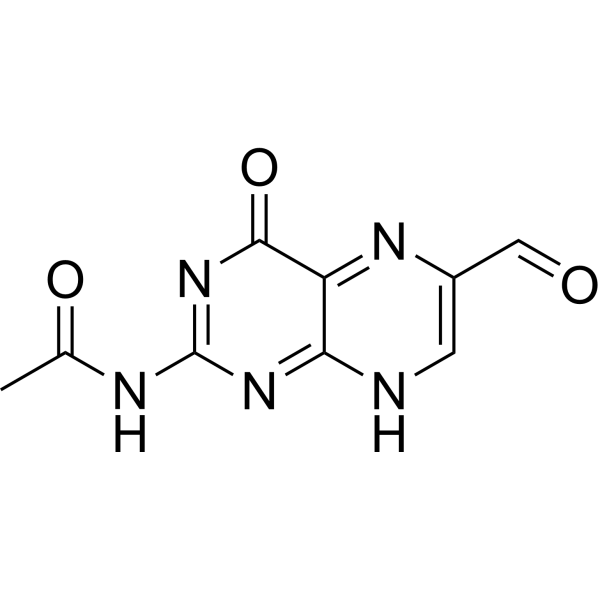 0 ImagesCat. No.: HY-124004CAS No.: 29769-49-1Synonyms: Ac-6-FPAcetyl-6-formylpterin (Ac-6-FP) is a hapten that stabilizes MR1 on antigen-presenting cells, forming an MR1:A6FP complex that fails to activate MAIT cell TCR, thereby acting as a competitive inhibitor of MAIT cell activation. Acetyl-6-formylpterin exacerbates house dust mite-induced airway hyperresponsiveness and elevates circulating IgE levels. Acetyl-6-formylpterin reduces systemic MAIT cell activity and decreases the frequency of IL-17A+ and IFNγ+ MAIT cells in the spleen. Acetyl-6-formylpterin is useful for the study of allergic asthma.
-
AH1
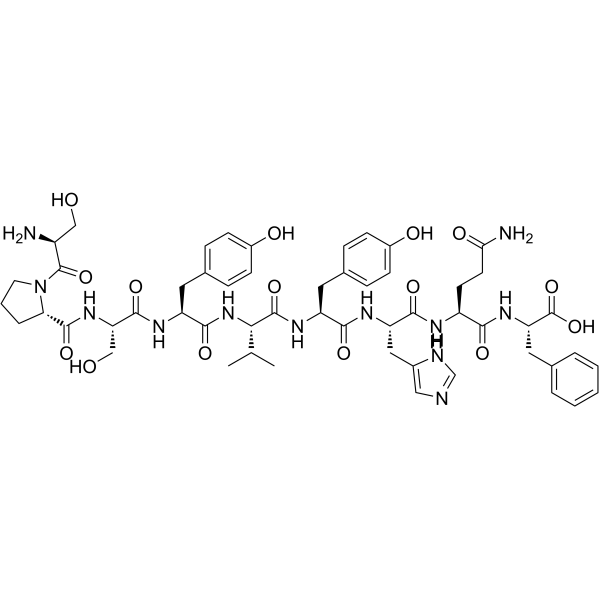 0 ImagesAH1 is an immunodominant MHC class I-restricted nonamer peptide recognized by CD8+ cytotoxic T lymphocytes. AH1 derives from the envelope protein (gp70) of an endogenous ecotropic murine leukemia virus and is presented by the MHC class I Ld molecule. AH1 can be used for the research of colorectal carcinoma.
-
Anti-Mouse MHC Class I (H-2Kd, H-2Dd) Antibody (34-1-2S)
 0 ImagesCat. No.: HY-P990193Anti-Mouse MHC Class I (H-2Kd, H-2Dd) Antibody (34-1-2S) is an anti-mouse MHC Class I (H-2Kd, H-2Dd) IgG2a monoclonal antibody. Anti-Mouse MHC Class I (H-2Kd, H-2Dd) Antibody (34-1-2S) can block the interaction between Ly49 and MHC-I. Anti-Mouse MHC Class I (H-2Kd, H-2Dd) Antibody (34-1-2S) can be used for the construction of acute lung injury models.
-
ESAT6 Epitope
 0 ImagesCat. No.: HY-P6312CAS No.: 183273-40-7ESAT6 Epitope is a ESAT6 CD4+ T cell epitope. ESAT6 Epitope binds to MHC class I molecules with an IC50 value of approximately 180 nM. ESAT6 Epitope has weak immunogenicity. ESAT6 Epitope can be used in studies related to pulmonary tuberculosis.
-
Adrixetinib
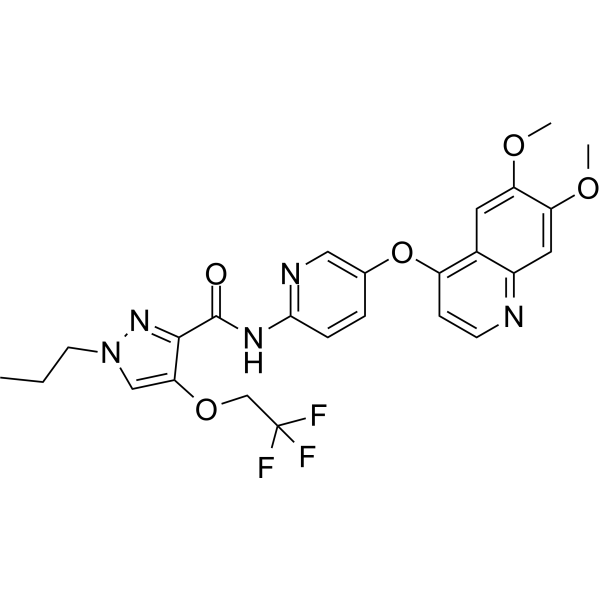 0 ImagesSynonyms: Q702Adrixetinib (Q702) is an orally active triple inhibitor against CSF1R, Mer, and Axl, with Kd values of 8.7 nM, 0.8 nM, and 0.3 nM, respectively. Adrixetinib acts as a potent immune modulator that remodels the tumor microenvironment. Adrixetinib increases the abundance of M1 macrophages and CD8⁺ T cells, while decreasing the levels of M2 macrophages and myeloid-derived suppressor cells (MDSCs). Adrixetinib upregulates the expression of MHC class I and E-cadherin in tumor cells. Adrixetinib shows remarkable antitumor efficacy in syngeneic mouse tumor models. Adrixetinib is suitable for the research of breast cancer, renal adenocarcinoma, colon carcinoma, and melanoma.
-
GRWD5769
 0 ImagesCat. No.: HY-184499CAS No.: 2420554-24-9GRWD5769 is an orally potent ERAP1 inhibitor. GRWD5769 regulates the peptide repertoire presented by MHC-I, alters TCR diversity/clonality, reprograms antigen-experienced T cells, induces novel T cell responses, drives tumor cell killing, and alleviates T cell exhaustion. GRWD5769 can be used in the research of advanced solid malignancies, microsatellite-stable colorectal cancer, non-small cell lung cancer, bladder cancer, hepatocellular carcinoma, head and neck squamous cell carcinoma, and cervical cancer.
-
Adrixetinib TFA
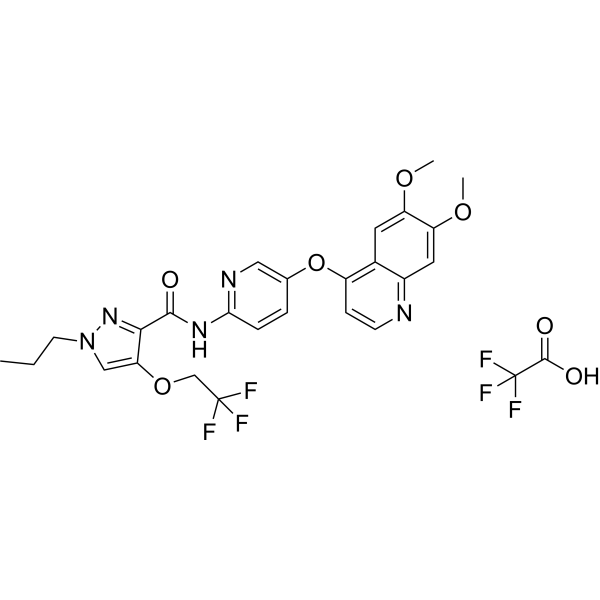 0 ImagesCat. No.: HY-152830APurity: 99.26%Synonyms: Q702 TFAAdrixetinib (Q702) TFA is an orally active triple inhibitor against CSF1R, Mer, and Axl, with Kd values of 8.7 nM, 0.8 nM, and 0.3 nM, respectively. Adrixetinib TFA acts as a potent immune modulator that remodels the tumor microenvironment. Adrixetinib TFA increases the abundance of M1 macrophages and CD8⁺ T cells, while decreasing the levels of M2 macrophages and myeloid-derived suppressor cells (MDSCs). Adrixetinib TFA upregulates the expression of MHC class I and E-cadherin in tumor cells. Adrixetinib TFA shows remarkable antitumor efficacy in syngeneic mouse tumor models. Adrixetinib TFA is suitable for the research of breast cancer, renal adenocarcinoma, colon carcinoma, and melanoma.

-
MC38 SLP Adpgk
 0 ImagesCat. No.: HY-P11060Synonyms: Adpgk peptideMC38 SLP Adpgk (Adpgk peptide) is an H-2 Kb-restricted colorectal cancer neoantigen peptide. MC38 SLP Adpgk is formulated into PCNP nanocomplexes together with CpG ODN. PCNP vaccines significantly enhance the co-delivery efficiency of neoantigens and adjuvants to lymphoid organs, and activate cytotoxic T cells. PCNP vaccines not only protect mice from MC-38 colorectal tumor invasion, but also exhibit anti-tumor efficacy in established colorectal tumor models and significantly prolong the survival of tumor-bearing mice.
-
KRAS G12V Peptide TFA
 0 ImagesCat. No.: HY-P11356AKRAS G12V Peptide TFA is a polypeptide and epitope derived from KRASG12V. KRAS G12V Peptide TFA forms a stable, high-affinity peptide-HLA class I complex, which is processed and presented by tumor cells and can be recognized by specific TCR. KRAS G12V Peptide TFA is applicable to research related to metastatic lung cancer.
-
KRAS G12V Peptide
 0 ImagesCat. No.: HY-P11356CAS No.: 1932689-39-8KRAS G12V Peptide is a polypeptide and epitope derived from KRASG12V. KRAS G12V Peptide forms a stable, high-affinity peptide-HLA class I complex, which is processed and presented by tumor cells and can be recognized by specific TCR. KRAS G12V Peptide is applicable to research related to metastatic lung cancer.
-
EBNA3B 399-408
 0 ImagesCat. No.: HY-P11713CAS No.: 179815-06-6
-
EBNA3 246-254
 0 ImagesCat. No.: HY-P11714CAS No.: 457881-09-3EBNA3 246-254 (RYSIFFDYM) is an EBV peptide. EBNA3 246-254 is submitted by HLA-A24. EBNA3 246-254 is amplified in vitro, followed by HLA multimer staining to measure EBV-specific CTLs. EBNA3 246-254 can be used for the research of lung cancer.
-
VMAPRTLFL
 0 ImagesCat. No.: HY-P11340CAS No.: 202657-61-2VMAPRTLFL is a 9-mer peptide derived from the signal peptide of HLA-G and can serve as a peptide ligand for HLA-E. VMAPRTLFL plays a crucial role in regulating the functions of adaptive natural killer (NK) cells. Specifically, VMAPRTLFL enriches FcεRγ- adaptive NK cells, upregulates the expression of CD25, and enhances their proliferative activity, antibody-dependent cellular cytotoxicity (ADCC), and IFN-γ release. VMAPRTLFL can be used in research related to human cytomegalovirus (HCMV) infection, transplant rejection, and pregnancy immunity.
-
CliMB-325
 0 ImagesCat. No.: HY-179211CliMB-325 is an HSP90 inhibitor that can induce MHC-I (EC50 = 498 nM) expression on the surface of CT26 murine colorectal cancer cells. CliMB-325 enhances T cell activation and exhibits lower toxicity. CliMB-325 can be used for the study of colorectal cancer.
- 1



