
12 Results for "

Potassium silicate

" in MedChemExpress (MCE) Product Catalog:
Products (12)

12 Results for "Potassium silicate" in MCE Product Catalog:

1
1 Cited Publications
Cat. No.: HY-B2205
CAS No.: 1343-88-0
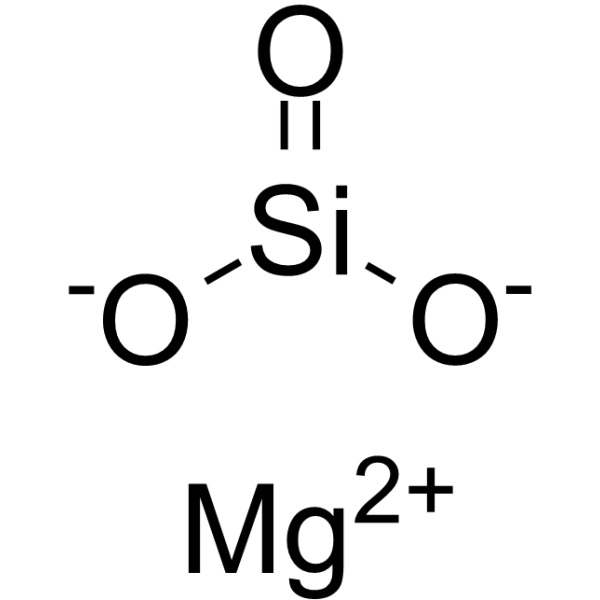
Synonyms: Activated magnesium silicate
Magnesium silicate (Activated magnesium silicate) is an orally active compound composed of magnesium oxide (MgO) and silicon dioxide (SiO2). Magnesium silicate can be used in the preparation of food additives, antacids and anti-ulcer agents. Magnesium silicate is also a piezoelectric biomaterial, deodorant, decolorizing agent and antifungal agent .
loading...
    loading...
Cat. No.: HY-119572
CAS No.: 17141-74-1
Purity:  ≥95.0%
Research Areas:  

Inflammation/Immunology

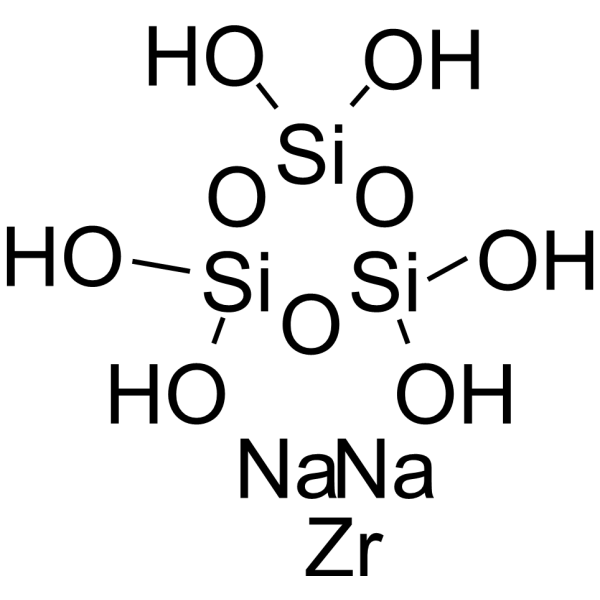
Sodium zirconium cyclosilicate is an orally administered, non-absorbed, novel, inorganic microporous zirconium silicate compound, is a highly selective cation exchanger that selectively removes excess K + in vivo. Sodium zirconium cyclosilicate can be used in research of chronic kidney disease (CKD) .
loading...
    loading...
Cat. No.: HY-W115789
CAS No.: 1344-09-8
Sodium silicate is a water-soluble silicate. Sodium silicate is widely used as a binder, particularly in the production of detergents, soaps, and cleaners. Sodium silicate promotes the deposition of suberin polyphenols and lignin at wound sites of potato tubers, accelerates callus structure formation, enhances ROS production, and induces the synthesis of total phenols and flavonoids. Sodium silicate reduces the weight loss rate and disease index of wounded potato tubers during storage .
loading...
    loading...
Cat. No.: HY-W094349A
CAS No.: 1344-95-2
Synonyms: Silicic acid, calcium salt
Calcium silicate, 99% (Silicic acid, calcium salt) is a kind of biological materials or organic compounds that are widely used in life science research .
loading...
    loading...
Cat. No.: HY-W024271
CAS No.: 63149-33-7
Synonyms: 9-Formyl-8-hydroxyjulolidine
8-Hydroxyjulolidine-9-carboxaldehyde (9-Formyl-8-hydroxyjulolidine) is a highly selective fluorescent probe for hydrogen sulfide (S 2−) and silicate (SiO3 2−). 8-Hydroxyjulolidine-9-carboxaldehyde operates via a mechanism of blocking intramolecular charge transfer (ICT), exhibiting significant fluorescence enhancement in the presence of weak acid ions. 8-Hydroxyjulolidine-9-carboxaldehyde is promising for research of fluorescence imaging of hydrogen sulfide within living cells .
loading...
    loading...
Cat. No.: HY-W773294
CAS No.: 53116-81-7
Synonyms: Tetramethylammonium silicate, 16-20% in water
Tetramethylammonium silicate solution is a salt solution formed by tetramethylammonium cations and silicate anions. Tetramethylammonium silicate solution can be used to prepare high-quality silicon dioxide films on substrates .
loading...
    loading...
Cat. No.: HY-20794
CAS No.: 41175-50-2
Target:  

Fluorescent Dye

Research Areas:  

Others

8-Hydroxyjulolidine is a chromophore moiety of a fluorescent probe for the detection of weak acid ions. 8-Hydroxyjulolidine can be used to synthesize the salicylaldehyde derivative 9-formyl-8-hydroxyjulolidine, which exhibits sensitive detection ability to pH changes of hydrogen sulfide and silicate in aqueous solution .
loading...
    loading...
Cat. No.: HY-154703
CAS No.: 12511-31-8
Research Areas:  

Others

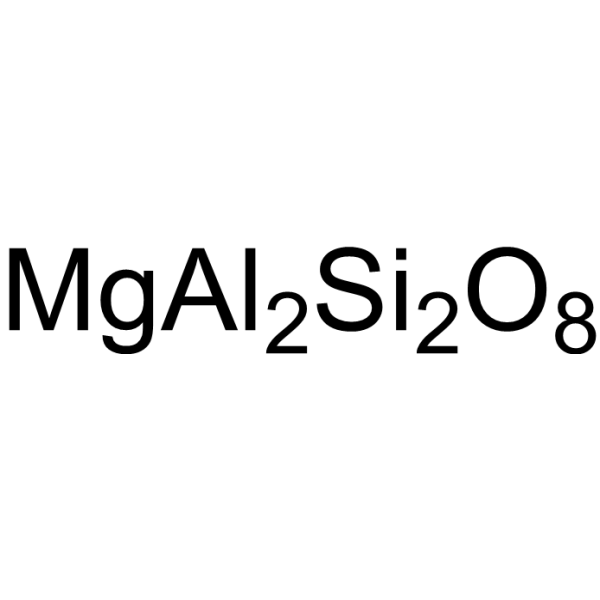
Aluminum magnesium silicate can be used as an excipient, such as adsorbent, stabilizer, suspending agent, disintegrant for tablet and capsule, binder for tablet, thickener. Pharmaceutical excipients, or pharmaceutical auxiliaries, refer to other chemical substances used in the pharmaceutical process other than pharmaceutical ingredients. Pharmaceutical excipients generally refer to inactive ingredients in pharmaceutical preparations, which can improve the stability, solubility and processability of pharmaceutical preparations. Pharmaceutical excipients also affect the absorption, distribution, metabolism, and elimination (ADME) processes of co-administered drugs .
loading...
    loading...
Cat. No.: HY-P2815
CAS No.: 37289-15-9
Research Areas:  

Others

Creatinine deiminase is a hydrolytic enzyme. Creatinine deiminase plays a crucial role in the conversion of the metabolic waste creatinine into creatine. Creatinine deiminase is a creatine bioanalytical tool. Creatinine deiminase can be used to construct a novel creatinine-sensitive biosensor when adsorbed on a silicate-modified pH-sensitive field-effect transistor (pH-FET) .
loading...
    loading...
Cat. No.: HY-B2143
CAS No.: 1318-93-0
Research Areas:  

Infection

Montmorillonite is a calcium-based 2:1 layered silicate clay mineral with excellent adsorption capacity, which can adsorb and immobilize a variety of substances, such as organic compounds, metal ions, and bacteria. Montmorillonite can serve as a nanoparticle carrier for research on functional nanocomposites for multiple scenarios, such as biomedical applications and food additives. Montmorillonite is also applicable to research related to wastewater treatment .
loading...
    loading...
Cat. No.: HY-W584165
CAS No.: 13983-17-0
Wollastonite is a white, chain-structured pyroxene silicate mineral with biocompatibility, biodegradability, osteogenicity and antibacterial properties. Wollastonite induces transient pulmonary inflammatory responses, reversible alveolar macrophage responses, early inflammatory/proliferative mesothelial cell responses, ROS production, and mild chronic pulmonary interstitial inflammation in rats. Wollastonite induces osteogenic differentiation, promotes bone growth, supports angiogenesis, and facilitates the formation of hydroxycarbonate apatite on its surface. Wollastonite enhances the strength, bioactivity and biodegradability of hydroxyapatite scaffolds, and is used to construct porous bone tissue engineering scaffolds. Wollastonite is applied in research related to diseases such as bronchitis, decreased lung function and bone defects .
loading...
    loading...
Cat. No.: HY-W094560
CAS No.: 1312-76-1
Research Areas:  

Infection

Potassium silicate acts as a silicon-containing foliar fertilizer and an inhibitor of rice blast. Foliar application of Potassium silicate to the susceptible rice cultivar 'Metica 1' reduces the incidence of rice blast caused by Pyricularia oryzae. Potassium silicate does not enhance silicon uptake or accumulation in rice plants. Potassium silicate can be used in studies related to rice blast .
loading...
    loading...
  • 1

