8 Results for "

Tubulin probe

" in MedChemExpress (MCE) Product Catalog:
Products (8)

8 Results for "Tubulin probe" in MCE Product Catalog:

Cat. No.: HY-135714
CAS No.: 2134109-20-7
Purity:  99.51%
Synonyms: EKZ-001
Research Areas:  

Neurological Disease Cancer

Bavarostat (EKZ-001) is a blood-brain barrier-permeable, potent HDAC6 inhibitor and PET radiotracer, with an IC50 as low as 17 nM against human HDAC6. Bavarostat can be labeled with 18F and used as a probe to map HDAC6 distribution and measure target occupancy in the brains of non-human primates. Bavarostat also selectively modulates tubulin acetylation, but not histone acetylation. Bavarostat is applicable for research on Alzheimer's disease, other neurodegenerative disorders, and cancers .
loading...
    loading...
Cat. No.: HY-129811
CAS No.: 65664-81-5
Purity:  98.20%
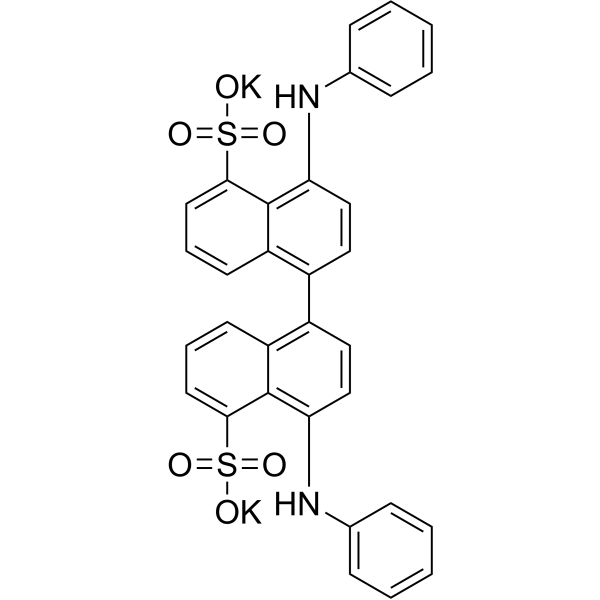
Bis-ANS dipotassium is a fluorescent probe of hydrophobic protein. Bis-ANS binds to tubulin with a Kd of 2 μM . Bis-ANS dipotassium is a potent biphasic modulator of protein liquid-liquid phase separation (LLPS). Bis-ANS dipotassium promotes LLPS at low concentrations but suppresses LLPS at high concentrations .
loading...
    loading...
Cat. No.: HY-169183
Target:  

Myosin

Research Areas:  

Others

Myokinasib-II is a MLCK1 inhibitor with an IC50 of 4.4 μM. Myokinasib-II induces cell cortex softening, impairs cell migration capacity, induces multinucleation, reduces cell stiffness, alters membrane tether dynamics, decreases actomyosin tension and changes nuclear morphology. Myokinasib-II is a MLCK1 chemical biology probe with a unique structure that does not depolymerize tubulin and maintains cell viability even under high-concentration treatment in fibroblasts .
loading...
    loading...
Cat. No.: HY-D2422B
Research Areas:  

Cancer

Cy5-Paclitaxel is a fluorescently labeled drug probe formed by conjugating the fluorescent dye Cy5 (Cyanine 5) with the chemotherapeutic agent Paclitaxel, which is used to track the cellular uptake, subcellular distribution and drug delivery process of Paclitaxel. The Cy5 (Cyanine 5) fluorophore is covalently linked to Paclitaxel, possessing both fluorescent tracing function and the biological activities of Paclitaxel (promoting tubulin polymerization and arresting the cell cycle at the G2/M phase); after entering cells, Cy5 emits far-red fluorescence, enabling real-time monitoring of drug localization and release .
loading...
    loading...
Cat. No.: HY-D2422C
Research Areas:  

Cancer

Cy5-Paclitaxel bromide is a fluorescently labeled drug probe formed by conjugating the fluorescent dye Cy5 (Cyanine 5) with the chemotherapeutic agent Paclitaxel, which is used to track the cellular uptake, subcellular distribution and drug delivery process of Paclitaxel. The Cy5 (Cyanine 5) fluorophore is covalently linked to Paclitaxel, possessing both fluorescent tracing function and the biological activities of Paclitaxel (promoting tubulin polymerization and arresting the cell cycle at the G2/M phase); after entering cells, Cy5 emits far-red fluorescence, enabling real-time monitoring of drug localization and release .
loading...
    loading...
Cat. No.: HY-KD1030

Tubulin Deep Red is a fluorescent probe with red fluorescence that can specifically label microtubules in living mammalian cells.

loading...
    loading...
Cat. No.: HY-D3306
Tubulin-RedTracker is a paclitaxel-derived fluorescent microtubule-binding probe. Tubulin-RedTracker induces F-actin cytoskeleton defects at relatively high concentrations. (Ex/Em=652/669) .
loading...
    loading...
Cat. No.: HY-D3153
CAS No.: 2693397-68-9
PbQ is a tubulin inhibitor (with an IC50 of 5 μM against goat tubulin) and a fluorescent probe for cuprous ions Cu (I). PbQ can penetrate the membrane of peripheral blood mononuclear cells, form a stable 1:1 complex with Cu + ions, and exhibits low toxicity and good biocompatibility toward macrophage cell lines. In addition, PbQ promotes tubulin degradation and disrupts the microtubule network in lung epithelial cells without affecting actin. PbQ also possesses genotoxicity by forming DNA base adducts, and it can activate caspase-3 and apoptosis-related genes, induce loss of mitochondrial membrane potential, and trigger cell apoptosis. PbQ can be used in studies related to chronic obstructive pulmonary disease .
loading...
    loading...

