13 Results for "

acylhydrazone

" in MedChemExpress (MCE) Product Catalog:
Products (13)

13 Results for "acylhydrazone" in MCE Product Catalog:

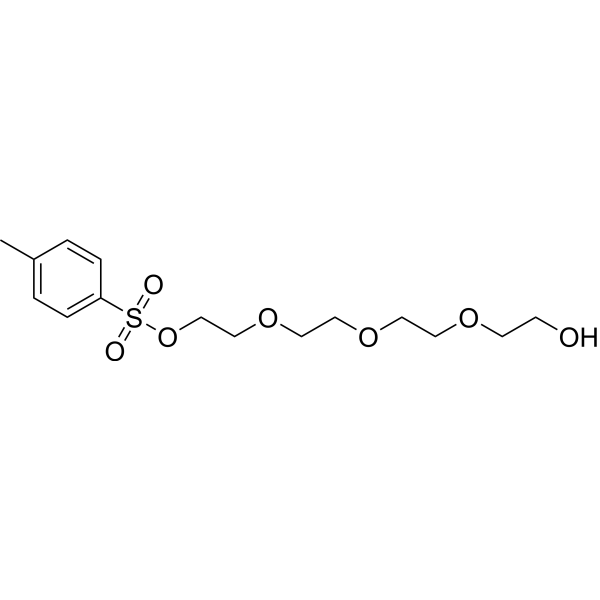
Cat. No.: HY-41541
CAS No.: 77544-60-6
Synonyms: Tos-PEG4
Research Areas:  

Cancer

Tetraethylene glycol monotosylate is a cleavable and acylhydrazone-based ADC linker used in the synthesis of antibody-drug conjugates (ADCs) . Tetraethylene glycol monotosylate also can be used as a PROTAC linker that can be used in the synthesis of PROTACs.
loading...
    loading...
Cat. No.: HY-177761
CAS No.: 3060504-66-4
Target:  

Molecular Glues

Research Areas:  

Cancer

GSPT1 degrader-15 (Compound Lib-B-15O) is a potent and highly selective GSPT1 molecular gel degrader, with a DC50 of 154 nM. GSPT1 degrader-15 has almost no effect on the expression of other proteins. GSPT1 degrader-15 exhibits significant anti-proliferative activity against leukemia cells and lymphoma cells. GSPT1 degrader-15 can be used in leukemia and lymphoma research .
loading...
    loading...
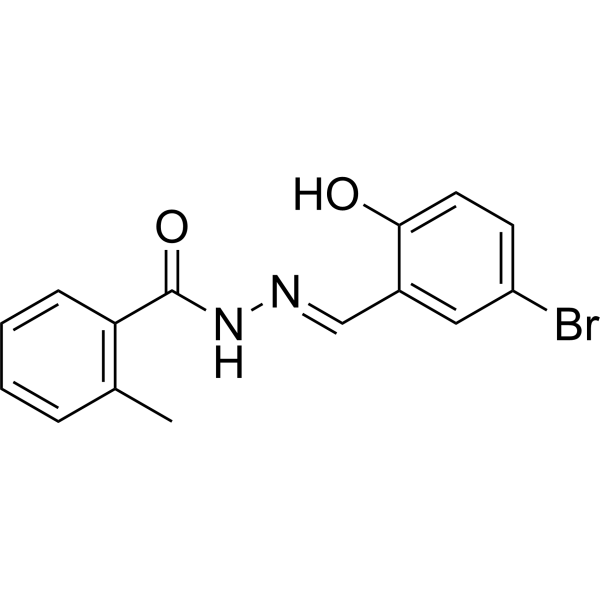
Cat. No.: HY-156195
CAS No.: 302807-84-7
Target:  

Fungal

Research Areas:  

Infection

BHBM (compound 1) is an aromatic acylhydrazone antifungal agent with high bactericidal activity against Cryptococcus neoformans .
loading...
    loading...
Cat. No.: HY-W514721
CAS No.: 321945-27-1
Target:  

Fungal

Research Areas:  

Infection Inflammation/Immunology

D13, an Acylhydrazones derivative, possesses antifungal activity. D13 is effective against murine sporotrichosis .
loading...
    loading...
Cat. No.: HY-179059
Research Areas:  

Infection

Anti-MRSA agent 40 (Compound 7-8) is a potent agent against Methicillin-resistant Staphylococcus aureus (MRSA). Anti-MRSA agent 40 exhibits significant antibacterial activity against MRSA2 and S. aureus ATCC 29213, with its MIC values being 1 μg/mL. Anti-MRSA agent 40 causes depolarization of the cell membrane, damages membrane integrity, and simultaneously increases the level of ROS within MRSA2, ultimately leading to cell lysis and death. Anti-MRSA agent 40 shows significant efficacy in the MRSA2 skin abscess model. Anti-MRSA agent 40 can be used for research on anti-MRSA infections .
loading...
    loading...
Cat. No.: HY-W1049075E
mPEG-pALD (MW 2000) is an important unilaterally active PEG derivative whose reactive groups can react with amines, peptides and the N-termini of proteins to form imines containing C=N double bonds, which can be further reduced. Polyethylene glycol aldehyde or ketone derivatives can be used for reversible PEGylation by reacting with hydrazine or hydrazine to form hydrolyzed acylhydrazone bonds .
loading...
    loading...
Cat. No.: HY-W1049075B
mPEG10000-Pald is an important unilaterally active PEG derivative whose reactive groups can react with amines, peptides and the N-termini of proteins to form imines containing C=N double bonds, which can be further reduced. Polyethylene glycol aldehyde or ketone derivatives can be used for reversible PEGylation by reacting with hydrazine or hydrazine to form hydrolyzed acylhydrazone bonds .
loading...
    loading...
Cat. No.: HY-W1049075D
mPEG40000-pALD is an important unilaterally active PEG derivative whose reactive groups can react with amines, peptides and the N-termini of proteins to form imines containing C=N double bonds, which can be further reduced. Polyethylene glycol aldehyde or ketone derivatives can be used for reversible PEGylation by reacting with hydrazine or hydrazine to form hydrolyzed acylhydrazone bonds .
loading...
    loading...
Cat. No.: HY-161617
CAS No.: 2549160-15-6
Research Areas:  

Cancer

LASSBio-2052 is a derivative of N-acylhydrazone with antitumor activity against hepatocellular carcinoma (HCC). LASSBio-2052 inhibits HCC cells HepG2 and Hep3B, with IC50 of 18 and 41 μM. LASSBio-2052 arrests the cell cycle at G2/M phase, through downregulation of FOXM1. LASSBio-2052 induces apoptosis in HCC cells .
loading...
    loading...
Cat. No.: HY-W1049075H
mPEG-pALD (MW 3400) is an important unilaterally active PEG derivative whose reactive groups can react with amines, peptides and the N-termini of proteins to form imines containing C=N double bonds, which can be further reduced. Polyethylene glycol aldehyde or ketone derivatives can be used for reversible PEGylation by reacting with hydrazine or hydrazine to form hydrolyzed acylhydrazone bonds .
loading...
    loading...
Cat. No.: HY-W1049075C
mPEG20000-pALD is an important unilaterally active PEG derivative whose reactive groups can react with amines, peptides and the N-termini of proteins to form imines containing C=N double bonds, which can be further reduced. Polyethylene glycol aldehyde or ketone derivatives can be used for reversible PEGylation by reacting with hydrazine or hydrazine to form hydrolyzed acylhydrazone bonds .
loading...
    loading...
Cat. No.: HY-W1049075
mPEG1000-pALD is an important unilaterally active PEG derivative whose reactive groups can react with amines, peptides and the N-termini of proteins to form imines containing C=N double bonds, which can be further reduced. Polyethylene glycol aldehyde or ketone derivatives can be used for reversible PEGylation by reacting with hydrazine or hydrazine to form hydrolyzed acylhydrazone bonds .
loading...
    loading...
Cat. No.: HY-W1049075A
mPEG5000-pALD is an important unilaterally active PEG derivative whose reactive groups can react with amines, peptides and the N-termini of proteins to form imines containing C=N double bonds, which can be further reduced. Polyethylene glycol aldehyde or ketone derivatives can be used for reversible PEGylation by reacting with hydrazine or hydrazine to form hydrolyzed acylhydrazone bonds .
loading...
    loading...
  • 1

