22 Results for "

boration

" in MedChemExpress (MCE) Product Catalog:
Products (22)

22 Results for "boration" in MCE Product Catalog:

Cat. No.: HY-W110927
CAS No.: 130-22-3
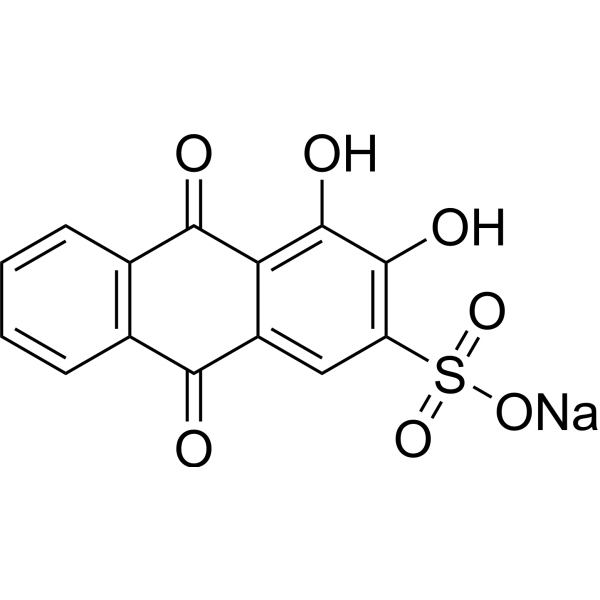
Alizarin red S indicator (C.I. 58005) is a reductively active (quinone-based) anthraquinone dye that forms complexes with metal ions (such as zirconium, calcium) or boric acid to label calcium deposition and perform electrochemical sensing functions. Alizarin Red S undergoes reversible redox reactions (for electrochemical detection) and irreversible chelation (for bone staining). Alizarin Red S is mainly used in bone metabolism research (labeling mineralized tissue), sugar detection (boric acid-sugar competition system) and metal ion sensing (such as zirconium ion detection), and can be used in osteoporosis and metabolic disease research .
loading...
    loading...
Cat. No.: HY-W008525
CAS No.: 1109-15-5
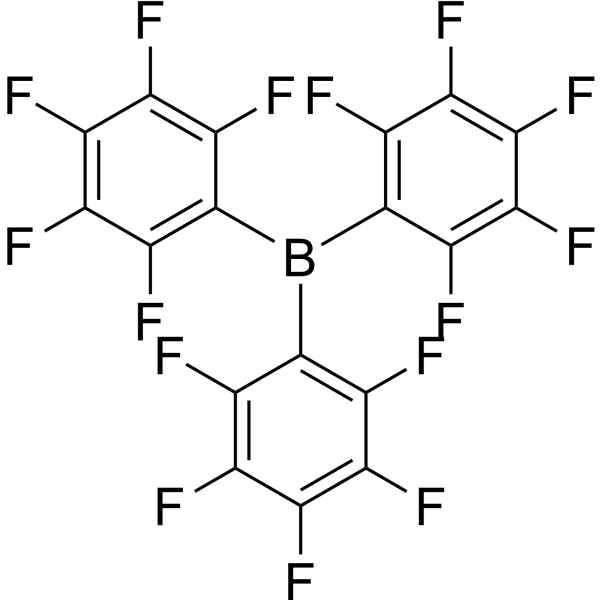
Tris (perfluorophenyl) borane is a biochemical reagent that can be used as a biomaterial or organic compound for life science-related research .
loading...
    loading...
Cat. No.: HY-W014815
CAS No.: 223463-14-7
Synonyms: 2-Bromopyridine-5-boronic acid
Research Areas:  

Others

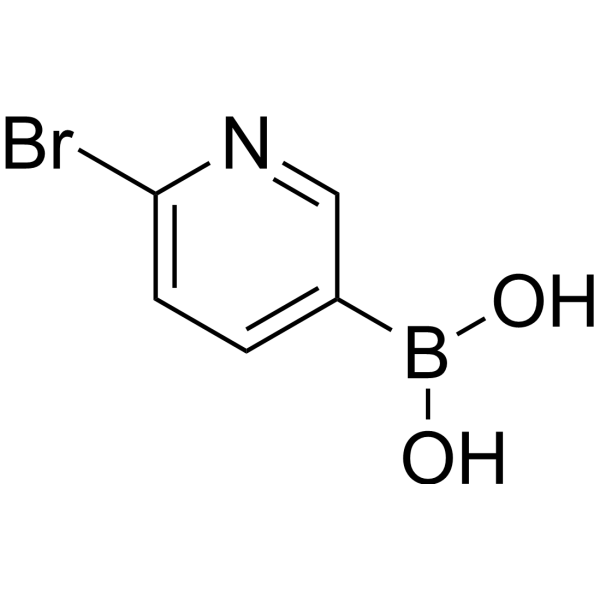
BPBA (2-Bromopyridine-5-boronic acid) is a derivatization reagent derived from Boric acid (HY-Y0314) with enhanced ionization efficiency in positive-mode electrospray ionization mass spectrometry. BPBA forms boronate ester derivatives with vicinal diols. It enables rapid, catalyst-free labeling operations, improves the detection sensitivity of liquid chromatography/mass spectrometry, and reduces false positive errors .
loading...
    loading...
Cat. No.: HY-34449
CAS No.: 13061-96-6
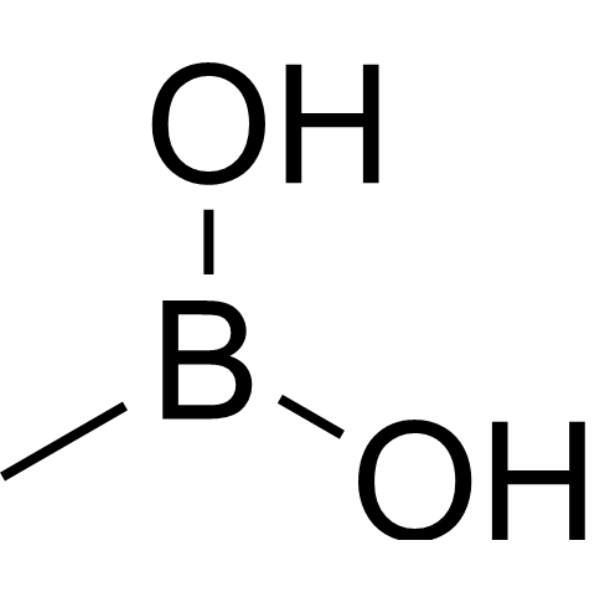
Methylboronic acid is a synthetic boric acid. Methylboronic acid alleviates boron deficiency symptoms in Arabidopsis thaliana and promotes the growth of taproots, lateral roots, root hairs and leaf surface area. Methylboronic acid is less toxic than boric acid at high concentrations, only causing a slight shortening of the taproot length in Arabidopsis thaliana without reducing the total chlorophyll content. Methylboronic acid can be used in studies related to boron deficiency in plants .
loading...
    loading...
Cat. No.: HY-W129975
CAS No.: 1303-86-2
Synonyms: Boron trioxide,99.98% trace metals basis
Boric anhydride,99.98% trace metals basis (Boron trioxide,99.98% trace metals basis) is a kind of biochemical reagent.
loading...
    loading...
Cat. No.: HY-34449S
CAS No.: 1332481-37-4
Methylboronic acid-d3 is the deuterated-labeled Methylboronic acid (HY-34449). Methylboronic acid is a synthetic boric acid. Methylboronic acid alleviates boron deficiency symptoms in Arabidopsis thaliana and promotes the growth of taproots, lateral roots, root hairs and leaf surface area. Methylboronic acid is less toxic than boric acid at high concentrations, only causing a slight shortening of the taproot length in Arabidopsis thaliana without reducing the total chlorophyll content. Methylboronic acid can be used in studies related to boron deficiency in plants .
loading...
    loading...
Cat. No.: HY-D2987
BacGO is a highly selective, wash free fluorescent probe for Gram positive bacteria. BacGO binds to the carbohydrate structure in peptidoglycan through boric acid and exhibits depolymerization induced luminescence (DIE) properties. BacGO can be used for imaging complex environmental samples (such as activated sludge) and flat plate bacteria without affecting bacterial activity .
loading...
    loading...
Cat. No.: HY-L167
165 compounds

Boric acid is a stable and usually non-toxic group widely used in modern synthesis to form C-C and C-heteroatom bonds. Boric acid exhibits exquisite reversible coordination characteristics and can be explored as a molecular construction tool, with specific mechanisms for controlling the structure and biological characteristics of bioconjugates. Boric acid has various activities, such as anticancer, antibacterial, and antiviral activities. In drugs, boric acid mainly exists in the form of arylboronic acid. In addition to this form, heterocycles containing boric acid, such as pyridine, pyrrole, and indole derivatives, are also very useful in pharmaceutical chemistry. Molecular modification by introducing boric acid groups into bioactive molecules has been shown to alter selectivity, physicochemical, and pharmacokinetic characteristics, and improve existing activity.

MCE designs a unique collection of 165 boronic acid compounds. It is a good tool to be used for research on cancer and other diseases.

Cat. No.: HY-182590
Boric Acid Buffer Solution, 0.05 M, pH 7.4 is a standard buffer solution, also known as borate buffer. It is mainly composed of boric acid and borax, with a pH of 7.4 and a final borate concentration of 0.05 M.
loading...
    loading...
Cat. No.: HY-182590A
Boric Acid Buffer Solution, 0.05 M, pH 7.6 is a standard buffer solution, also known as borate buffer. It is mainly composed of boric acid and borax, with a pH of 7.6 and a final borate concentration of 0.05 M.
loading...
    loading...
Cat. No.: HY-182590B
Boric Acid Buffer Solution, 0.05 M, pH 7.8 is a standard buffer solution, also known as borate buffer. It is mainly composed of boric acid and borax, with a pH of 7.8 and a final borate concentration of 0.05 M.
loading...
    loading...
Cat. No.: HY-182590C
Boric Acid Buffer Solution, 0.05 M, pH 8.0 is a standard buffer solution, also known as borate buffer. It is mainly composed of boric acid and borax, with a pH of 8.0 and a final borate concentration of 0.05 M.
loading...
    loading...
Cat. No.: HY-182590D
Boric Acid Buffer Solution, 0.05 M, pH 8.2 is a standard buffer solution, also known as borate buffer. It is mainly composed of boric acid and borax, with a pH of 8.2 and a final borate concentration of 0.05 M.
loading...
    loading...
Cat. No.: HY-182590E
Boric Acid Buffer Solution, 0.05 M, pH 8.4 is a standard buffer solution, also known as borate buffer. It is mainly composed of boric acid and borax, with a pH of 8.4 and a final borate concentration of 0.05 M.
loading...
    loading...
Cat. No.: HY-182590H
Boric Acid Buffer Solution, 0.05 M, pH 8.6 is a standard buffer solution, also known as borate buffer. It is mainly composed of boric acid and borax, with a pH of 8.6 and a final borate concentration of 0.05 M.
loading...
    loading...
Cat. No.: HY-182590I
Boric Acid Buffer Solution, 0.05 M, pH 8.8 is a standard buffer solution, also known as borate buffer. It is mainly composed of boric acid and borax, with a pH of 8.8 and a final borate concentration of 0.05 M.
loading...
    loading...
Cat. No.: HY-182590J
Boric Acid Buffer Solution, 0.05 M, pH 9.0 is a standard buffer solution, also known as borate buffer. It is mainly composed of boric acid and borax, with a pH of 9.0 and a final borate concentration of 0.05 M.
loading...
    loading...
Cat. No.: HY-182570
Sodium Borate Solution, 1 M, pH 8.0, is composed of boric acid and sodium hydroxide and is used to maintain a stable pH environment of around 8.0 in biochemical or molecular biology experiments.
loading...
    loading...
Cat. No.: HY-K1016

MCE TBE Powder (1 L of 1×) consists of Tris, Boric Acid and EDTA, and is widely used in agarose gel electrophoresis of nucleic acid. The 10 pouches are defined as the base specification. All larger sizes correspond to incremental volumes of this base.

loading...
    loading...
Cat. No.: HY-184600
Reactive oxygen species responsive hydrogels are a novel class of smart hydrogels, formed by the cross-linking of ROS-responsive modules through covalent, coordination, or supramolecular interactions. Due to the introduction of these ROS-responsive modules, these hydrogels exhibit a sensitive response to the oxidative stress microenvironment present in organisms. PVA-TSPBA hydrogel is a hydrogel formed by the cross-linking polymerization of polyvinyl alcohol (PVA) and the reactive oxygen species-sensitive cross-linking agent N1-(4-benzyl borate)-N3-(4-phenyl borate)N1,N1,N3,N3-tetramethyl-1,3-propanediamine (TSPBA). This hydrogel consists of two parts: a boric acid precursor (TSPBA) and an aqueous solution of PVA. The boric acid bonds on TSPBA and the hydroxyl groups on PVA rapidly cross-link to form borate ester bonds, thus forming the hydrogel.
loading...
    loading...

