7 Results for "

cellulose synthesis

" in MedChemExpress (MCE) Product Catalog:
Products (7)

7 Results for "cellulose synthesis" in MCE Product Catalog:

Cat. No.: HY-Y1078
CAS No.: 4637-24-5
Synonyms: N-Dimethoxymethyl-N,N-dimethylamine
Research Areas:  

Others

DMF-DMA (N-Dimethoxymethyl-N,N-dimethylamine) is a reagent with both condensation and alkylation functions. DMF-DMA can undergo condensation reactions with active methylene groups or amino groups to generate enamine and imino derivatives, and can also act as an alkylating agent to methylate nitrogen and oxygen atoms in heterocyclic structures. DMF-DMA is widely used in the synthesis of enaminones and dimethylamino imine intermediates, as well as in the construction of heterocyclic backbones such as pyridine, pyrimidine and pyrazole. DMF-DMA can also serve as a polar aprotic co-solvent; although DMF-DMA cannot dissolve cellulose alone, it can form an efficient cellulose dissolution system with diallylimidazolium methoxyacetate .
loading...
    loading...
Cat. No.: HY-D0980
CAS No.: 138529-46-1
Synonyms: Biotinyl-3,6-dioxaoctanediamine; EZ-Link Amine-PEO2-Biotin
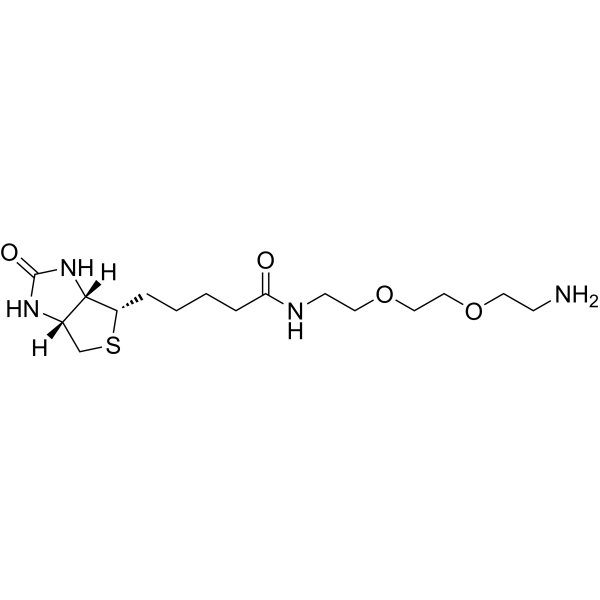
Biotin-DADOO (Biotinyl-3,6-dioxaoctanediamine; EZ-Link Amine-PEO2-Biotin) is a biotin-containing amine compound and a biotinylation reagent. As an amino component, Biotin-DADOO participates in the nucleophilic ring-opening reaction of epoxidized ω-double bonds during the synthesis of biotinylated inhibitor derivatives. Biotin-DADOO can be conjugated with carboxymethyl cellulose derivatives. Biotin-DADOO is involved in the synthesis of biotin-estradiol conjugates for enzyme immunoassays. Biotin-DADOO can be used in the research of influenza A .
loading...
    loading...
Cat. No.: HY-W744966
CAS No.: 374726-62-2
Research Areas:  

Infection

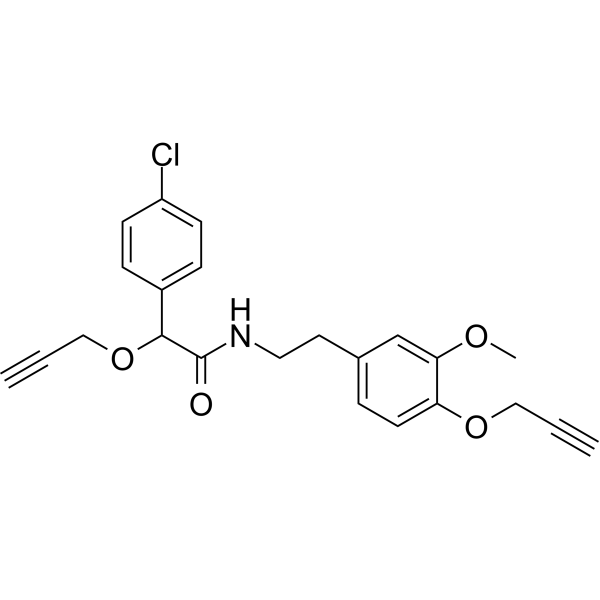
Mandipropamid is a cellulose synthase (CesA3) inhibitor and fungicide, with an IC50 of 19.8 nM against Phytophthora infestans. Mandipropamid inhibits the synthesis of crystalline cellulose on the cell surface, disrupts the cell wall structure of oomycetes, and induces germ tube tip swelling and growth arrest in Phytophthora infestans. S-Mandipropamid, an isomer of Mandipropamid, exhibits enantioselective acute toxicity to zebrafish embryos and larvae. Mandipropamid is applicable to studies related to plant infections .
loading...
    loading...
Cat. No.: HY-E70425
CAS No.: 9030-05-1
Target:  

Glycosyltransferase

Research Areas:  

Metabolic Disease

Sucrose synthase belongs to glycosyltransferases and is a reversible catalyst present in plants, which catalyzes the conversion of sucrose into fructose and UDP-G or ADP-G. Sucrose synthase localizes to the cytoplasm, plasma membrane, cell wall, vacuole and mitochondria of plants. Sucrose synthase regulates sugar metabolism, supports the development of taproots, fruits, seeds and vascular tissues, drives the synthesis of starch, cellulose and callose, and enhances nitrogen fixation capacity. Sucrose synthase mediates signal transduction in plant meristems. Sucrose synthase is associated with plant growth, anaerobic stress tolerance, as well as shoot apical meristem and leaf morphology; overexpression of this enzyme promotes plant growth, increases xylem size, and elevates cellulose and starch contents .
loading...
    loading...
Cat. No.: HY-W744966R
CAS No.: 374726-62-2
Research Areas:  

Infection

Mandipropamid (Standard) is the analytical standard of Mandipropamid (HY-W744966). This product is intended for research and analytical applications. Mandipropamid is a cellulose synthase (CesA3) inhibitor and fungicide, with an IC50 of 19.8 nM against Phytophthora infestans. Mandipropamid inhibits the synthesis of crystalline cellulose on the cell surface, disrupts the cell wall structure of oomycetes, and induces germ tube tip swelling and growth arrest in Phytophthora infestans. S-Mandipropamid, an isomer of Mandipropamid, exhibits enantioselective acute toxicity to zebrafish embryos and larvae. Mandipropamid is applicable to studies related to plant infections .
loading...
    loading...
Cat. No.: HY-E71366
Research Areas:  

Metabolic Disease

Endo-1,4-β-D-glucanase is a glycoside hydrolase that cleaves internal β-1,4-glycosidic bonds in cellulose and related β-D-glucans (β-D-Glucan) (HY-139413). Endo-1,4-β-D-glucanase randomly cuts long, insoluble cellulose polymer chains into shorter, soluble fragments such as oligosaccharides, thereby paving the way for further digestion into glucose .
loading...
    loading...
Cat. No.: HY-135721
CAS No.: 13304-62-6
Synonyms: Benzyl acrylamide
Research Areas:  

Others

N-Benzylacrylamide (Benzyl acrylamide) is a hydrophobic monomer. N-Benzylacrylamide can form hydrophobic microdomains that act as physical cross-linking sites to connect polymer chains to each other into a three-dimensional network; dynamically reversible hydrophobic interactions enable the spontaneous reformation of physical cross-linking sites after contact of fractured surfaces, thereby achieving autonomous self-healing. N-Benzylacrylamide can promote the synthesis of carboxymethyl cellulose-modified amphiphilic copolymers, and enhance the intermolecular association, viscoelasticity, thermal stability, as well as fire resistance/fire extinguishing performance of the resulting hydrogels .
loading...
    loading...

