33 Results for "

dioxin

" in MedChemExpress (MCE) Product Catalog:
Products (33)

33 Results for "dioxin" in MCE Product Catalog:

Cat. No.: HY-N2625A
CAS No.: 6028-07-5
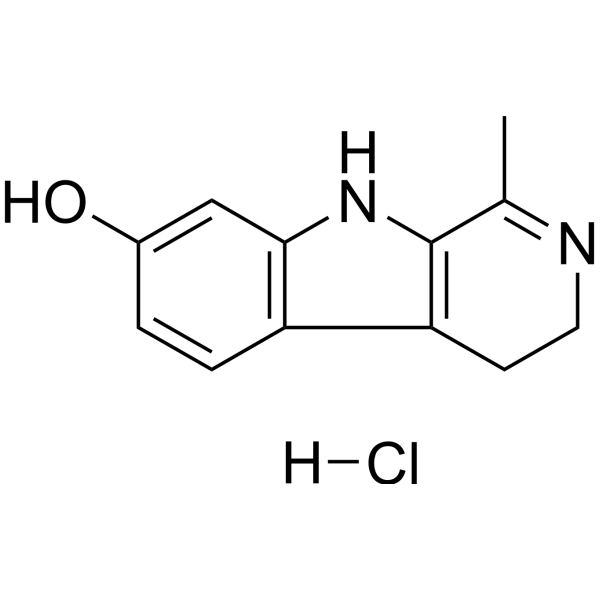
Harmalol hydrochloride, a beta carboline alkaloid, presents in several medicinal plants such as Peganum harmala. Harmalol hydrochloride, main metabolite of Harmaline, significantly inhibits the dioxin-mediated induction of CYP1A1 at the transcriptional and posttranslational levels. Harmalol hydrochloride possesses antioxidant and hydroxyl radical-scavenging properties .
Cat. No.: HY-W762012
CAS No.: 3268-87-9
Synonyms: OCDD
Research Areas:  

Others

Octachlorodibenzo-p-dioxin (OCDD) is an environmental contaminant but is not acutely toxic. In rats, Octachlorodibenzo-p-dioxin (50 μg/kg i.v. or 50-5000 μg/kg p.o.) has a systemic elimination half-life of 3-5 months and accumulates and concentrates in the liver and adipose tissue after low-dose, repeated exposure. Repeated administration of octachlorodibenzo-p-dioxin causes increases in 7-ethoxyresorufin-O-deethylase (7-EROD) activity and total cytochrome P-450 levels .
Cat. No.: HY-B2187
CAS No.: 83-63-6
Synonyms: Diacetotoluide
Target:  

Cytochrome P450

Research Areas:  

Metabolic Disease

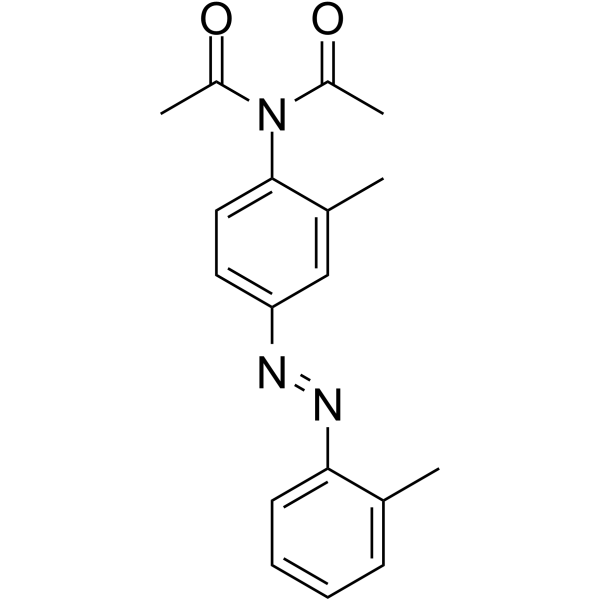
Diacetazotol inhibits dioxin-induced ethoxyresorufin-O-deethylase (EROD) activity with IC50 of 75±4 nM. Diacetazotol extracts from patent US20070032458, compound 3.
Cat. No.: HY-W094748S1
CAS No.: 125749-32-8
Dibenzo-p-dioxin- 13C12 is 13C labeled Dibenzo[b,e][1,4]dioxin .
Cat. No.: HY-W762012S
CAS No.: 114423-97-1
Synonyms: OCDD-13C12
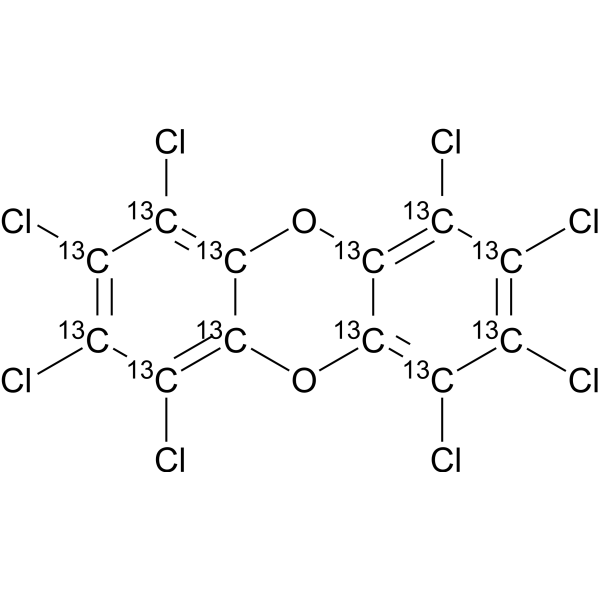
Octachlorodibenzo-p-dioxin- 13C12 is Octachlorodibenzo-p-dioxin- 13 C-labeled octachlorodibenzo-p-dioxin- 13C. Octachlorodibenzo-p-dioxin is a widespread environmental pollutant .
Cat. No.: HY-W748204
CAS No.: 109719-79-1
1,2,3,7,8-Pentachloro dibenzo-p-dioxin- 13C12 is 13C labeled 1,2,3,7,8-Pentachlorodibenzo-p-dioxin. 1,2,3,7,8-Pentachlorodibenzo-p-dioxin is a biochemical reagent .
Cat. No.: HY-W748196S
CAS No.: 910107-83-4
1,2,3,4,6,7-Hexachloro dibenzo-p-dioxin- 13C12 is 13C labeled 1, 2, 3, 4, 6, 7- Hexachlorodibenzo- p- dioxin .
Cat. No.: HY-W762019
CAS No.: 39227-28-6
Synonyms: 1,2,3,4,7,8-HxCDD
Research Areas:  

Metabolic Disease

1,2,3,4,7,8-Hexachlorodibenzo-p-dioxin is a polychlorinated dibenzo-p-dioxin (PCDD) congener. 1,2,3,4,7,8-Hexachlorodibenzo-p-dioxin can cause pale (fatty) livers, gastrointestinal hemorrhage and early death in H/W and line A rats at the highest dose (10,000 μg/kg). 1,2,3,4,7,8-Hexachlorodibenzo-p-dioxin also induces sinusoidal distension, and even severe peliosis in line B .
Cat. No.: HY-169475
CAS No.: 19408-74-3
Synonyms: 1,2,3,7,8,9-HxCDD
Research Areas:  

Cancer

1,2,3,7,8,9-Hexachlorodibenzo-p-dioxin (1,2,3,7,8,9-HxCDD) is a polychlorinated dibenzodioxin. 1,2,3,7,8,9-Hexachlorodibenzo-p-dioxin combined with 1,2,3,6,7,8-hexachlorodibenzo-p-dioxin induces the formation of liver adenomas or carcinomas in rats .
Cat. No.: HY-W727522
CAS No.: 40321-76-4
Synonyms: PCDD 54; 1,2,3,7,8-PeCDD
Research Areas:  

Others

1,2,3,7,8-Pentachlorodibenzo-p-dioxin is a biochemical reagent.
Cat. No.: HY-W715121S
CAS No.: 125749-35-1
2,3,7,8-Tetrabromo dibenzo-p-dioxin- 13C12 is 13C labeled 2,3,7,8-Tetrabromodibenzo[b,E][1,4]dioxine .
Cat. No.: HY-W715180S
CAS No.: 176761-26-5
2,3-Dibromo-7,8-dichloro dibenzo-p-dioxin- 13C12 is 13C labeled 2,3-Dibromo-7,8-dichlorodibenzo[b,E][1,4]dioxine .
Cat. No.: HY-W517076S
CAS No.: 109719-81-5
1,2,3,6,7,8-Hexachloro dibenzo-p-dioxin- 13C12 is 13C labeled 1,2,3,6,7,8-Hexachlorodibenzo[b,e][1,4]dioxine .
Cat. No.: HY-W762019S
CAS No.: 109719-80-4
Synonyms: 1,2,3,4,7,8-HxCDD-13C12
1,2,3,4,7,8-Hexachloro dibenzo-p-dioxin- 13C12 (1,2,3,4,7,8-HxCDD- 13C12) is 13C labeled 1,2,3,4,7,8-Hexachlorodibenzo-p-dioxin .
Cat. No.: HY-N2625AR
CAS No.: 6028-07-5
Harmalol (hydrochloride) (Standard) is the analytical standard of Harmalol (hydrochloride). This product is intended for research and analytical applications. Harmalol hydrochloride, a beta carboline alkaloid, presents in several medicinal plants such as Peganum harmala. Harmalol hydrochloride, main metabolite of Harmaline, significantly inhibits the dioxin-mediated induction of CYP1A1 at the transcriptional and posttranslational levels. Harmalol hydrochloride possesses antioxidant and hydroxyl radical-scavenging properties .
Cat. No.: HY-W1006349
CAS No.: 67562-39-4
Synonyms: 1,2,3,4,6,7,8-HpCDF
Target:  

Drug Metabolite

Research Areas:  

Others

1,2,3,4,6,7,8-Heptachlorodibenzofuran (1,2,3,4,6,7,8-HpCDF) is a dioxin-like polychlorinated dibenzofuran (PCDF). 1,2,3,4,6,7,8-Heptachlorodibenzofuran has been found in the soil near municipal waste incinerators, in freshwater fish, and in human breastmilk .
Cat. No.: HY-W762018
CAS No.: 60851-34-5
Synonyms: 2,3,4,6,7,8-HxCDF
Target:  

Cytochrome P450

Research Areas:  

Infection Cancer

2,3,4,6,7,8-Hexachlorodibenzofuran (2,3,4,6,7,8-HxCDF) is a dioxin-like polychlorinated dibenzofuran (PCDF). 2,3,4,6,7,8-Hexachlorodibenzofuran induces expression of the genes encoding aryl hydrocarbon hydroxylase (AHH) and ethoxyresorufin-O-deethylase (EROD) in H-4-II-E rat hepatoma cells (EC50s = 0.687 and 0.575 nM, respectively) .
Cat. No.: HY-W762015
CAS No.: 57117-44-9
Synonyms: 1,2,3,6,7,8-HxCDF
Target:  

Cytochrome P450

Research Areas:  

Cancer

1,2,3,6,7,8-Hexachlorodibenzofuran (1,2,3,6,7,8-HxCDF) is a dioxin-like polychlorinated dibenzofuran (PCDF). 1,2,3,6,7,8-Hexachlorodibenzofuran induces expression of the genes encoding aryl hydrocarbon hydroxylase (AHH) and ethoxyresorufin-O-deethylase (EROD) in H-4-II-E rat hepatoma cells (EC50s = 1.47 and 1.24 nM, respectively). 1,2,3,6,7,8-Hexachlorodibenzofuran reduces weight, induces thymic atrophy, and induces the expression of genes encoding the cytochrome P450 (CYP) isoform CYP1A1 and 4-chlorobiphenyl hydroxylase in rats (EC50s = 3.2, 0.9, 0.35, and 0.21 µmol/kg, respectively) .
Cat. No.: HY-W094748S
CAS No.: 69699-83-8
Dibenzo[b,e][1,4]dioxin-d8 is the deuterium labeled Dibenzo[b,e][1,4]dioxin .
Cat. No.: HY-W094748
CAS No.: 262-12-4
Target:  

Drug Intermediate

Research Areas:  

Others

Dibenzo-p-dioxin is an organic compound which can be metabolized by Sphingomonas wittichii RW1 .

