

14 Results for "

human neoplasms

" in MedChemExpress (MCE) Product Catalog:
Products (14)

14 Results for "human neoplasms" in MCE Product Catalog:

Cat. No.: HY-P99234
CAS No.: 2234335-84-1

Research Areas:  

Cancer

Pivekimab is a human IgG1 monoclonal antibody that targets interleukin-3 (IL-3) and CD123. Pivekimab is used to synthesize pivekimab sunirine, a CD123-directed antibody-active molecule conjugate (ADC). Pivekimab is used in the study of blastic plasmacytoid dendritic cell neoplasm (BPDCN) .
loading...
    loading...
Cat. No.: HY-12854
CAS No.: 868169-64-6
Purity:  99.43%
Synonyms: GRN163L
Target:  

Telomerase Apoptosis

Research Areas:  

Cardiovascular Disease Cancer

Imetelstat (GRN163L) is a 13-mer oligonucleotide and competitive Telomerase inhibitor. Imetelstat binds with high affinity to the template region of the RNA component of human telomerase. Imetelstat induces Apoptosis. Imetelstat is capable of selectively eliminating myelofibrosis hematopoietic stem cells. Imetelstat leads to the loss of a cancer cell's ability to maintain telomere length, resulting in the inhibition of cell proliferation .
loading...
    loading...
Cat. No.: HY-N0891
CAS No.: 115810-12-3
Synonyms: Tubeimoside-B
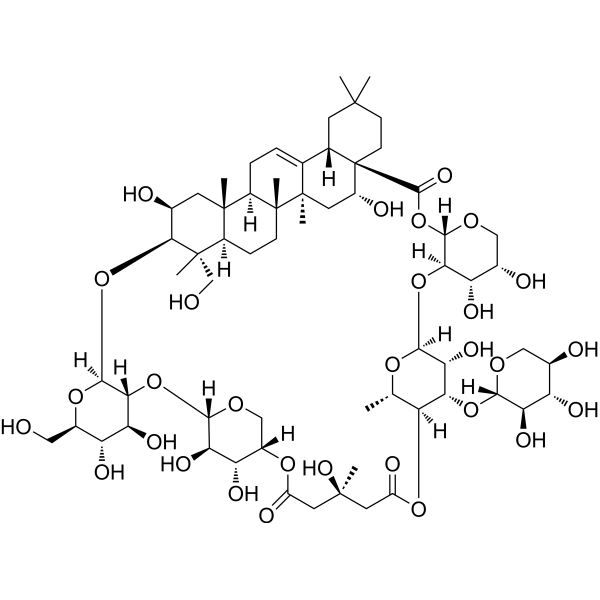
Tubeimoside II is an orally active triterpenoid saponin and antiviral agent that binds to PACT/PRKRA with Kd values of 5.37 μM and 133.1 μM, respectively. Tubeimoside II inhibits oxidase-dependent EGFR activation and reduces TGF-β1-induced oxidative stress. Tubeimoside II activates the RIG-I signaling pathway and increases IFN-β secretion. Tubeimoside II suppresses TPA-induced ear edema, mouse sarcoma 180 growth, and TPA-induced skin tumor formation. Tubeimoside II exerts broad-spectrum antiviral activity against SARS-CoV-2, HCoV-OC43, and IAV-H1N1/FM1. Tubeimoside II can be used in research related to retinoblastoma, respiratory viral infections, skin tumors, and sarcoma 180 .
loading...
    loading...
Cat. No.: HY-P9972
CAS No.: 1935694-88-4
Synonyms: PDR001

Target:  

PD-1/PD-L1 IFNAR

Research Areas:  

Cancer

Spartalizumab is a humanized PD-1 IgG4 monoclonal antibody, with a Kd of 0.83 nM for human PD-1 and a Kd of 0.93 nM for cynomolgus monkey PD-1. Spartalizumab binds to PD-1 and blocks its interaction with the ligands PD-L1 and PD-L2. Spartalizumab induces increased IFNγ release. Spartalizumab can be used in the research of anaplastic thyroid carcinoma (ATC) and neuroendocrine neoplasms (NENs) .
loading...
    loading...
Cat. No.: HY-174428
Target:  

PROTACs JAK STAT Apoptosis

Research Areas:  

Cancer

PROTAC JAK2 degrader-1 is a JAK2 PROTAC degrader, with a DC50 of 27.35 nM. PROTAC JAK2 degrader-1 induces JAK2 degradation via the ubiquitin-proteasome pathway. PROTAC JAK2 degrader-1 inhibits the JAK2-STAT signaling pathway. PROTAC JAK2 degrader-1 induces G2/M phase arrest and apoptosis in cancer cells. PROTAC JAK2 degrader-1 exhibits antiproliferative activity against cancer cells. PROTAC JAK2 degrader-1 inhibits recombinant human erythropoietin (rhEPO)-mediated polycythemia and splenomegaly in mice. PROTAC JAK2 degrader-1 can be used for research on myeloproliferative neoplasms, including polycythemia vera .
loading...
    loading...
Cat. No.: HY-W096169D
CAS No.: 7440-06-4
Platinum is a metallic element, and its complexes act as orally active anticancer agents. Platinum-based complexes used for tumors include Cisplatin (HY-17394), Carboplatin (HY-17393), and Oxaliplatin (HY-17371) .
loading...
    loading...
Cat. No.: HY-155746
CAS No.: 2568842-26-0
Target:  

JAK STAT Akt Apoptosis

Research Areas:  

Cancer

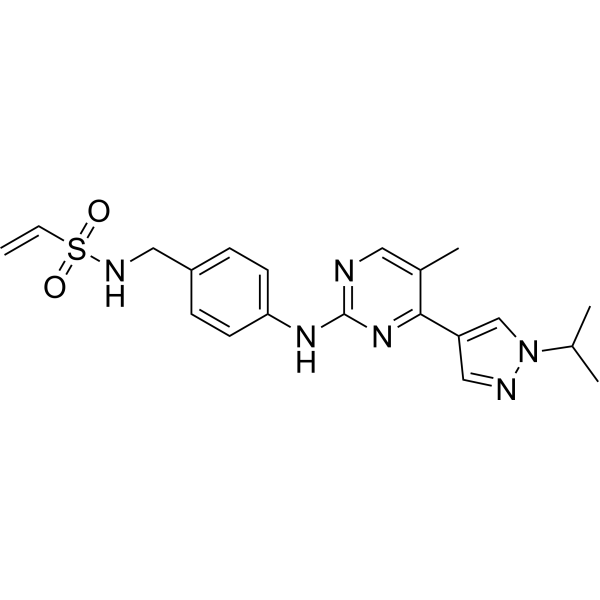
JAK2-IN-9 is an orally active selective JAK2 inhibitor with a human IC50 of 5 nM. JAK2-IN-9 inhibits JAK2 kinase activity, blocks JAK2 phosphorylation, and suppresses the activation of the downstream JAK2-STAT signaling pathway. JAK2-IN-9 inhibits the phosphorylation of STAT3, STAT5 and AKT in cancer cells. JAK2-IN-9 induces cancer cell apoptosis (apoptosis) and cell cycle arrest. JAK2-IN-9 can be used for the research of myeloproliferative neoplasms .
loading...
    loading...
Cat. No.: HY-N0891R
CAS No.: 115810-12-3
Synonyms: Tubeimoside-B (Standard)
Tubeimoside II (Standard) (Tubeimoside-B (Standard)) is the analytical standard of Tubeimoside II (HY-N0891). This product is intended for research and analytical applications. Tubeimoside II is an orally active triterpenoid saponin and antiviral agent that binds to PACT/PRKRA with Kd values of 5.37 μM and 133.1 μM, respectively. Tubeimoside II inhibits oxidase-dependent EGFR activation and reduces TGF-β1-induced oxidative stress. Tubeimoside II activates the RIG-I signaling pathway and increases IFN-β secretion. Tubeimoside II suppresses TPA-induced ear edema, mouse sarcoma 180 growth, and TPA-induced skin tumor formation. Tubeimoside II exerts broad-spectrum antiviral activity against SARS-CoV-2, HCoV-OC43, and IAV-H1N1/FM1. Tubeimoside II can be used in research related to retinoblastoma, respiratory viral infections, skin tumors, and sarcoma 180 .
loading...
    loading...
Cat. No.: HY-K6125

MCE Human Neuroendocrine Neoplasm Organoid Kit includes a basic culture medium for Neuroendocrine Neoplasm organoids, as well as culture supplements, and is designed for the effective construction of human Neuroendocrine Neoplasm organoids.

loading...
    loading...
Cat. No.: HY-P991888

Target:  

STAT

Research Areas:  

Cardiovascular Disease Cancer

INCA033989 is a fully human IgG1 monoclonal antibody targeting mutCALR (KD = 1.75 nM for mutCALR del52; KD = 6.78 nM for mutCALR ins5). INCA033989 antagonizes mutCALR-driven signaling and proliferation. INCA033989 selectively inhibits pSTAT3/pSTAT5. INCA033989 prevents thrombocytosis and reduces the expansion of mutCALR-positive cells. INCA033989 is useful for research on myeloproliferative neoplasms .
loading...
    loading...
Cat. No.: HY-115541
CAS No.: 1877286-69-5
BRD4-IN-41 is a BRD4 inhibitor with an IC50 of 34 nM. BRD4-IN-41 also inhibits JAK2, FLT3, RET, ROS1, NTRK3, PDGFRb, and FGFR1 kinases with IC50 values ranging from 0.9 nM to 43 nM. BRD4-IN-41 inhibits acetyl-lysine binding site of BRD4, downregulates c-MYC, reduces phosphorylated STAT3 levels, induces G1 cell cycle arrest and apoptosis, thereby inhibiting cancer cells growth. BRD4-IN-41 can be used for the research of cancer, such as multiple myeloma and acute myeloid leukemia .
loading...
    loading...
Cat. No.: HY-L025
11,167 compounds

Cancer is the second leading cause of death globally and seriously threatens human health. A neoplasm and malignant tumor are other common names for cancer. Disruption of the normal regulation of cell-cycle progression and division lies at the heart of the events leading to cancer. Target therapy, which targets proteins that control how cancer cells grow, divide and spread, plays an important role in cancer treatment. Recent studies mainly focus on targeting the key proteins for cancer surviving, cancer stem cells, the tumor microenvironment, tumor immunology, etc.

MCE designs a unique collection of 11,167 anti-cancer compounds that target kinases, cell cycle key components, tumorigenesis related signaling pathways, etc. MCE Anti-cancer compound library is a useful tool for anti-cancer drug screening.

Cat. No.: HY-P2997B
CAS No.: 9046-27-9
γ-glutamyltransferase, Human participates in glutathione metabolism. Serum γ-glutamyltransferase activity is identified as a predictor of atherosclerotic complications, and has prognostic value for cardiovascular diseases and stroke. γ-glutamyltransferase also serves as a biomarker for carcinogenesis and tumor progression .
loading...
    loading...
Cat. No.: HY-184103
CAS No.: 378230-75-2
Synonyms: Ethylenedicysteine deoxyglucose
ECDG is a small-molecule compound dependent on α-ketoglutarate/Fe 2+ that participates in the biosynthesis of echinocandins. ECDG is involved in the targeted transport of glucose, and can be used for PET imaging after labeling with radioactive atoms. ECDG increases blood glucose levels in rats, undergoes cellular uptake mediated by D-glucose, localizes in ischemic viable myocardial tissue, and accumulates in the synovial space of rheumatoid arthritis. ECDG can be used in research related to candidiasis, glucose metabolism disorders, fungal infections, myocardial ischemia and rheumatoid arthritis .
loading...
    loading...
  • 1

