

Search Result
Results for "
immunoprecipitation
" in MedChemExpress (MCE) Product Catalog:
1
Biochemical Assay Reagents
| Cat. No. |
Product Name |
Target |
Research Areas |
Chemical Structure |
-
- HY-Y0649D
-
|
|
Environmental Pollutants
Biochemical Assay Reagents
|
Others
|
|
Lithium chloride, for molecular biology, 99% can be used in the preparation of wash buffers for chromatin immunoprecipitation. Lithium chloride, for molecular biology, 99% is a kind of biological materials or organic compounds that are widely used in life science research .
|
-
-
- HY-W123005
-
|
|
Biochemical Assay Reagents
|
Others
|
|
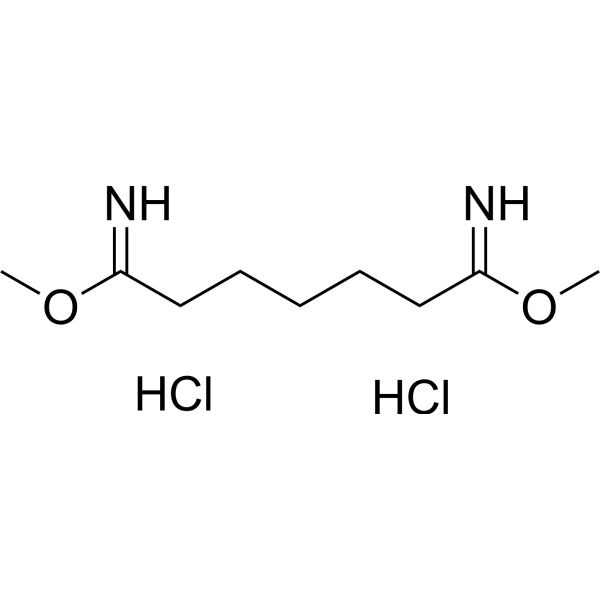
Dimethyl pimelimidate dihydrochloride is a bifunctional imidoester protein-protein crosslinker used in chromatin immunoprecipitation (ChIP) assays .
|
-
-
- HY-P990301
-
|
|
Amyloid-β
|
Neurological Disease
|
|
Anti-Human/Mouse/Rat Amyloid-beta Antibody (MOAB-2) is a mouse-derived IgG2b λ type antibody inhibitor, targeting to Amyloid-beta. Anti-Human/Mouse/Rat Amyloid-beta Antibody (MOAB-2) recognizes unaggregated, oligomeric or fibrillar forms of Aβ42 and unaggregated Aβ40. Anti-Human/Mouse/Rat Amyloid-beta Antibody (MOAB-2) is selective for human Aβ42 over Aβ40, but not amyloid precursor protein (APP). Anti-Human/Mouse/Rat Amyloid-beta Antibody (MOAB-2) can immunostain human or rat and mouse tissue. Anti-Human/Mouse/Rat Amyloid-beta Antibody (MOAB-2) can be used for detections of western blot, immunohistochemistry, immunofluorescence, immunoprecipitation and ELISA .
|
-
-
- HY-P990198
-
|
|
Galectin
|
Inflammation/Immunology
|
|
Anti-Mouse/Human Mac-2/Galectin-3 Antibody (TIB-166) is a rat-derived anti-mouse/human Mac-2/Galectin-3 IgG2a monoclonal antibody. Anti-Mouse/Human Mac-2/Galectin-3 Antibody (TIB-166) significantly inhibits IL-6 expression (inhibition rates 34.7% and 55.3%). Anti-Mouse/Human Mac-2/Galectin-3 Antibody (TIB-166) is often used for immunoprecipitation, western blot, immunofluorescence, and flow cytometry .
|
-
-
- HY-P11345
-
|
|
Biochemical Assay Reagents
|
Others
|
|
VPS35 c-terminal peptide is a peptide that can bind to VPS35. VPS35 c-terminal peptide can be used in immunoprecipitation experiments to specifically elute VPS35 and its interacting proteins, facilitating the identification of VPS35-interacting molecules .
|
-
-
- HY-P10403
-
|
|
IGF-1R
|
Inflammation/Immunology
Cancer
|
|
IGFBP-3 peptide is a 18-amino acid insulin-like growth factor binding protein-3. IGFBP-3 peptide binds Humanin (HY-P1928) and Hyaluronan (HY-B0633A), blocks the interaction of CD44 and hyaluronan .
|
-
-
- HY-P990850
-
|
|
c-Myc
|
Cancer
|
|
Anti-c-myc Antibody (9E10) is a kind of mouse IgG1 chimeric antibody, targeting to human c-myc. Anti-c-myc Antibody (9E10) reacts with human c-myc, which is over-expressing in several types of human cancers including lung, breast and colon carcinomas. Anti-c-myc Antibody (9E10) can be can be used for the detections of western blot, ELISA, immunoprecipitation and flow cytometry .
|
-
-
- HY-P990140
-
|
|
MHC
|
Inflammation/Immunology
|
|
Anti-Rat β-2-Microglobulin Antibody (4C9) is an anti-rat β-2-Microglobulin IgG1 monoclonal antibody. Anti-Rat β-2-Microglobulin Antibody (4C9) reduces pJNK nuclear translocation and restore SMAD nuclear localization. Anti-Rat β-2-Microglobulin Antibody (4C9) is often used in immunoprecipitation experiments .
|
-
-
- HY-P990146
-
|
|
Ras
|
Inflammation/Immunology
|
|
Anti-Mouse/Rat/Human v-H-Ras Antibody (Y13-238) is an anti-mouse/rat/human v-H-Ras IgG2a monoclonal antibody. Anti-Mouse/Rat/Human v-H-Ras Antibody (Y13-238) can be used as a control antibody. Anti-Mouse/Rat/Human v-H-Ras Antibody (Y13-238) is often used for immunofluorescence and immunoprecipitation .
|
-
-
- HY-P990239
-
|
|
HSP
Akt
Interleukin Related
|
Inflammation/Immunology
Cancer
|
|
Anti-Human/Mouse GRP78 Antibody (N88) is an anti-human/mouse GRP78 IgG1 monoclonal antibody. Anti-Human/Mouse GRP78 Antibody (N88) can activate the Akt signaling pathway. Anti-Human/Mouse GRP78 Antibody (N88) can inhibit the expression of inflammatory factors and plasminogen activator inhibitors induced by TLR agonists. Anti-Human/Mouse GRP78 Antibody (N88) can be used for research on inflammation conditions. Anti-Human/Mouse GRP78 Antibody (N88) can be used for immunoprecipitation .
|
-
-
- HY-P990232
-
|
|
IFNAR
|
Others
|
|
Anti-Mouse IFNγRα/CD119 Antibody (2E2) is an Armenian hamster-derived IgG type antibody inhibitor, targeting to mouse IFNγRα/CD119. Anti-Mouse IFNγRα/CD119 Antibody (2E2) reacts with the mouse IFNγR (interferon gamma receptor) α chain also known as CD119 and IFNγ receptor 1. Anti-Mouse IFNγRα/CD119 Antibody (2E2) is a non-neutralizing antibody and does not block the binding of IFNγ to the receptor. Anti-Mouse IFNγRα/CD119 Antibody (2E2) can be used for detections of western blot, flow cytometry and immunoprecipitation .
|
-
-
- HY-P990873
-
|
|
DNA/RNA Synthesis
|
Cancer
|
|
Anti-BRCA1 Antibody (BR64) is a kind of mouse IgG1 κ chimeric antibody, targeting to human BRCA1. Anti-BRCA1 Antibody (BR64) reacts with BRCA1 (Breast cancer susceptibility gene 1) involved in tumor suppression, transcription, genomic stability, DNA repair and recombination. Anti-BRCA1 Antibody (BR64) can be used for the detections of immunofluorescence, western blot, and immunoprecipitation in cancer, such as breast and ovarian cancer .
|
-
-
- HY-D1870
-
|
|
Fluorescent Dye
|
Others
|
|
Sulfo-Cy3-PEG3-biotin potassium is a biotin-modified derivative of Cy3 (Cyanine3) (HY-D0822) dye containing a TCO group. The TCO group of Sulfo-Cy3-PEG3-biotin potassium reacts with the tetrazine functional group in highly specific click chemistry to form a covalent bond. Thus, Sulfo-Cy3-PEG3-biotin potassium can be covalently bound to some biomolecules (especially antibodies, proteins, etc.) to track their location and dynamic changes in biological samples. And because it is labeled with biotin, it is often used in affinity chromatography experiments, such as immunoprecipitation.
|
-
-
- HY-118197
-
|
|
FLAP
|
Inflammation/Immunology
|
|
L-669083 is a leukotriene biosynthesis inhibitor whose structure is based on a mixture of indole and quinoline. In this study, a potent radioiodinated photoaffinity analog of L-689,037, [125I] L-691,678, was developed and characterized for immunoprecipitation studies showing that the quindole series of leukotriene biosynthesis inhibitors directly interact with FLAP. In addition, the results showed that MK-886, L-674,573, and L-689,037 competed with [125I] L-691,678 and [125I] L-669083 for binding to FLAP in a concentration-dependent manner, indicating that these three leukotriene biosynthesis inhibitors share a binding site on FLAP, further demonstrating that FLAP is a suitable target for structurally diverse leukotriene biosynthesis inhibitors.
|
-
-
- HY-W706341
-
|
|
Drug Derivative
|
Others
|
|
7,7-Azo-3-α,12-α-dihydroxycholanic acid is a photoinactive (photopolymerization) derivative of Cholic acid (HY-N0324), and it has a relatively low affinity for high-density lipoprotein (HDL) .
|
-
-
- HY-P992061
-
|
|
CD3
Calcium Channel
|
Inflammation/Immunology
|
|
Anti-Mouse CD3E Antibody (500A2) is an antibody targeting mouse CD3ε, which specifically binds to the region on CD3ε adjacent to the T cell receptor binding site. Anti-Mouse CD3E Antibody (500A2) triggers functional signal transduction in immature T cells and activates naive T cells. When cross-linked, Anti-Mouse CD3E Antibody (500A2) induces a rapid, robust and transient increase in cytoplasmic calcium concentration, acting as a potent calcium flux inducer. Anti-Mouse CD3E Antibody (500A2) is suitable for multiple experimental techniques such as flow cytometry, immunoprecipitation and EMARS reactions. It can be used to detect CD3E expression on thymocytes, mature T lymphocytes and NK-T cells from different mouse strains, or to identify membrane cluster components of the TCR complex, and shows no cross-reactivity with rat leukocytes .
|
-
| Cat. No. |
Product Name |
Type |
-
- HY-D1870
-
|
|
Fluorescent Dyes
|
|
Sulfo-Cy3-PEG3-biotin potassium is a biotin-modified derivative of Cy3 (Cyanine3) (HY-D0822) dye containing a TCO group. The TCO group of Sulfo-Cy3-PEG3-biotin potassium reacts with the tetrazine functional group in highly specific click chemistry to form a covalent bond. Thus, Sulfo-Cy3-PEG3-biotin potassium can be covalently bound to some biomolecules (especially antibodies, proteins, etc.) to track their location and dynamic changes in biological samples. And because it is labeled with biotin, it is often used in affinity chromatography experiments, such as immunoprecipitation.
|
| Cat. No. |
Product Name |
Type |
-
- HY-Y0649D
-
|
|
Biochemical Assay Reagents
|
|
Lithium chloride, for molecular biology, 99% can be used in the preparation of wash buffers for chromatin immunoprecipitation. Lithium chloride, for molecular biology, 99% is a kind of biological materials or organic compounds that are widely used in life science research .
|
| Cat. No. |
Product Name |
Target |
Research Area |
-
- HY-P10531
-
|
|
Peptides
|
Others
|
|
ALFA-tag is a small and stable α-helical structure composed of 15 amino acids. ALFA-tag is highly hydrophilic and can be placed at the N-terminus, C-terminus, or between two independently folded domains of the target protein without affecting the function of the protein. ALFA-tag is widely used as an epitope tag and is used for the detection and manipulation of proteins in living cells .
|
-
- HY-P11345
-
|
|
Biochemical Assay Reagents
|
Others
|
|
VPS35 c-terminal peptide is a peptide that can bind to VPS35. VPS35 c-terminal peptide can be used in immunoprecipitation experiments to specifically elute VPS35 and its interacting proteins, facilitating the identification of VPS35-interacting molecules .
|
-
- HY-P10403
-
|
|
IGF-1R
|
Inflammation/Immunology
Cancer
|
|
IGFBP-3 peptide is a 18-amino acid insulin-like growth factor binding protein-3. IGFBP-3 peptide binds Humanin (HY-P1928) and Hyaluronan (HY-B0633A), blocks the interaction of CD44 and hyaluronan .
|
-
- HY-K1000
-
4 Publications Verification
|
|
MCE WB/IP Lysis Buffer is a lysis buffer used to lyse cell or tissue samples under non-denaturing conditions to prepare protein samples. The lysed cell or tissue samples can be used for PAGE, Western Blot, Immunoprecipitation (IP), Co-Immunoprecipitation (Co-IP), ELISA, and other assays.
|
-
- HY-K0204
-
|
|
|
Protein G Magnetic Beads provide a fast and convenient method for Immunoprecipitation and Co-Immunoprecipitation and Chromatin Immunoprecipitation. The 1 mL is defined as the base specification. All larger sizes correspond to incremental volumes of this base.
|
-
- HY-K0203
-
|
|
|
Protein A Magnetic Beads provide a fast and convenient method for Immunoprecipitation and Co-Immunoprecipitation and Chromatin Immunoprecipitation.The 1 mL volume is defined as the base specification. All larger sizes correspond to incremental volumes of this base.
|
-
- HY-K0202
-
Maximum Cited Publications
1240 Publications Verification
|
|
MCE Protein A/G Magnetic Beads provide a fast and convenient method for Immunoprecipitation, Co-Immunoprecipitation and Chromatin Immunoprecipitation. The 1 mL volume is defined as the base specification. All larger sizes correspond to incremental volumes of this base.
|
-
- HY-K0205
-
|
|
|
Protein L Magnetic Beads provide a fast and convenient method for Immunuoprecipitaion, Co-Immunoprecipitation and Chromatin Immunoprecipitation. The 1 mL is defined as the base specification. All larger sizes correspond to incremental volumes of this base.
|
-
- HY-K0250
-
|
|
|
Anti-MBP Magnetic Beads are suitable for the detection and purification of MBP-tagged fusion proteins, as well as for immunoprecipitation (IP) and co-immunoprecipitation (Co-IP) applications. The 1 mL is defined as the base specification. All larger sizes correspond to incremental volumes of this base.
|
-
- HY-K0249
-
|
|
|
MCE Anti-V5 Magnetic Beads are well suited for the detection and purification of V5-tagged fusion proteins, as well as for applications such as immunoprecipitation (IP) and co-immunoprecipitation (Co-IP). The 1 mL is defined as the base specification. All larger sizes correspond to incremental volumes of this base.
|
-
- HY-K0207
-
|
|
|
MCE Anti-Flag Magnetic Beads are used for immunoprecipitation (IP) of specific Flag-tagged (DYKDDDDK) proteins expressed in bacterial and mammalian cells and in vitro expression systems, and also suitable for Co-immunoprecipitation and purification of Flag-tagged protein. The 1 mL is defined as the base specification. All larger sizes correspond to incremental volumes of this base.
|
-
- HY-K0217
-
5 Publications Verification
|
|
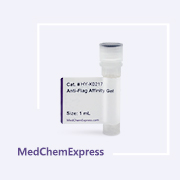
MCE Anti-Flag Affinity Gel is used for immunoprecipitation (IP) or protein purification of specific Flag-tagged (DYKDDDDK) proteins expressed in bacterial and mammalian cells and in vitro expression systems.
|
-
- HY-K0231
-
|
|
|
MCE Anti-c-Myc Affinity Gel can be used for the detection and purification of c-Myc fusion expressed proteins, and immunoprecipitation (IP) experiments to detect the expression of recombinant proteins in target cells.
|
-
- HY-K0232
-
|
|
|
MCE Anti-HA Affinity Gel can be employed for the detection and purification of HA fusion expressed proteins, and can also be used in immunoprecipitation (IP) experiments to detect the expression of recombinant proteins in target cells.
|
-
- HY-K0222
-
|
|
|
MCE Anti-GST Magnetic Beads are used for immunoprecipitation (IP) of specific GST-tagged proteins expressed in bacterial and mammalian cells and in vitro expression systems. The 1 mL is defined as the base specification. All larger sizes correspond to incremental volumes of this base.
|
-
- HY-K0209
-
|
|
|
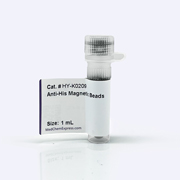
MCE Anti-His Magnetic Beads are used for immunoprecipitation (IP) of specific His-tagged proteins expressed in bacterial and mammalian cells and in vitro expression systems. The 1 mL is defined as the base specification. All larger sizes correspond to incremental volumes of this base.
|
-
- HY-K0201
-
|
|
|
MCE Anti-HA Magnetic Beads are used for immunoprecipitation (IP) of specific HA-tagged proteins expressed in bacterial and mammalian cells and in vitro expression systems.The 1 mL volume is defined as the base specification. All larger sizes correspond to incremental volumes of this base.
|
-
- HY-K0206
-
|
|
|
MCE Anti-c-Myc Magnetic Beads are used for immunoprecipitation (IP) of specific c-Myc-tagged proteins expressed in bacterial and mammalian cells and in vitro expression systems. The 1 mL is defined as the base specification. All larger sizes correspond to incremental volumes of this base.
|
-
- HY-K0201A
-
4 Publications Verification
|
|
MCE Anti-HA Magnetic Beads (1 μm) are used for immunoprecipitation (IP) of specific HA-tagged proteins expressed in bacterial and mammalian cells andin vitro expression systems. The 1 mL is defined as the base specification. All larger sizes correspond to incremental volumes of this base.
|
-
- HY-K0208
-
|
|
|
MCE Streptavidin Magnetic Beads provide a fast and convenient method for numerous applications, including purification of proteins and nucleic acids, protein interaction studies, immunoprecipitation, immunoassays, pull-down and cell isolation. The 1 mL is defined as the base specification. All larger sizes correspond to incremental volumes of this base.
|
| Cat. No. |
Product Name |
Target |
Research Area |
Image |
-
- HY-P99995
-
|
|
Inhibitory Antibodies
|
Inflammation/Immunology
|
|
Human IgG1 (K214R) kappa, Isotype Control is a human IgG1 kappa monoclonal antibody mutant with a lysine-to-arginine substitution at position 214. Human IgG1 (K214R) kappa, Isotype Control is mainly used as an isotype control in experiments such as immunoprecipitation. Human IgG1 (K214R) kappa, Isotype Control binds to proteins non-specifically, thereby helping researchers verify the interactions of specific antibodies and ensure the accuracy of experimental results .
|
-
(5)
-
- HY-P990301
-
|
|
Amyloid-β
|
Neurological Disease
|
|
Anti-Human/Mouse/Rat Amyloid-beta Antibody (MOAB-2) is a mouse-derived IgG2b λ type antibody inhibitor, targeting to Amyloid-beta. Anti-Human/Mouse/Rat Amyloid-beta Antibody (MOAB-2) recognizes unaggregated, oligomeric or fibrillar forms of Aβ42 and unaggregated Aβ40. Anti-Human/Mouse/Rat Amyloid-beta Antibody (MOAB-2) is selective for human Aβ42 over Aβ40, but not amyloid precursor protein (APP). Anti-Human/Mouse/Rat Amyloid-beta Antibody (MOAB-2) can immunostain human or rat and mouse tissue. Anti-Human/Mouse/Rat Amyloid-beta Antibody (MOAB-2) can be used for detections of western blot, immunohistochemistry, immunofluorescence, immunoprecipitation and ELISA .
|
-
(5)
-
- HY-P990198
-
|
|
Galectin
|
Inflammation/Immunology
|
|
Anti-Mouse/Human Mac-2/Galectin-3 Antibody (TIB-166) is a rat-derived anti-mouse/human Mac-2/Galectin-3 IgG2a monoclonal antibody. Anti-Mouse/Human Mac-2/Galectin-3 Antibody (TIB-166) significantly inhibits IL-6 expression (inhibition rates 34.7% and 55.3%). Anti-Mouse/Human Mac-2/Galectin-3 Antibody (TIB-166) is often used for immunoprecipitation, western blot, immunofluorescence, and flow cytometry .
|
-
(5)
-
- HY-P990850
-
|
|
c-Myc
|
Cancer
|
|
Anti-c-myc Antibody (9E10) is a kind of mouse IgG1 chimeric antibody, targeting to human c-myc. Anti-c-myc Antibody (9E10) reacts with human c-myc, which is over-expressing in several types of human cancers including lung, breast and colon carcinomas. Anti-c-myc Antibody (9E10) can be can be used for the detections of western blot, ELISA, immunoprecipitation and flow cytometry .
|
-
(5)
-
- HY-P990140
-
|
|
MHC
|
Inflammation/Immunology
|
|
Anti-Rat β-2-Microglobulin Antibody (4C9) is an anti-rat β-2-Microglobulin IgG1 monoclonal antibody. Anti-Rat β-2-Microglobulin Antibody (4C9) reduces pJNK nuclear translocation and restore SMAD nuclear localization. Anti-Rat β-2-Microglobulin Antibody (4C9) is often used in immunoprecipitation experiments .
|
-
(5)
-
- HY-P990146
-
|
|
Ras
|
Inflammation/Immunology
|
|
Anti-Mouse/Rat/Human v-H-Ras Antibody (Y13-238) is an anti-mouse/rat/human v-H-Ras IgG2a monoclonal antibody. Anti-Mouse/Rat/Human v-H-Ras Antibody (Y13-238) can be used as a control antibody. Anti-Mouse/Rat/Human v-H-Ras Antibody (Y13-238) is often used for immunofluorescence and immunoprecipitation .
|
-
(5)
-
- HY-P990239
-
|
|
HSP
Akt
Interleukin Related
|
Inflammation/Immunology
Cancer
|
|
Anti-Human/Mouse GRP78 Antibody (N88) is an anti-human/mouse GRP78 IgG1 monoclonal antibody. Anti-Human/Mouse GRP78 Antibody (N88) can activate the Akt signaling pathway. Anti-Human/Mouse GRP78 Antibody (N88) can inhibit the expression of inflammatory factors and plasminogen activator inhibitors induced by TLR agonists. Anti-Human/Mouse GRP78 Antibody (N88) can be used for research on inflammation conditions. Anti-Human/Mouse GRP78 Antibody (N88) can be used for immunoprecipitation .
|
-
(5)
-
- HY-P990232
-
|
|
IFNAR
|
Others
|
|
Anti-Mouse IFNγRα/CD119 Antibody (2E2) is an Armenian hamster-derived IgG type antibody inhibitor, targeting to mouse IFNγRα/CD119. Anti-Mouse IFNγRα/CD119 Antibody (2E2) reacts with the mouse IFNγR (interferon gamma receptor) α chain also known as CD119 and IFNγ receptor 1. Anti-Mouse IFNγRα/CD119 Antibody (2E2) is a non-neutralizing antibody and does not block the binding of IFNγ to the receptor. Anti-Mouse IFNγRα/CD119 Antibody (2E2) can be used for detections of western blot, flow cytometry and immunoprecipitation .
|
-
(5)
-
- HY-P990873
-
|
|
DNA/RNA Synthesis
|
Cancer
|
|
Anti-BRCA1 Antibody (BR64) is a kind of mouse IgG1 κ chimeric antibody, targeting to human BRCA1. Anti-BRCA1 Antibody (BR64) reacts with BRCA1 (Breast cancer susceptibility gene 1) involved in tumor suppression, transcription, genomic stability, DNA repair and recombination. Anti-BRCA1 Antibody (BR64) can be used for the detections of immunofluorescence, western blot, and immunoprecipitation in cancer, such as breast and ovarian cancer .
|
-
(5)
-
- HY-P992061
-
|
|
CD3
Calcium Channel
|
Inflammation/Immunology
|
|
Anti-Mouse CD3E Antibody (500A2) is an antibody targeting mouse CD3ε, which specifically binds to the region on CD3ε adjacent to the T cell receptor binding site. Anti-Mouse CD3E Antibody (500A2) triggers functional signal transduction in immature T cells and activates naive T cells. When cross-linked, Anti-Mouse CD3E Antibody (500A2) induces a rapid, robust and transient increase in cytoplasmic calcium concentration, acting as a potent calcium flux inducer. Anti-Mouse CD3E Antibody (500A2) is suitable for multiple experimental techniques such as flow cytometry, immunoprecipitation and EMARS reactions. It can be used to detect CD3E expression on thymocytes, mature T lymphocytes and NK-T cells from different mouse strains, or to identify membrane cluster components of the TCR complex, and shows no cross-reactivity with rat leukocytes .
|
-
(5)
| Cat. No. |
Product Name |
|
Classification |
-
- HY-118197
-
|
|
|
Azide
|
|
L-669083 is a leukotriene biosynthesis inhibitor whose structure is based on a mixture of indole and quinoline. In this study, a potent radioiodinated photoaffinity analog of L-689,037, [125I] L-691,678, was developed and characterized for immunoprecipitation studies showing that the quindole series of leukotriene biosynthesis inhibitors directly interact with FLAP. In addition, the results showed that MK-886, L-674,573, and L-689,037 competed with [125I] L-691,678 and [125I] L-669083 for binding to FLAP in a concentration-dependent manner, indicating that these three leukotriene biosynthesis inhibitors share a binding site on FLAP, further demonstrating that FLAP is a suitable target for structurally diverse leukotriene biosynthesis inhibitors.
|
Your information is safe with us. * Required Fields.
Inquiry Information
- Product Name:
- Cat. No.:
- Quantity:
- MCE Japan Authorized Agent:

