1. Search Result
Search Result
Results for "

leaf chlorophyll

" in MedChemExpress (MCE) Product Catalog:

10

Inhibitors & Agonists

1

Isotope-Labeled Compounds

Cat. No. Product Name Target Research Areas Chemical Structure
  • HY-122464

    Herbicide Others
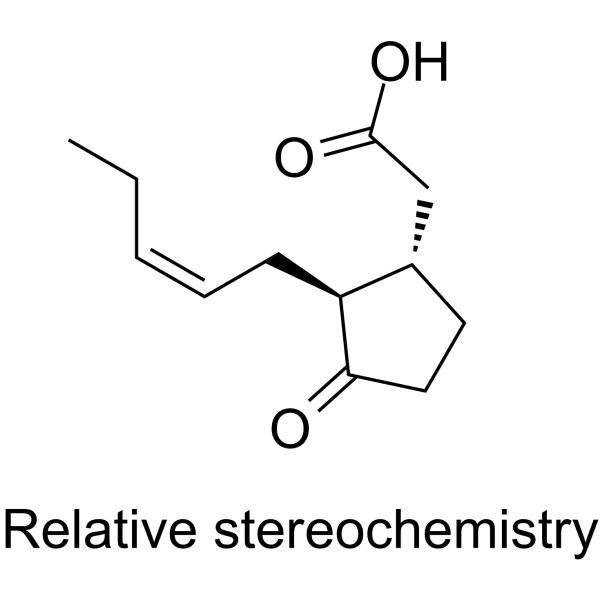
    (±)-Jasmonic acid is an endogenous growth regulator closely related to plant resistance to abiotic stresses, used to activate defense responses to wounding, herbivory, and pathogen attacks. (±)-Jasmonic acid does not play an independent regulatory role, but works in a complex signaling network with other plant hormone signaling pathways. In addition, (±)-Jasmonic acid can also reduce chlorophyll levels in green and etiolated barley leaf segments and inhibit the elongation of rice seedlings .
    (±)-Jasmonic acid
  • HY-W051140

    Disilver sulfate, 99%

    Environmental Pollutants Biochemical Assay Reagents Others
    Silver sulfate acts as an ethylene inhibitor and a shoot regeneration promoter. Silver sulfate promotes shoot proliferation in explants of the cherry rootstock CAB-6P. Silver sulfate is applicable to studies on the optimization of micropropagation for cherry rootstocks .
    Silver sulfate
  • HY-122464S2

    Isotope-Labeled Compounds Others
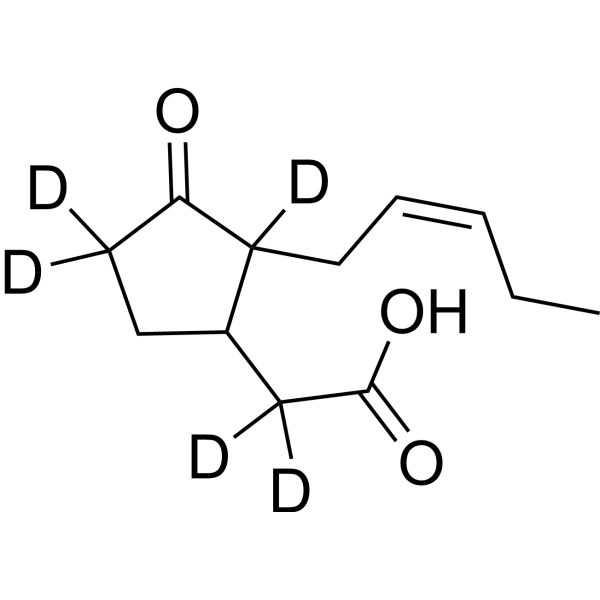
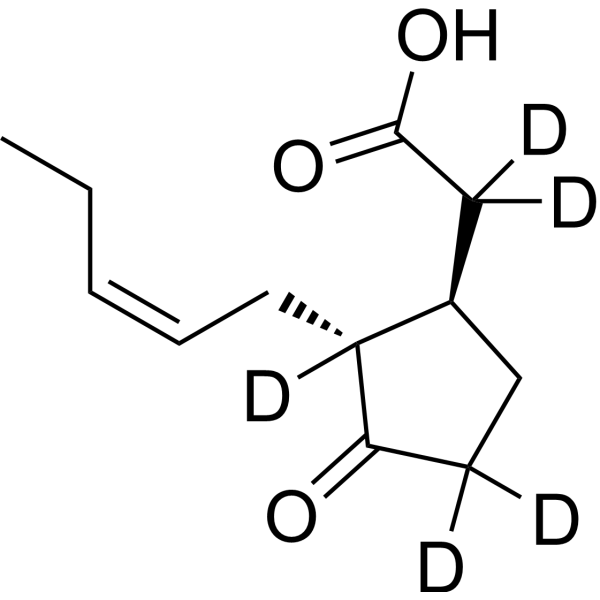
    (±)-Jasmonic acid-d5 is the deuterium labeled (±)-Jasmonic acid. (±)-Jasmonic acid is a plant growth regulator and a derivative of α-linolenic acid. (±)-Jasmonic acid decreases chlorophyll levels in green and etiolated barley leaf segments and inhibits elongation of rice seedlings.
    (±)-Jasmonic acid-d5
  • HY-137910

    Environmental Pollutants HPPD Herbicide Infection
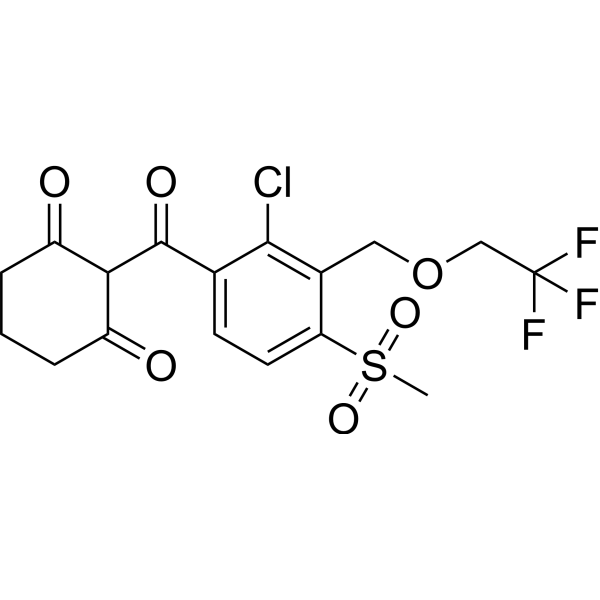
    Tembotrione is a herbicide belonging to the HPPD (dioxygenase) inhibitor class with crop selectivity. Tembotrione effectively controls a variety of weeds including broadleaf and gramineous species by disrupting carotenoid synthesis, which leads to chlorophyll degradation and leaf whitening. Mixing Tembotrione with isoxaflutole or adding surfactants optimizes its efficacy and reduces phytotoxicity, with no residual impact on subsequent cruciferous crops, thus helping to increase maize grain yield. The activity of Tembotrione decreases under drought conditions, and under specific conditions (such as double-dose treatment), it may cause reversible yellowing and even yield reduction in crops such as poppy .
    Tembotrione
  • HY-122464S1

    Isotope-Labeled Compounds Others
    Jasmonic acid-d5 is deuterium labeled (±)-Jasmonic acid. (±)-Jasmonic acid is a plant growth regulator and a derivative of α-linolenic acid. (±)-Jasmonic acid decreases chlorophyll levels in green and etiolated barley leaf segments and inhibits elongation of rice seedlings.
    Jasmonic acid-d5
  • HY-122464B

    2-iso Jasmonic acid; 7-iso Jasmonic acid

    Herbicide Others
    7-epi Jasmonic acid is the isomer of (±)-Jasmonic acid (HY-122464). (±)-Jasmonic acid is a plant growth regulator and a derivative of α-linolenic acid. (±)-Jasmonic acid decreases chlorophyll levels in green and etiolated barley leaf segments and inhibits elongation of rice seedlings.
    7-epi Jasmonic acid
  • HY-137910R

    Reference Standards Herbicide HPPD Others
    Tembotrione (Standard) is the analytical standard of Tembotrione. This product is intended for research and analytical applications. Tembotrione is a drug that may reduce the productivity of carrots. Tembotrione has the activity of reducing carrot stem mass. Tembotrione can be used to study the total productivity of carrot . Tembotrione is a herbicide belonging to the HPPD (dioxygenase) inhibitor class with crop selectivity. Tembotrione effectively controls a variety of weeds including broadleaf and gramineous species by disrupting carotenoid synthesis, which leads to chlorophyll degradation and leaf whitening. Mixing Tembotrione with isoxaflutole or adding surfactants optimizes its efficacy and reduces phytotoxicity, with no residual impact on subsequent cruciferous crops, thus helping to increase maize grain yield. The activity of Tembotrione decreases under drought conditions, and under specific conditions (such as double-dose treatment), it may cause reversible yellowing and even yield reduction in crops such as poppy .
    Tembotrione (Standard)
  • HY-E70911

    Biochemical Assay Reagents Others
    Chlorophyllase (EC 3.1.1.14) is part of the chlorophyll degradation pathway and is believed to be involved in various plant chlorosis processes, such as fruit ripening, leaf senescence, and flowering, as well as chlorophyll turnover and homeostasis. Chlorophyllase (EC 3.1.1.14) preferentially acts on chlorophyll a, but can also use chlorophyll b and pheophytin as substrates.
    Chlorophyllase
  • HY-W681749

    Morphactin

    Biochemical Assay Reagents Others
    Morphactin Chlorflurenol methyl (Morphactin) is a plant growth regulator. Morphactin Chlorflurenol methyl preserves chlorophyll and suppresses senescence. Morphactin Chlorflurenol methyl regulates chlorophyll metabolic enzymes and alleviates heat-induced leaf senescence by enhancing chlorophyll content and reducing electrolyte leakage. Morphactin Chlorflurenol methyl promotes shoot redifferentiation and tracheary element development in tobacco calluses. Morphactin Chlorflurenol methyl can be applied to the investigation of heat-induced leaf senescence .
    Morphactin Chlorflurenol methyl
  • HY-167959

    Herbicide Infection
    MCPA-isooctyl is a selective conductive phenoxycarboxylate herbicide and an alternative to 2,4-D Butyl ester (HY-B0867). MCPA-isooctyl effectively controls broadleaf weeds in various crop fields via post-emergence foliar or soil treatment. MCPA-isooctyl is absorbed by the roots, stems and leaves of plants; it is easily metabolized and detoxified in gramineous crops, but difficult to metabolize in dicotyledonous weeds, causing stem and leaf distortion, root deformation, and eventually weed death. When formulated into chitosan nanoparticles, MCPA-isooctyl still significantly inhibits the growth of weeds in wheat fields, and reduces their chlorophyll content and biomass at low doses .
    MCPA-isooctyl

Inquiry Online

Your information is safe with us. * Required Fields.

Salutation


Country or Region *

Applicant Name *


Organization Name *

Department *


Email Address *


Product Name *

Cat. No.


Requested quantity *

Phone Number *


Remarks

Inquiry Online

Inquiry Information

Product Name:
Cat. No.:
Quantity:
MCE Japan Authorized Agent:

