9 Results for "

lithium ions

" in MedChemExpress (MCE) Product Catalog:
Products (9)

9 Results for "lithium ions" in MCE Product Catalog:

3
3 Cited Publications
Cat. No.: HY-130777A
Purity:  ≥94.0%
Synonyms: Adenylyl imidodiphosphate lithium hydrate
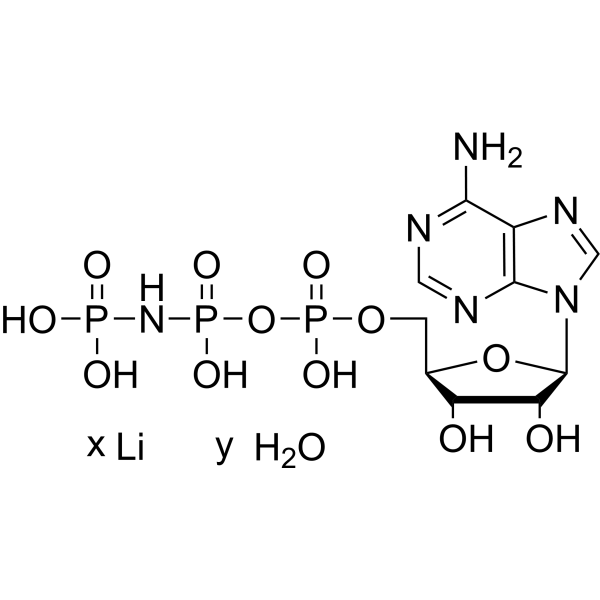
AMP-PNP (Adenylyl imidodiphosphate) lithium hydrate is a non-hydrolyzable ATP analog. AMP-PNP lithium hydrate binds to ATP binding sites competely but is not hydrolyzed by enzymes, providing stable experimental conditions for studying ATP-dependent processes. AMP-PNP lithium hydrate can also be used to study enzyme activity, kinase regulation, DNA/RNA metabolism, ion channel function, and protein complex assembly .
loading...
    loading...
Cat. No.: HY-W007656
CAS No.: 294-90-6
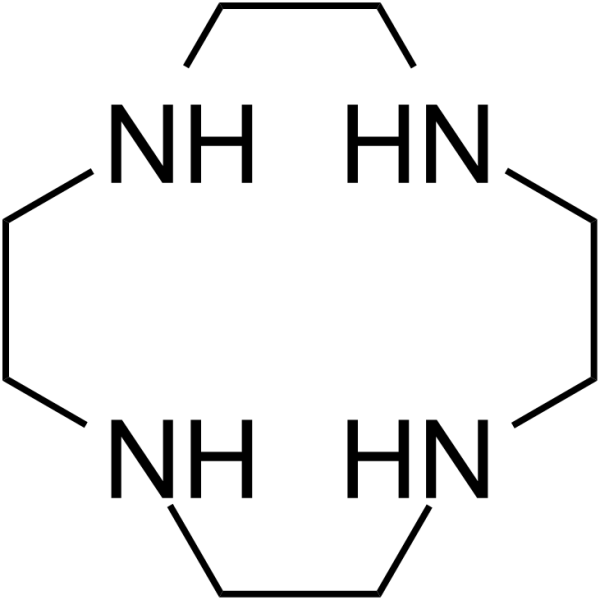
Cyclen is a macrocyclic tetraamine chelating agent. Cyclen is the aza analogue of crown ether, used as a precursor for MRI contrast agents, and is an intermediate for the preparation of effective macrocyclic chelates. Cyclen is employed as a structural regulator through interfacial polymerization of polyethleneimine (PEI) and trimesoyl chloride (TMC) to develop polyamide NF membrane with efficient Li +/Mg 2+ separation performance. Cyclen has specific cavity structure and exhibits selective coordination properties for Li + ions [1][2].
loading...
    loading...
Cat. No.: HY-W105310A
CAS No.: 14379-00-1
Synonyms: Nacr
Research Areas:  

Others

Croconic acid disodium (Nacr) is a lysine crotonylation (Kcr) activator and electroactive material. Croconic acid disodium reduces the expression of HDAC2, HDAC3, SIRT1, and SIRT3, and increases the expression of EP300, CITED1, ACSS2, DPF2, CDYL, MLLT3, and YEATS2. Croconic acid disodium elevates intracellular crotonyl-CoA content and global histone lysine crotonylation levels. Croconic acid disodium promotes the growth of bovine fibroblasts, regulates cell cycle progression, and inhibits bovine fibroblast apoptosis (apoptosis). Croconic acid disodium improves the blastocyst development efficiency of bovine somatic cell nuclear transfer embryos. Croconic acid disodium undergoes reversible lithium intercalation/deintercalation reactions via sodium-lithium ion exchange. Croconic acid disodium is applicable to research related to cell growth promotion .
loading...
    loading...
Cat. No.: HY-W391506
CAS No.: 9011-14-7
Synonyms: Poly(methyl methacrylate), beads; PMMA
Research Areas:  

Others

Poly (methyl methacrylate) (Poly(methyl methacrylate), beads; PMMA) is an amorphous glassy acrylic thermoplastic polymer belonging to the acrylate family, synthesized from methyl methacrylate monomers. Poly (methyl methacrylate) drives biochemical processes including free volume expansion induced by inelastic deformation, yield stress and strain softening regulated by physical aging, acid hydrolysis to polymethacrylic acid, multi-stage combustion, oxygen-dependent thermal decomposition, primary amine-mediated polypentanimide formation, and grafting/crosslinking-based copolymer and composite formation. Poly (methyl methacrylate) exhibits histocompatibility, low toxicity, low inflammatory potential, and fracture resistance; it can form functional blends and composites for biomedical and dental applications; it also allows performance-enhancing chemical and mechanical modifications. Poly (methyl methacrylate) is applicable to studies related to cranial repair .
loading...
    loading...
Cat. No.: HY-21170B
CAS No.: 33454-82-9
Synonyms: Triflate lithium; Trifluoromethylsulfonate lithium; Trifluoromethanesulphonic acid lithium
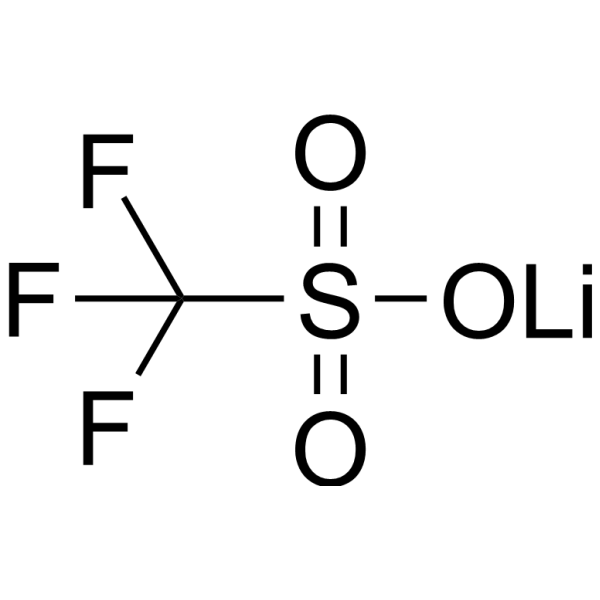
Trifluoromethanesulfonate (Triflate;Trifluoromethylsulfonate) lithium is a stable lithium salt and dopant with four resonance states, which is commonly used as an electrolyte component in polymer light-emitting electrochemical cells and primary lithium batteries. Trifluoromethanesulfonate lithiumalso acts as a catalyst for the preparation of the herbicide Imazapyr. In MEH-PPV-based light-emitting electrochemical cells, Trifluoromethanesulfonate lithium promotes electrochemical p-type doping at the anode interface under applied bias, thereby facilitating the formation of p-i-n junctions, exciton generation, and light emission. Trifluoromethanesulfonate lithiumexhibits strong ion pairing in non-aqueous electrolytes, but its electrochemical stability window is narrower than that of lithium bistrifluoromethylsulfonyl imidee .
loading...
    loading...
Cat. No.: HY-W017850
CAS No.: 99591-74-9
1,5,2,4-Dioxadithiane 2,2,4,4-tetraoxide is a sulfur-containing electrolyte additive that can be used to prepare graphite/NMC111 lithium-ion cells .
loading...
    loading...
Cat. No.: HY-Y1005
CAS No.: 25447-33-0
Triammonium phosphate trihydrate interacts with the magnesium ions to form a precipitate, which can be used for magnesium separation from lithium in salt-lake brines .
loading...
    loading...
Cat. No.: HY-107205
CAS No.: 13861-22-8
Research Areas:  

Others

Propargyl methacrylate is an effective electrolyte additive used to stabilize the formation of the solid electrolyte interface (SEI) layer on meso-porous carbon microbeads (MCMB) in lithium-ion batteries .
loading...
    loading...
Cat. No.: HY-19938
CAS No.: 1030303-53-7
Research Areas:  

Cancer

MTL-005 is a boron-containing radiosensitizer used in Boron Neutron Capture Therapy (BNCT). MTL-005 enriches the boron-10 isotope in tumor tissues, causing nuclear fission under thermal neutron irradiation, releasing high linear energy transfer (LET) α particles and lithium ions, which selectively destroy tumor cells while minimizing damage to surrounding normal tissues. MTL-005 significantly controlls the tumor progression in the SCCVII squamous cell carcinoma mouse model and prolonged the survival of the mice. MTL-005 can be used to study solid tumors such as head and neck cancer.
loading...
    loading...

