
7 Results for "

metabolic engineering

" in MedChemExpress (MCE) Product Catalog:
Products (7)

7 Results for "metabolic engineering" in MCE Product Catalog:

Cat. No.: HY-137006
CAS No.: 57360-69-7
Target:  

Fluorescent Dye

Research Areas:  

Others

MTT Formazan is a purple water-insoluble product formed by the reduction of yellow soluble MTT by succinate dehydrogenase in the mitochondria of viable cells. The amount of MTT Formazan produced is proportional to cellular metabolic activity, and it can serve as an indicator for evaluating cell viability and proliferation. MTT Formazan exhibits solvent-dependent solubility properties, and its absorbance value can be measured by spectrophotometry to reflect cellular status. MTT Formazan also supports the assessment of cell viability in bacterial MTT assays. MTT Formazan can be used in photoacoustic microscopy to enhance the imaging effect of viable cells, especially in applications in the fields of three-dimensional cell culture and tissue engineering .
loading...
    loading...
Cat. No.: HY-W250120
CAS No.: 37220-17-0
Konjac glucomannan (Viscosity≥15000mPa.s) is an orally active acetylated (1-4)-β-D-glucomannan with multiple biological activities including anti-diabetic, anti-obesity, anti-inflammatory effects, as well as film-forming and gelling properties. Konjac glucomannan (Viscosity≥15000mPa.s) forms a defensive coating on the intestinal surface, reducing levels of blood glucose, cholesterol, triglycerides and blood pressure; it is specifically degraded by colonic β-mannanase produced by human colonic bacteria. Konjac glucomannan (Viscosity≥15000mPa.s) can be used as a food additive, dietary supplement and excipient for oral colon-targeted drug delivery systems. Konjac glucomannan (Viscosity≥15000mPa.s) is applicable to research related to various diseases such as type 2 diabetes, obesity, atopic dermatitis and metabolic syndrome, as well as research in fields including biotechnology, pharmaceuticals and tissue engineering .
loading...
    loading...
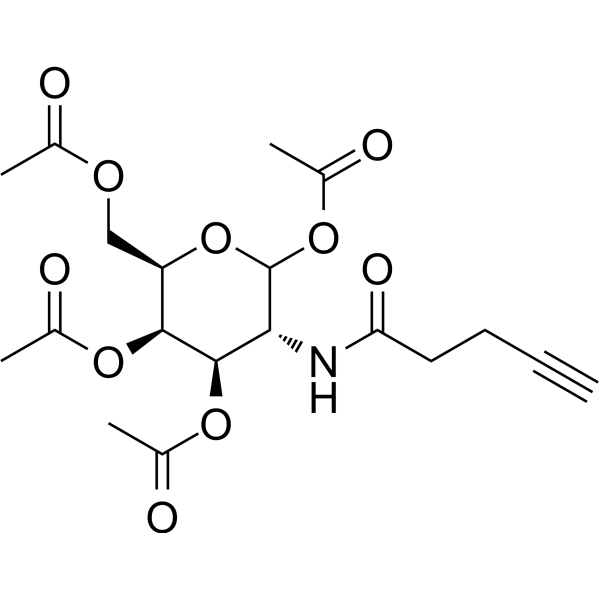
Cat. No.: HY-W415798
CAS No.: 1810852-60-8
Ac4GalNAlk is a weakly alkyne-labeled reagent for metabolic oligosaccharide engineering (MOE) that can be used to detect protein glycosylation. MOE reagents can be activated by cellular biosynthetic machinery into nucleotide sugars, which can be further traced through the introduction of glycoproteins in bioorthogonal chemistry. Ac4GalNAlk promotes nucleotide-sugar biosynthesis and increases bioorthogonal cell surface markers .
loading...
    loading...
Cat. No.: HY-164072
Research Areas:  

Others Cancer

DBCO-Dextran is a dibenzocyclooctyne-modified dextran with excellent click chemistry activity and biocompatibility, which can be used in cancer immunotherapy and bioimaging research .
loading...
    loading...
Cat. No.: HY-P11275
TC4 is a highly balanced single-molecule quadruple agonist that can respectively activate GIPR, GLP-1R, GcgR, and Y2R with IC50 values of 0.95, 31, 81, and 1100 nM respectively. TC4 exhibits extremely strong signal bias on GLP-1R and has very low recruitment efficacy for β-inhibitor protein 2 (βArr2) and this strong cAMP preference is believed to maximize metabolic benefits (such as weight loss and hypoglycemia) while possibly minimizing side effects mediated by β-inhibitor protein recruitment (such as receptor desensitization). TC4 can be used for research on obesity and diabetes .
loading...
    loading...
Cat. No.: HY-P11279
TC2 is an efficient GIPR-preferring monomeric quadruple agonist that can respectively activate GIPR, GLP-1R, GcgR, and Y2R with IC50 values of 0.47, 2.1, 30, and 55 nM respectively. TC2 exhibits a significant GLP-1R preference, with a significant reduction in β-inhibitory protein 2 (βArr2) recruitment, while maintaining a strong cAMP signal. TC2 can be used for research on obesity and diabetes .
loading...
    loading...
Cat. No.: HY-E70417
CAS No.: 9001-49-4
Synonyms: GPDH, Saccharomyces cerevisiae
Research Areas:  

Others

Glycerol-3-phosphate dehydrogenase, Saccharomyces cerevisiae, is an enzyme involved in glycerol metabolism and energy production, responsible for catalyzing the oxidation of glycerol-3-phosphate (G3P) to dihydroxyacetone phosphate (DHAP). Glycerol-3-phosphate dehydrogenase, Saccharomyces cerevisiae, is the rate-limiting enzyme in glycerol production in Saccharomyces cerevisiae, and helps Saccharomyces cerevisiae adapt to high osmotic environments by regulating glycerol production and accumulation. Glycerol-3-phosphate dehydrogenase, Saccharomyces cerevisiae, can be used in research within the field of metabolic engineering .
loading...
    loading...

