8 Results for "

monooxygenase system

" in MedChemExpress (MCE) Product Catalog:
Products (8)

8 Results for "monooxygenase system" in MCE Product Catalog:

Cat. No.: HY-B1044
CAS No.: 20098-14-0
Synonyms: Kemantane; 5-Hydroxy-2-adamantanone
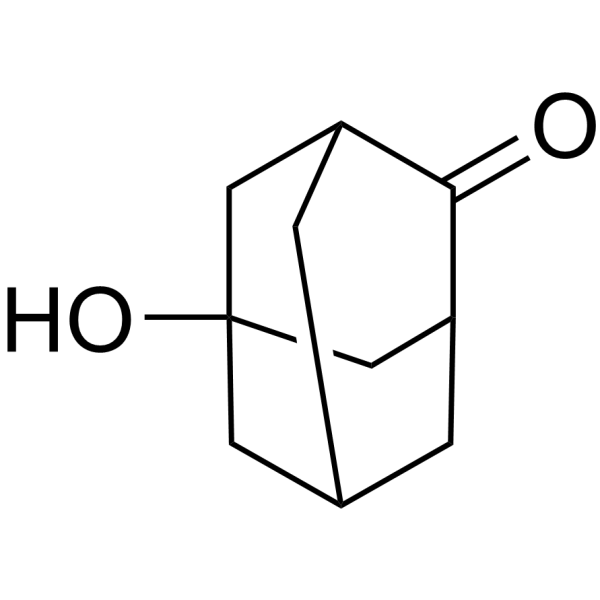
Idramantone (Kemantane, 5-Hydroxy-2-adamantanone) is an adamantane-based immunomodulator. Idramantone increases the activity of T helper cells by 1.5 to 2-fold, but exerts no significant effect on the functional activity, induction or accumulation of antigen-specific T suppressor cells. Idramantone serves as a key intermediate for the synthesis of various adamantane derivatives, and can be produced via the regioselective oxidation of 2-adamantanone catalyzed by P450cam monooxygenase, a process that relies on an NADH regeneration system to provide reducing equivalents. Idramantone can be used in studies related to immunomodulation .
loading...
    loading...
Cat. No.: HY-34765
CAS No.: 7341-96-0
Propiolamide is a monooxygenase (MMO) system activator and glutathione peroxidase 4 (GPX4) inhibitor. Propiolamide induces ROS production through interaction with the MMO system. Propiolamide promotes the accumulation of intracellular cytotoxic lipid peroxides and induces ferroptosis. Propiolamide induces programmed cell death via the apoptosis pathway. Propiolamide can be used in cancer research .
loading...
    loading...
Cat. No.: HY-135739
CAS No.: 744-80-9
Target:  

Cytochrome P450

Benzobarbital is an active low-toxicity inductor of the liver monooxygenase system. Benzobarbital raises cytochrome P-450 concentration. Benzobarbital can be used in the research of post-ischemic liver disease .
loading...
    loading...
Cat. No.: HY-177148
CAS No.: 134867-97-3
Research Areas:  

Cardiovascular Disease

G256 is a cytochrome P450 substrate with antiarrhythmic properties. In recombinant monooxygenase systems, G256 undergoes N-hydroxylation of the terminal aminoguanidine nitrogen, as well as ring hydroxylation catalyzed by cytochrome P4502C3. G256 generates N-hydroxyaminoguanidine metabolites via N-hydroxylation in liver microsomal fractions. G256 produces phenol metabolites through ring hydroxylation in both liver microsomal fractions and recombinant cytochrome P450 systems. G256 can be used for research on arrhythmias .
loading...
    loading...
Cat. No.: HY-177148A
CAS No.: 134867-96-2
Research Areas:  

Cardiovascular Disease

G256 dihydrochloride is a cytochrome P450 substrate with antiarrhythmic properties. In recombinant monooxygenase systems, G256 dihydrochloride undergoes N-hydroxylation of the terminal aminoguanidine nitrogen, as well as ring hydroxylation catalyzed by cytochrome P4502C3. G256 dihydrochloride generates N-hydroxyaminoguanidine metabolites via N-hydroxylation in liver microsomal fractions. G256 dihydrochloride produces phenol metabolites through ring hydroxylation in both liver microsomal fractions and recombinant cytochrome P450 systems. G256 dihydrochloride can be used for research on arrhythmias .
loading...
    loading...
Cat. No.: HY-177148B
CAS No.: 136623-15-9
Research Areas:  

Cardiovascular Disease

(E/Z)-G256 (dihydrochloride) is an isomer of G256 dihydrochloride (HY-177148A). G256 dihydrochloride is a cytochrome P450 substrate with antiarrhythmic properties. In recombinant monooxygenase systems, G256 dihydrochloride undergoes N-hydroxylation of the terminal aminoguanidine nitrogen, as well as ring hydroxylation catalyzed by cytochrome P4502C3. G256 dihydrochloride generates N-hydroxyaminoguanidine metabolites via N-hydroxylation in liver microsomal fractions. G256 dihydrochloride produces phenol metabolites through ring hydroxylation in both liver microsomal fractions and recombinant cytochrome P450 systems. G256 dihydrochloride can be used for research on arrhythmias .
loading...
    loading...
Cat. No.: HY-129565
CAS No.: 613-37-6
Target:  

Cytochrome P450

Research Areas:  

Others

4-Methoxybiphenyl is a cytochrome P450-dependent microsomal monooxygenase system substrate and metabolite precursor. 4-Methoxybiphenyl undergoes O-demethylation to generate 4-hydroxybiphenyl. 4-Methoxybiphenyl undergoes sulphation and glucuronidation conjugation; inhibition of sulphation shifts metabolism toward increased glucuronidation and unconjugated 4-hydroxybiphenyl accumulation. 4-Methoxybiphenyl serves as a model substrate for studying phase II metabolic conjugation pathway balance in rat isolated hepatocytes .
loading...
    loading...
Cat. No.: HY-E71757
Research Areas:  

Others

3-Ketosteroid 9α-monooxygenase (EC 1.14.13.142) is involved in the cholesterol degradation pathway of several bacterial pathogens, such as Mycobacterium tuberculosis, and is a two-component system consisting of a terminal oxygenase (KshA) and a ferredoxin reductase (KshB).
loading...
    loading...

