8 Results for "

optical microscopy

" in MedChemExpress (MCE) Product Catalog:
Products (8)

8 Results for "optical microscopy" in MCE Product Catalog:

Cat. No.: HY-154487
CAS No.: 25637-84-7
Research Areas:  

Neurological Disease

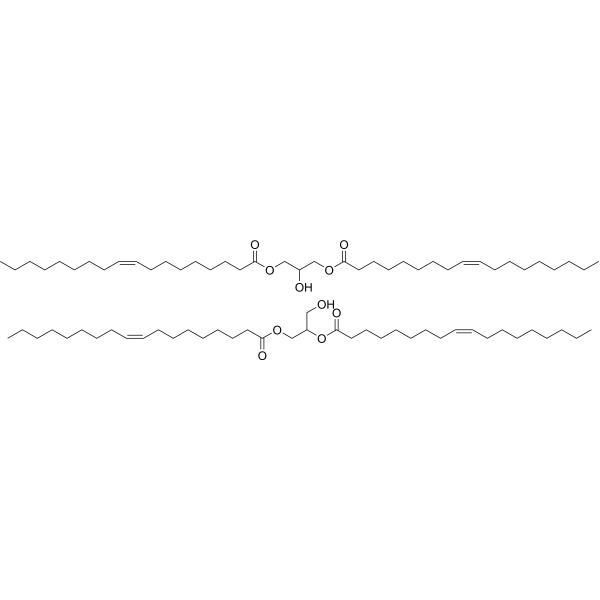
Glycerol dioleate is a lipid capable of forming Lyotropic Liquid Crystal (LLC). When formulated with phosphatidylcholine and exposed to aqueous media, glycerol dioleate constructs an inverted hexagonal (HII) phase structure with sustained-release properties. The in-situ forming gel prepared by optimizing glycerol dioleate with phosphatidylcholine and N-methyl-2-pyrrolidone enables stable release of Risperidone (HY-11018) for up to 60 days in vitro and in vivo. Glycerol dioleate causes minimal side effects in rabbits, making it an ideal carrier component for the development of antischizophrenia agents .Note: Lyotropic liquid crystals (Lyotropic Liquid Crystal, LLC) are ordered fluid phases self-assembled by amphipathic molecules (e.g., lipids, surfactants) in solvents (usually water) at specific concentrations .
loading...
    loading...
Cat. No.: HY-W923198
CAS No.: 480439-15-4
Synonyms: Methacryloyloxy fluorescein
Fluorescein O-methacrylate (Methacryloyloxy fluorescein) is a pH-responsive fluorescent monomeric dye. Fluorescein O-methacrylate exhibits pH-responsive fluorescence properties: its fluorescence is activated under alkaline conditions and quenched under neutral or acidic conditions; reversible switching of fluorescence is achievable by adjusting the pH of the solution. Fluorescein O-methacrylate can be used as a monomer for the synthesis of amphiphilic fluorescein polymers. These polymers can self-assemble into stable polymer nanoparticles with enhanced aqueous-phase fluorescence, and also enable the conjugation of nanoparticles with amine-containing biomolecules to support sensitive optical detection of biomarkers (Ex/Em = 490/520 nm) .
loading...
    loading...
Cat. No.: HY-W013973
CAS No.: 92-94-4
p-Terphenyl is a specialty material, and may be used in ionized radiation detectors, nonpolar laser dye, and single molecule optical probe of scanning near-field microscopy. p-Terphenyl can be used to synthesis p-Terphenyl derivatives, for the research of cancer and inflammatory diseases .
loading...
    loading...
Cat. No.: HY-W013973R
CAS No.: 92-94-4
p-Terphenyl (Standard) is the analytical standard of p-Terphenyl. This product is intended for research and analytical applications. p-Terphenyl is a specialty material, and may be used in ionized radiation detectors, nonpolar laser dye, and single molecule optical probe of scanning near-field microscopy. p-Terphenyl can be used to synthesis p-Terphenyl derivatives, for the research of cancer and inflammatory diseases .
loading...
    loading...
Cat. No.: HY-D3349
Target:  

Fluorescent Dye

Research Areas:  

Others

Fluorne rhodamine picolyl azide is a fluorescent dye used for optical microscopy and nanoscopy, which can be applied in fluorescence correlation spectroscopy (FCS), stimulated emission depletion (STED) nanoscopy, biomolecule labeling, and live-cell imaging .
loading...
    loading...
Cat. No.: HY-W013973S
CAS No.: 1718-51-0
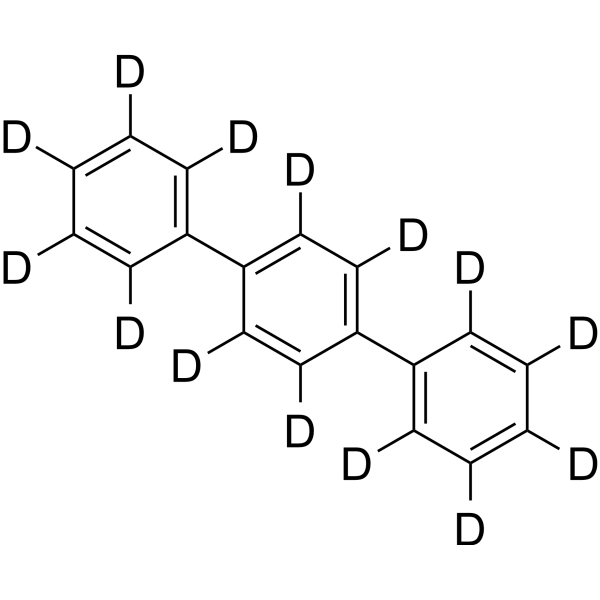
p-Terphenyl-d14 is the deuterium labeled p-Terphenyl (HY-W013973). p-Terphenyl is a specialty material, and may be used in ionized radiation detectors, nonpolar laser dye, and single molecule optical probe of scanning near-field microscopy. p-Terphenyl can be used to synthesis p-Terphenyl derivatives, for the research of cancer and inflammatory diseases .
loading...
    loading...
Cat. No.: HY-D1737
RADA is a fluorescent D-amino acid (FDAA) with high photostability and thermostability, which emits yellow-to-orange fluorescence. RADA shows low outer membrane permeability in wild-type Gram-negative Escherichia coli, but it targets penicillin-binding proteins and L,D-transpeptidases, mimics the interaction between acyl acceptors and enzyme intermediates, and integrates into peptidoglycan during biosynthesis. As a peptidoglycan labeling reagent, RADA metabolically integrates into the nascent peptidoglycan of live bacterial cells, labels the peptidoglycan at the poles and lateral walls of mycobacteria, and enables visualization of peptidoglycan synthesis and remodeling processes. RADA serves as a non-specific stain for fixed cells, is non-toxic to bacterial cells, and its red-shifted excitation/emission spectra reduce phototoxicity. RADA also supports virtual pulse-chase labeling experiments and stochastic optical reconstruction microscopy for sub-diffraction-limited imaging of bacterial cell walls .
loading...
    loading...
Cat. No.: HY-D3567
Target:  

Fluorescent Dye

Research Areas:  

Others

AF647 Cadaverine is a far-red fluorescent polarity tracer. AF647 Cadaverine possesses a primary amine group that enables covalent labeling of carboxylic acids via carbodiimide activation or covalent labeling of glutamine residues through transamidation, rendering it applicable for bioconjugation, cell imaging, and blood-brain barrier permeability assays (Ex/Em = 651/670 nm) .
loading...
    loading...

