8 Results for "

pH-sensitive fluorescent probe

" in MedChemExpress (MCE) Product Catalog:
Products (8)

8 Results for "pH-sensitive fluorescent probe" in MCE Product Catalog:

5
5 Cited Publications
Cat. No.: HY-15940
CAS No.: 72088-94-9
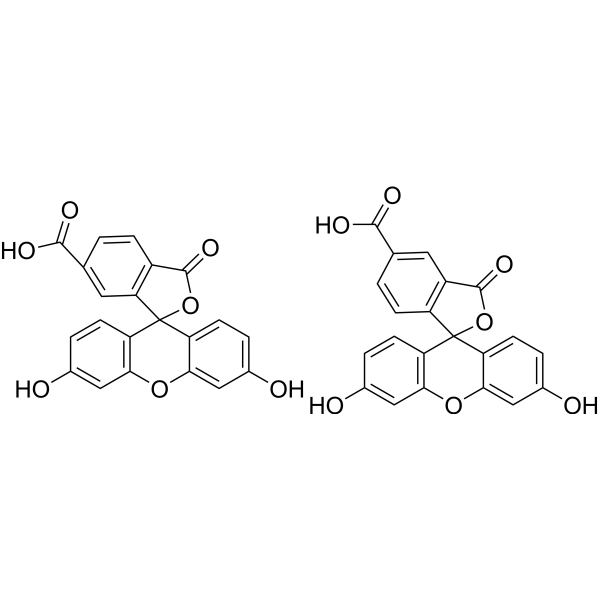
Synonyms: 5(6)-FAM; 5-(and-6)-Carboxyfluorescein mixed isomers
5(6)-Carboxyfluorescein (5(6)-FAM) is an amine-reactive pH-sensitive green fluorescent probe. 5(6)-Carboxyfluorescein (5(6)-FAM) can be used to label proteins, peptides and nucleotides. 5(6)-Carboxyfluorescein can be used for the detection of tumour areas in vivo .
loading...
    loading...
3
3 Cited Publications
Cat. No.: HY-118155
CAS No.: 3548-09-2
Purity:  99.56%
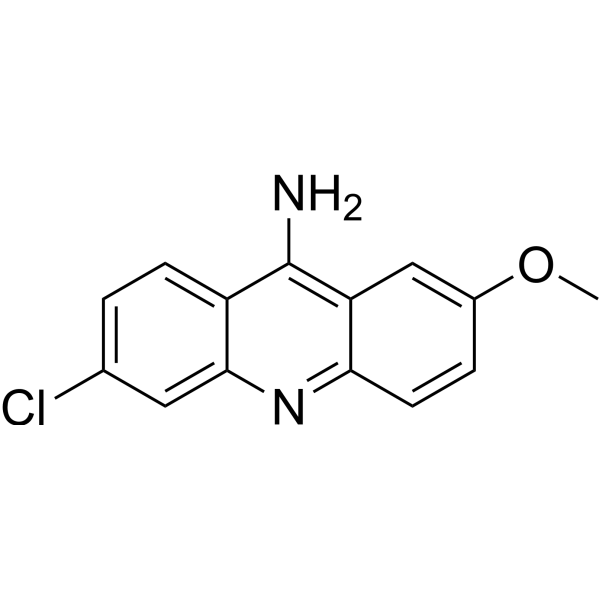
Synonyms: ACMA
9-Amino-6-chloro-2-methoxyacridine is a pH sensitive fluorescent probe. 9-Amino-6-chloro-2-methoxyacridine has been frequently used to measure changes in vacuolar pH when a specific substrate crosses the tonoplast through a putative H +/solute antiport system .
loading...
    loading...
Cat. No.: HY-D0077
CAS No.: 195136-58-4
Synonyms: Oregon green 488
Target:  

Fluorescent Dye

Research Areas:  

Others

2',7'-Difluorofluorescein (Oregon green 488) is a fluorescein derivative and a pH-sensitive fluorescent probe (pKa ~4.7). Upon excitation at 488 nm, 2',7'-Difluorofluorescein exhibits pH-sensitive fluorescence intensity through the formation of dianions, while its pH sensitivity decreases under excitation at 450 nm, allowing its use in ratiometric pH analysis. 2',7'-Difluorofluorescein can be used for the quantitative analysis of pH values in the range of 2-7 in submicron aerosol particles. 2',7'-Difluorofluorescein undergoes buffer-mediated and buffer-free excited-state proton transfer between different protonated forms, and its cationic form undergoes rapid excited-state deprotonation. 2',7'-Difluorofluorescein is resistant to photodegradation, maintains stable absorption and fluorescence properties within the physiological pH range, and serves as a fluorescent protein label, a component of Ca 2+ indicators, a fluorescent imaging agent, and an anisotropy probe .
loading...
    loading...
Cat. No.: HY-124473
CAS No.: 61419-02-1
Purity:  99.52%
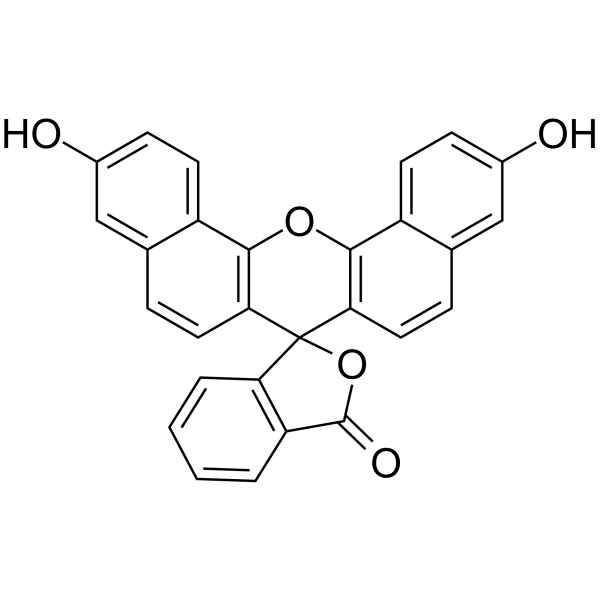
Synonyms: NapHthafluorescein
Research Areas:  

Cancer

Naphthofluorescein inhibits the interaction between HIF-1 and Mint3. Naphthofluorescein suppresses Mint3-dependent HIF-1 activity and glycolysis in cancer cells and macrophages without cytotoxicity in vitro and adverse effect in vivo . Naphthofluorescein is also a fluorescent pH-sensitive probe that can be used for functional Cerenkov imaging .
loading...
    loading...
Cat. No.: HY-W110898
CAS No.: 2381-85-3
Target:  

Fluorescent Dye

Research Areas:  

Others

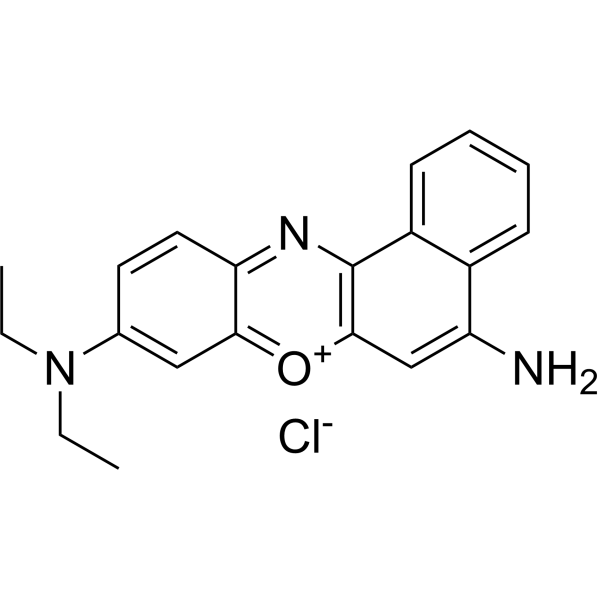
Nile blue chloride is a highly fluorescent and photostable organic dye. Nile blue chloride and fluorescein isothiocyanate (FITC) can be used to construct a ratiometric pH sensitive probe for tracking the pH of the extracellular fluid between cancer cells in realtime. Nile Blue chloride has the potential for the research of nonlinear optics .
loading...
    loading...
Cat. No.: HY-157036
CAS No.: 2962939-33-7
Purity:  98.82%
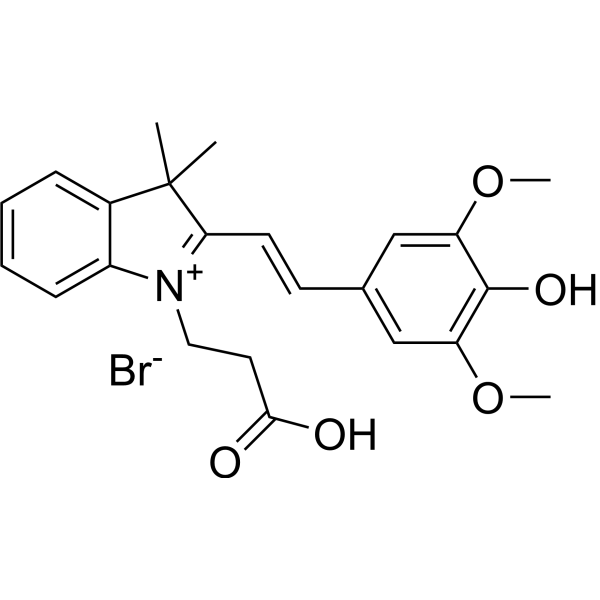
INSA is a a pH-sensitive fluorescent probe. INSA can simultaneously light up mitochondria (red emission) and lysosomes (green emission) for their internal pH differences .
loading...
    loading...
Cat. No.: HY-W024881
CAS No.: 184351-56-2
Synonyms: 2,3,3-Trimethylindolenine-5-sulfonic acid potassium salt
Research Areas:  

Cancer

Potassium 2,3,3-trimethylindole-5-sulfonate (2,3,3-Trimethylindolenine-5-sulfonic acid potassium salt) is a sulfonated indoline compound, and also serves as the starting indole raw material for the synthesis of pH-sensitive near-infrared cyanine dye HCyC-646 and near-infrared fluorescent probe IR-793. Potassium 2,3,3-trimethylindole-5-sulfonate can be used in lung adenocarcinoma-related research .
loading...
    loading...
Cat. No.: HY-D3129
Target:  

Fluorescent Dye

Research Areas:  

Others

Ratio-pHCL-1 is a fluorescent probe for quantitative ratiometric pH imaging in biological systems. Ratio-pHCL-1 consists of an acrylamide 1,2-dioxetane chemiluminescent scaffold and a linked pH-sensitive carbon fluorescein fluorophore, and functions via chemically initiated electron exchange luminescence (CIEEL) decomposition and chemiluminescence resonance energy transfer (CRET). Ratio-pHCL-1 can cross cell membranes and accumulate intracellularly, enabling pH measurement within the range of 6.8-8.4 .
loading...
    loading...

