5 Results for "

self-association

" in MedChemExpress (MCE) Product Catalog:
Products (5)

5 Results for "self-association" in MCE Product Catalog:

Cat. No.: HY-122671
CAS No.: 300803-69-4
Purity:  99.12%
Target:  

Anion Exchangers

Research Areas:  

Neurological Disease

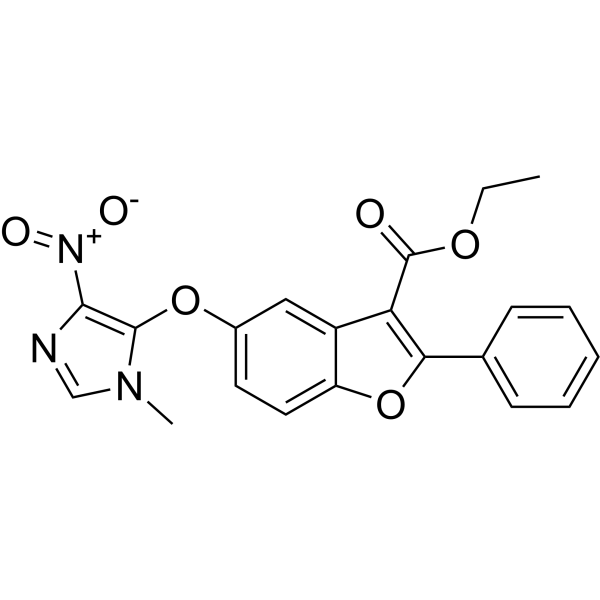
OB-1 is a stomatin-like protein-3 (STOML3) oligomerization blocker. OB-1 is an effective inhibitor of the self-association of Stomatin, STOML1 and STOML2, but not podocin .
loading...
    loading...
Cat. No.: HY-153338
CAS No.: 902940-64-1
Research Areas:  

Cancer

C791-0064 is a RAD52 inhibitor. C791-0064 specifically binds to RAD52 and disrupts its single-strand annealing activity. C791-0064 specifically inhibits the proliferation of cancer cells with BRCA2 deficiency, inducing DNA damage and apoptosis (apoptosis). C791-0064 can be used for the study of BRCA mutation-related cancers (such as breast cancer and ovarian cancer) .
loading...
    loading...
Cat. No.: HY-122671S
OB-1-d3 is the deuterium labeled OB-1 (HY-122671). OB-1 is a stomatin-like protein-3 (STOML3) oligomerization blocker. OB-1 is an effective inhibitor of the self-association of Stomatin, STOML1 and STOML2, but not podocin .
loading...
    loading...
Cat. No.: HY-159739
CAS No.: 708291-86-5
Target:  

Androgen Receptor

Research Areas:  

Cancer

M17-B15 is an androgen receptor dimerization inhibitor with an IC50 of 30 nM. M17-B15 effectively disrupts AR self-association, thereby suppressing AR signaling. M17-B15 exhibits extraordinary anti- prostate cancer (PCa) efficacy in vitro and in mouse xenograft tumor models.M17-B15 can be used for the study of prostate cancer .
loading...
    loading...
Cat. No.: HY-D0005
CAS No.: 4733-39-5
Target:  

Amyloid-β

Research Areas:  

Neurological Disease

Bathocuproine is a phenanthroline chelator that binds specifically to Cu +. Bathocuproine preferentially binds Cu + over Cu 2+ to form a chromogenic complex, which is used to detect the oxidation state of copper in biomolecules. Bathocuproine undergoes concentration-dependent self-association to form dimers, and it can engage in aromatic stacking interactions with aromatic residues of (Kd ≈ 1 mM). Bathocuproine is applicable to research related to Alzheimer's disease .
loading...
    loading...

