7 Results for "

sucrose intake

" in MedChemExpress (MCE) Product Catalog:
Products (7)

7 Results for "sucrose intake" in MCE Product Catalog:

  • Targets Recommended:
12
12 Cited Publications
Cat. No.: HY-10895
CAS No.: 249889-64-3
Synonyms: SB 334867A
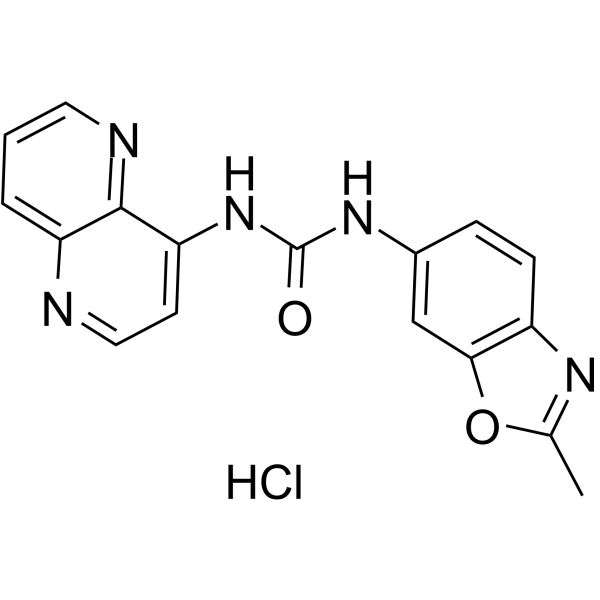
SB-334867 (SB 334867A) is an excellent,selective and blood-brain barrier permeable orexin-1 (OX1) receptor antagonist, shows selectivity over OX2 (pKb=7.4), 100-fold over 5-HT2B, 5-HT2C with pKi values of 5.4 and 5.3, respectively . SB-334867 reduces ethanol consumption and inhibits the acquisition of morphine-induced sensitization to locomotor activity in vivo .
loading...
    loading...
12
12 Cited Publications
Cat. No.: HY-10895A
CAS No.: 792173-99-0
Purity:  99.88%
Synonyms: SB334867A free base
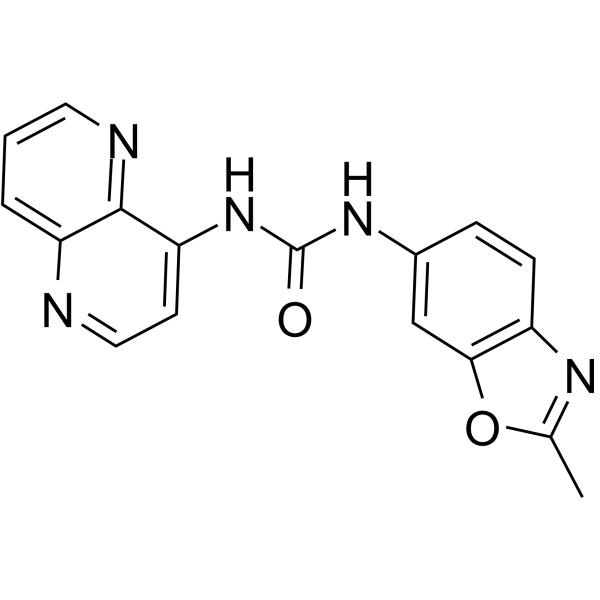
SB-334867 free base (SB334867A free base) is an excellent, selective and blood–brain barrier permeable orexin-1 (OX1) receptor antagonist, shows selectivity over OX2 (pKb=7.4), 100-fold over 5-HT2B, 5-HT2C with pKi values of 5.4 and 5.3, respectively . SB-334867 reduces ethanol consumption and inhibits the acquisition of morphine-induced sensitization to locomotor activity in vivo .
loading...
    loading...
Cat. No.: HY-167856
CAS No.: 3034664-39-3
Target:  

GPR88

Research Areas:  

Neurological Disease

RTI-122 is a selective, blood-brain barrier-permeable GPR88 agonist (cAMP EC50=11 nM), with EC50 values of 11.5 nM and 155 nM for human and mouse GPR88, respectively ([ 35S]GTPγS assay). By activating the GPR88 receptor to regulate the cAMP signaling pathway and G protein activity, RTI-122 significantly attenuates Binge-like drinking, reduces alcohol intake, and decreases alcohol-seeking motivation. RTI-122 blocks the reinstatement of alcohol-seeking behavior without affecting water or sucrose intake. RTI-122 exhibits metabolic stability in mice (T1/2=5.8 h) and can be used to investigate alcohol use disorder .
loading...
    loading...
Cat. No.: HY-15386
CAS No.: 73815-11-9
Synonyms: MD 780515
Target:  

Monoamine Oxidase

Research Areas:  

Metabolic Disease

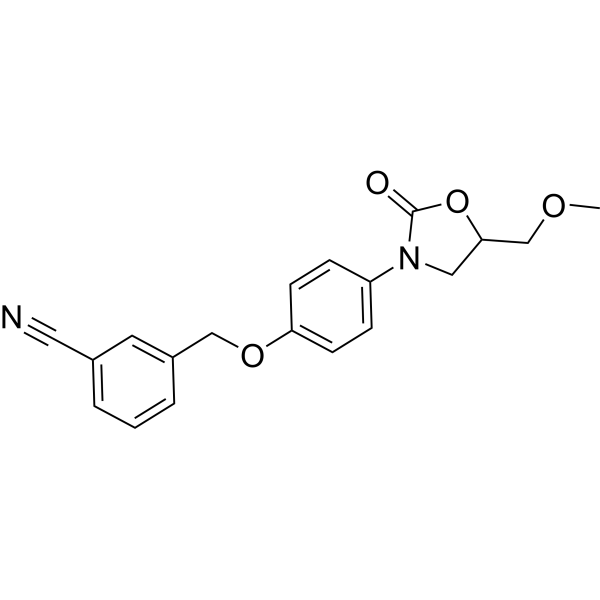
Cimoxatone (MD 780515) is a reversible, selectively and orally active type A monoamine oxidase (MAO-A) inhibitor. Cimoxatone enhances the anorectic action of Serotonin (HY-B1473A) .
loading...
    loading...
Cat. No.: HY-10895R
CAS No.: 249889-64-3
Synonyms: SB 334867A (Standard)
SB-334867 (Standard) is the analytical standard of SB-334867. This product is intended for research and analytical applications. SB-334867 (SB 334867A) is an excellent,selective and blood-brain barrier permeable orexin-1 (OX1) receptor antagonist, shows selectivity over OX2 (pKb=7.4), 100-fold over 5-HT2B, 5-HT2C with pKi values of 5.4 and 5.3, respectively . SB-334867 reduces ethanol consumption and inhibits the acquisition of morphine-induced sensitization to locomotor activity in vivo .
loading...
    loading...
Cat. No.: HY-10895AR
CAS No.: 792173-99-0
Synonyms: SB334867A free base (Standard)
SB-334867 free base (Standard) is the analytical standard of SB-334867 (free base) (HY-10895A). This product is intended for research and analytical applications. SB-334867 free base (SB334867A free base) is an excellent, selective and blood–brain barrier permeable orexin-1 (OX1) receptor antagonist, shows selectivity over OX2 (pKb=7.4), 100-fold over 5-HT2B, 5-HT2C with pKi values of 5.4 and 5.3, respectively . SB-334867 reduces ethanol consumption and inhibits the acquisition of morphine-induced sensitization to locomotor activity in vivo .
loading...
    loading...
Cat. No.: HY-167856A
Target:  

GPR88

Research Areas:  

Neurological Disease

RTI-122 dihydrochloride is a selective, blood-brain barrier-permeable GPR88 agonist (cAMP EC50=11 nM), with EC50 values of 11.5 nM and 155 nM for human and mouse GPR88, respectively ([ 35S]GTPγS assay). By activating the GPR88 receptor to regulate the cAMP signaling pathway and G protein activity, RTI-122 dihydrochloride significantly attenuates Binge-like drinking, reduces alcohol intake, and decreases alcohol-seeking motivation. RTI-122 dihydrochloride blocks the reinstatement of alcohol-seeking behavior without affecting water or sucrose intake. RTI-122 dihydrochloride exhibits metabolic stability in mice (T1/2=5.8 h) and can be used to investigate alcohol use disorder .
loading...
    loading...

