11 Results for "

tumor recognition

" in MedChemExpress (MCE) Product Catalog:
Products (11)

11 Results for "tumor recognition" in MCE Product Catalog:

1
1 Cited Publications
Cat. No.: HY-P3443
Synonyms: PNA
Peanut agglutinin (PNA) is a carbohydrate-recognition protein that binds competitively and irreversibly to cell-surface β-D-Gal (1-3)-GalNAc, and this binding can be inhibited by D-galactose and asialofetuin. Peanut agglutinin recognizes exposed glycoepitopes and reflects the glycosylation status of cells. Peanut agglutinin can label glycoconjugates at neuromuscular junctions to safely visualize synaptic structures. Peanut agglutinin can be used to synthesize dyes to distinguish between normal and tumor tissues. Peanut agglutinin provides support for research on leukemia, Burkitt's tumors, and cutaneous squamous lesions .
loading...
    loading...
Cat. No.: HY-P990981
CAS No.: 2930861-48-4
Synonyms: ALPS-12; RG-6524; RO 7616789

Target:  

CD3

Research Areas:  

Inflammation/Immunology Cancer

Clesitamig (ALPS-12) is a trispecific T cell engager with two CD3/CD137 dual-specific Fabs and one DLL3 Fab. Clesitamig engages CD3 and CD137 on T cells to activate and co-stimulate T cells, promoting their proliferation, survival, and antitumor activity. Clesitamig binds to DLL3 on tumor cells for tumor-specific recognition. Clesitamig can be used for the research of small cell lung cancer (SCLC) .
loading...
    loading...
Cat. No.: HY-P2612A
Target:  

TNF Receptor

Research Areas:  

Others Cancer

WP9QY, TNF-a Antagonist, TNF-a Antagonist is a biological active peptide. (This cyclic peptide is designed to mimic the most critical tumor necrosis factor (TNF) recognition loop on TNF receptor I. It prevents interactions of TNF with its receptor. This TNF antagonist is a useful template for the development of small molecular inhibitors to prevent both inflammatory bone destruction and systemic bone loss in rheumatoid arthritis.)
loading...
    loading...
Cat. No.: HY-P3052
CAS No.: 93674-99-8
Target:  

Peptides

Research Areas:  

Cancer

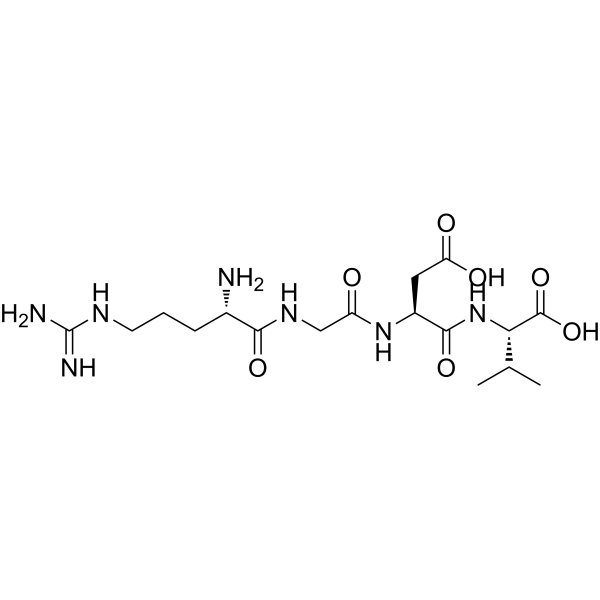
RGDV is a platelet aggregation inhibitor. RGDV inhibits platelet-dependent thrombus formation. RGDV is used for tumor recognition via the targeting effect .
loading...
    loading...
Cat. No.: HY-119505
CAS No.: 69301-27-5
Target:  

HDAC

Research Areas:  

Others

Curcuphenol is a compound with histone deacetylase enhancing activity and has the activity of reversing immune escape. Curcuphenol can reverse the immune escape of tumors by restoring the expression of antigen presentation machinery. Its two synthetic analogs have histone deacetylase enhancing activity and play an important role in the immune recognition of metastatic tumors.
loading...
    loading...
Cat. No.: HY-172533
Target:  

STING

Research Areas:  

Cancer

3’,5’-DiOA-dC is a hydrophobic nucleotide lipid and a ligand for the STING agonist c-di-GMP (CDG). 3’,5’-DiOA-dC can assemble with CDG and form stable cyclic dinucleotide nanoparticles via various supramolecular forces driven by molecular recognition. 3’,5’-DiOA-dC can decrease tumor weight and volume, increase CD8 T cell, neutrophils as well as NK cell counts in tumor microenvironment in combination with CDG. 3’,5’-DiOA-dC also increases the levels of TNF-α and IFN-γ in murine melanoma model .
loading...
    loading...
Cat. No.: HY-P10295
CAS No.: 155314-26-4
Target:  

MDM-2/p53

Research Areas:  

Cancer

p53 (232-240) is a peptide segment of the 232-240 amino acid sequence of the human tumor suppressor protein p53. p53 (232-240) enhances its binding affinity to the Major histocompatibility complex (MHC), thereby enhancing the immunogenicity of this peptide to enhance the immune system's response to tumor antigens. p53 (232-240) can be used in the development of cancer vaccines and in the study of tumor cell recognition and clearance by the immune system .
loading...
    loading...
Cat. No.: HY-122637
CAS No.: 2071636-70-7
Target:  

SF3B1

Research Areas:  

Cancer

Sudemycin K is a selective splicing inhibitor targeting SF3B1. Sudemycin K blocks U2 snRNP recognition of branch point sequences in pre-mRNA, inducing tumor-specific splicing deregulation and apoptosis. Sudemycin K is promising for research of SF3B1-mutated malignancies such as chronic lymphocytic leukemia (CLL) and myelodysplastic syndromes (MDS) .
loading...
    loading...
Cat. No.: HY-183631
CAS No.: 2248127-86-6
Research Areas:  

Cancer

PM54 is an antitumor agent with activity across multiple cancer types. PM54 acts as a transcription and WNT/β-catenin signaling pathway inhibitor. PM54 suppresses oncogenic transcriptional programs, and key malignant pathways, while inducing DNA double-strand breaks, S-phase cell cycle arrest and apoptosis. PM54 enhances innate immune recognition, remodels the tumor microenvironment. PM54 exhibits antitumor activity as monotherapy or in combination in xenograft models. PM54 is applicable to research on various cancers and advanced solid tumors .
loading...
    loading...
Cat. No.: HY-D3136
Target:  

Fluorescent Dye

Research Areas:  

Cancer

MC-PSE is a fluorescent probe that can be used for glutathione (GSH) detection, NIR-II fluorescence imaging and ratiometric photoacoustic imaging. MC-PSE spontaneously forms J-aggregates in aqueous solution through π-π stacking, and its phenylselenyl group acts as a fluorescence quencher and GSH recognition receptor, thereby eliminating intrinsic fluorescence and generating a maximum absorption peak at 1000 nm. The excitation/emission wavelengths of MC-PSE are Ex = 808 nm and Em = 940 nm. MC-PSE can be applied in tumor-related research .
loading...
    loading...
Cat. No.: HY-P11891
Target:  

PD-1/PD-L1

Research Areas:  

Cancer

FM213 is a PD-L1 inhibitor with a human IC50 of 323 nM. FM213 blocks PD-1/PD-L1 protein-protein interactions, and promotes endocytosis and lysosome-dependent degradation of PD-L1 on the surface of cancer cells. FM213 binds to PD-L1 on cancer cells and exosomes, and enhances the recognition and killing of cancer cells by human PBMC. Combination of FM213 with the TIGIT inhibitor DTBP-3 (HY-P11903) enhances anti-tumor immunity. FM213 can be used in research related to non-small cell lung cancer .
loading...
    loading...
  • 1

