7 Results for "

varroa mites

" in MedChemExpress (MCE) Product Catalog:
Products (7)

7 Results for "varroa mites" in MCE Product Catalog:

1
1 Cited Publications
Cat. No.: HY-Y0262
CAS No.: 144-62-7
Synonyms: Ethanedioic acid
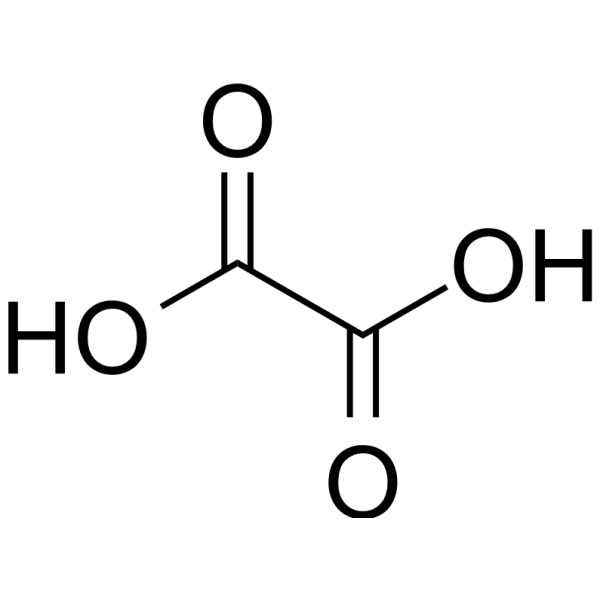
Oxalic acid, 99% (Ethanedioic acid) is a dicarboxylic acid found in a wide variety of plants. Oxalic acid, 99% shows antioxidant acyivity and suppresses lipid peroxidation. Oxalic acid, 99% is a pathogenicity factor for sclerotinia sclerotiorum, and suppresses the oxidative burst of the host plant. Oxalic acid, 99% exerts acaricidal activity. Oxalic acid can be used for the researches of sclerotinia disease, varroatosis and inflammatory diseases .
loading...
    loading...
1
1 Cited Publications
Cat. No.: HY-Y0262A
CAS No.: 6009-70-7
Synonyms: Ethanedioic acid diammonium monohydrate
Oxalic acid (Ethanedioic acid) diammonium monohydrate is a dicarboxylic acid found in a wide variety of plants.
Oxalic acid diammonium monohydrate shows antioxidant acyivity and suppresses lipid peroxidation.
Oxalic acid diammonium monohydrate is a pathogenicity factor for sclerotinia sclerotiorum, and suppresses the oxidative burst of the host plant. Oxalic acid diammonium monohydrate exerts acaricidal activity. Oxalic acid can be used for the researches of sclerotinia disease varroatosis and inflammatory diseases .
loading...
    loading...
Cat. No.: HY-W041831
CAS No.: 1113-38-8
Synonyms: Ethanedioic acid ammonium
Oxalic acid (Ethanedioic acid) ammonium is a dicarboxylic acid. Oxalic acid ammonium is widely found in various plants. Oxalic acid ammonium has antioxidant activity and can inhibit lipid peroxidation. Oxalic acid ammonium is a pathogenic factor of Sclerotinia sclerotiorum and can inhibit the oxidative burst of host plants. Oxalic acid ammonium has acaricidal activity. Oxalic acid ammonium can be used for related research on Sclerotinia sclerotiorum disease, Varroa mite disease and inflammatory diseases .
loading...
    loading...
Cat. No.: HY-W106742
CAS No.: 622-85-5
Synonyms: Propyl phenyl ether
Research Areas:  

Infection

Propoxybenzene (Propyl phenyl ether) is a dialkoxybenzene intermediate. Propoxybenzene has antiparasitic activity. Propoxybenzene can be used in the study of Varroa mite infestation .
loading...
    loading...
Cat. No.: HY-B2021
CAS No.: 102851-06-9
Target:  

Insecticide

Research Areas:  

Neurological Disease

τ-Fluvalinate is an insecticide and in-hive miticide, with its mechanism involving interfering with nervous systems. τ-Fluvalinate binds to the open state of Varroa destructor (VdNaV1) and Apis mellifera (AmNaV1) voltage-dependent sodium channels, with EC50 values of 160 nM and 60 nM respectively. τ-Fluvalinate has higher affinity for AmNaV1, which causes sublethal toxicity to honeybees. τ-Fluvalinate can be applied for research on Varroa destructor infestation in honeybee colonies .
loading...
    loading...
Cat. No.: HY-123320S
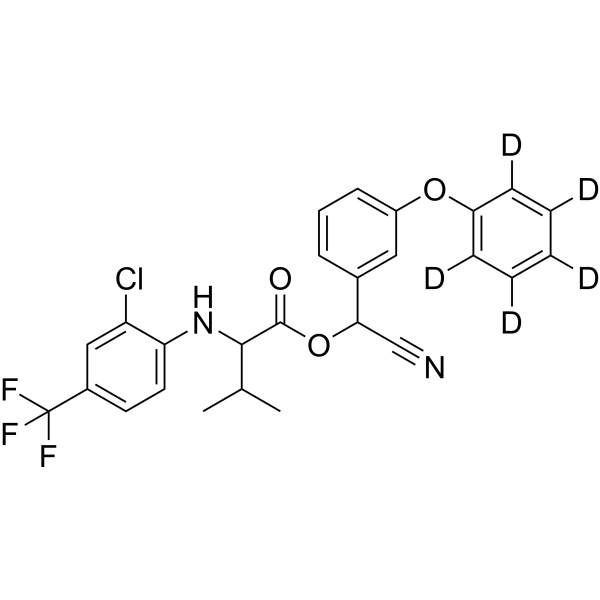
Fluvalinate-d5 is the deuterated-labeled Fluvalinate (HY-123320). Fluvalinate is an orally active acaricide classified as a sodium channel inhibitor. Fluvalinate delays sodium channel closure, prolongs cell membrane depolarization, inhibits the excitability of honeybee brain neurons, and exerts a central nervous system inhibitory effect. Fluvalinate negatively affects the learning ability, memory ability, sucrose responsiveness, and survival of honeybees. Fluvalinate potentiates pentobarbital-induced hypnosis, reduces spontaneous activity in mice, and decreases the total white blood cell count and absolute lymphocyte count in mice. Fluvalinate induces acute toxic symptoms in rats, acts as a cholinergic stimulant, and induces the production of hepatic enzymes in rats. Fluvalinate causes the death of Varroa jacobsoni sensitive to τ-Fluvalinate (HY-B2021). Fluvalinate can be used in studies related to mite pest control .
loading...
    loading...
Cat. No.: HY-123320
CAS No.: 69409-94-5
Research Areas:  

Infection Neurological Disease

Fluvalinate is an orally active acaricide classified as a sodium channel inhibitor. Fluvalinate delays sodium channel closure, prolongs cell membrane depolarization, inhibits the excitability of honeybee brain neurons, and exerts a central nervous system inhibitory effect. Fluvalinate negatively affects the learning ability, memory ability, sucrose responsiveness, and survival of honeybees. Fluvalinate potentiates pentobarbital-induced hypnosis, reduces spontaneous activity in mice, and decreases the total white blood cell count and absolute lymphocyte count in mice. Fluvalinate induces acute toxic symptoms in rats, acts as a cholinergic stimulant, and induces the production of hepatic enzymes in rats. Fluvalinate causes the death of Varroa jacobsoni sensitive to τ-Fluvalinate (HY-B2021). Fluvalinate can be used in studies related to mite pest control .
loading...
    loading...

