



Sodium glycolate, 98%

Based on 1 Customer Validation
Sodium glycolate, 98% (Sodium hydroxyacetate, 98%) is an orally active, versatile organic salt. Sodium glycolate, 98% acts as an enzyme activity regulator that increases the activities of glycolate oxidase (GAO) and lactate dehydrogenase (LDH), while reducing the activity of glycolate dehydrogenase (GAD). Sodium glycolate, 98% induces oxalate biosynthesis and causes hyperoxaluria in rats. Sodium glycolate, 98% reduces urinary calcium excretion in male albino rats. Sodium glycolate, 98% can be used in studies related to calcium oxalate urolithiasis and hyperoxaluria.
For research use only. We do not sell to patients.
- Purity : 98.0%
- CAS No.: 2836-32-0
- Formula: C2H3NaO3
- Molecular Weight:98.03
-
Storage:
4°C, stored under nitrogen, away from moisture
* In solvent : -80°C, 6 months; -20°C, 1 month (stored under nitrogen, away from moisture)


To place orders, for customer services and technical support, please contact: MedChemExpress USA
Tel: 609-228-6898 E-mail: [email protected] [email protected]


-
 Biological Activity
-
Chemical Information
-
Solvent & Solubility
- Purity & Documentation
- References
-
 Help & FAQs



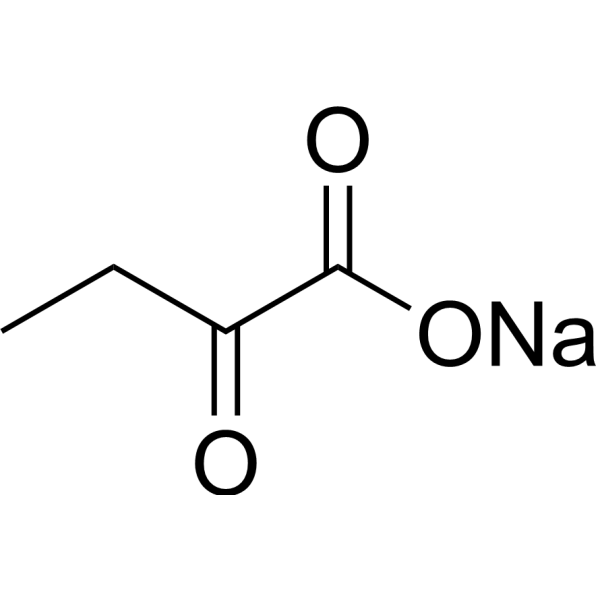
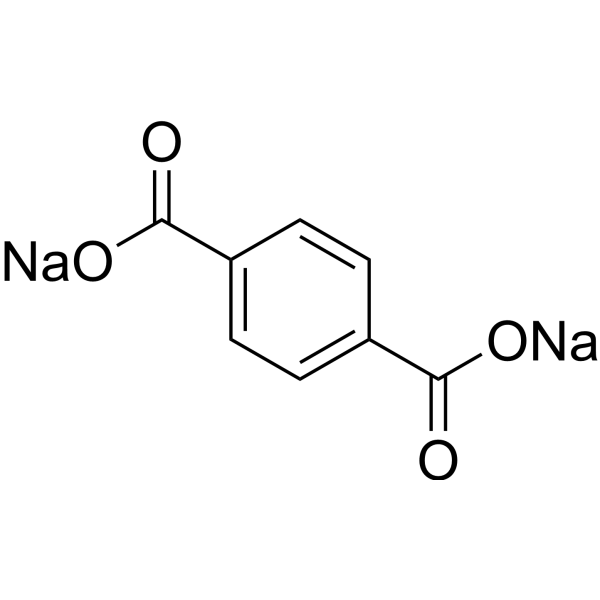
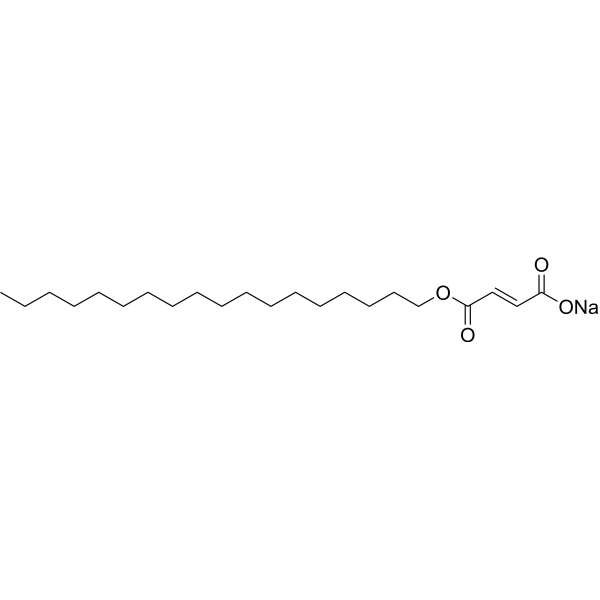


Biological Activity
Description
In Vivo
Sodium glycolate, 98% (100 mg per 100 g body weight/24 hr; p.o.; daily; 6 weeks) induces significant hyperoxaluria in male Wistar rats, alongside hypocalciuria and reduced transaminase activities in liver, kidney, and erythrocytes[2].
Sodium glycolate, 98% (100 mg per 100 g body weight/24 hr; p.o.; daily; 6 weeks) co-administered with pyridoxine induces significant hyperoxaluria in male Wistar rats, alongside hypocalciuria, increased urinary citrate excretion, and partially restored kidney transaminase activities relative to sodium glycolate-only treatment[2].
MedChemExpress (MCE) has not independently confirmed the accuracy of these methods. They are for reference only.
-
Animal Model:Wistar (male, 4 months old)[1]
-
Dosage:50 mg/100 g body weight/day
-
Administration:p.o.; daily; 7 days
-
Result:Significantly increased liver weight relative to normal controls.
Significantly increased liver weight/100 g body weight relative to normal controls.
Significantly lowered liver protein to 174 mg/g relative to normal controls.
Did not significantly change kidney weight and kidney weight/100 g body weight relative to normal controls.
Significantly lowered kidney protein to 212 mg/g relative to normal controls.
Significantly increased liver LDH activity to 3.71 U/mg protein relative to normal controls.
Significantly increased liver GAO activity to 1.33 U/mg protein relative to normal controls.
Directionally reduced liver GAD activity to 1.86 × 10⁻² U/mg protein, with no statistically significant difference relative to normal controls.
Significantly increased kidney LDH activity to 3.67 U/mg protein relative to normal controls.
Significantly reduced kidney GAD activity to 0.18 × 10⁻² U/mg protein relative to normal controls.
-
Animal Model:Wistar (male, 200 g body weight)[2]
-
Dosage:100 mg per 100 g body weight/24 hr
-
Administration:p.o.; daily; 6 weeks
-
Result:Increased urinary oxalate levels to 55 mg/dg creatinine at week 1, 36 mg/dg creatinine at week 2, 44 mg/dg creatinine at week 4, and 36 mg/dg creatinine at week 5, compared to a basal level of 19 mg/dg creatinine.
Decreased urinary calcium excretion to 37 mg/dg creatinine at week 1, 14 mg/dg creatinine at week 3, 35 mg/dg creatinine at week 4, 18 mg/dg creatinine at week 5, and 35 mg/dg creatinine at week 6, compared to a basal level of 100 mg/dg creatinine.
Reduced liver glutamate-oxaloacetate transaminase (GOT) activity to 8.29 μmoles pyruvate produced/min/mg protein × 10-2.
Reduced kidney GOT activity to 6.06 μmoles pyruvate produced/min/mg protein × 10-2 and kidney glutamate-pyruvate transaminase (GPT) activity to 0.37 μmoles pyruvate produced/min/mg protein × 10-2.
Reduced erythrocyte GOT activity to 0.29 μmoles pyruvate produced/min/mg protein × 10-2.
Caused a slight, insignificant increase in body weight (from 199 g to 242 g) over 6 weeks, with no significant changes in liver weight (5.7 g), kidney weight (1.6 g), liver protein content (159 mg/g tissue), or kidney protein content (154 mg/g tissue) relative to pyridoxine-supplemented sodium glycolate-treated rats.
-
Animal Model:Wistar (male, 200 g body weight)[2]
-
Dosage:100 mg per 100 g body weight/24 hr (sodium glycolate); 10 mg per 100 g body weight/24 hr (pyridoxine)
-
Administration:p.o.; daily; 6 weeks
-
Result:Increased urinary oxalate levels to 50 mg/dg creatinine at week 1, 30 mg/dg creatinine at week 2, and 32 mg/dg creatinine at week 4, compared to a basal level of 19 mg/dg creatinine.
Decreased urinary calcium excretion to 22 mg/dg creatinine at week 1, 26 mg/dg creatinine at week 3, 32 mg/dg creatinine at week 4, 26 mg/dg creatinine at week 5, and 32 mg/dg creatinine at week 6, compared to a basal level of 100 mg/dg creatinine.
Increased urinary citrate excretion to 372 mg/dg creatinine at week 2, 369 mg/dg creatinine at week 3, and 466 mg/dg creatinine at week 6, compared to a basal level of 227 mg/dg creatinine.
Caused a slight, insignificant increase in body weight (from 185 g to 245 g) over 6 weeks, with no significant changes in liver weight (5.9 g), kidney weight (1.6 g), liver protein content (191 mg/g tissue), or kidney protein content (151 mg/g tissue) relative to sodium glycolate-only treated rats.


Chemical Information
-
CAS No. 2836-32-0
-
Appearance Solid
-
Molecular Weight 98.03
-
Formula C2H3NaO3
-
Color White to off-white
-
SMILES
OCC(O[Na])=O
-
Synonyms
Sodium hydroxyacetate, 98%
-
Shipping
Room temperature in continental US; may vary elsewhere.
-
Storage
4°C, stored under nitrogen, away from moisture
* In solvent : -80°C, 6 months; -20°C, 1 month (stored under nitrogen, away from moisture)


Solvent & Solubility
In Vitro:
H2O : ≥ 100 mg/mL (1020.10 mM)
* "≥" means soluble, but saturation unknown.
Please refer to the solubility information to select the appropriate solvent. Once prepared, please aliquot and store the solution to prevent product inactivation from repeated freeze-thaw cycles.
Storage method and period of stock solution: -80°C, 6 months; -20°C, 1 month (stored under nitrogen, away from moisture). When stored at -80°C, please use it within 6 months. When stored at -20°C, please use it within 1 month.
* Note: If you choose water as the stock solution, please dilute it to the working solution, then filter and sterilize it with a 0.22 μm filter before use.
Please refer to the solubility information to select the appropriate solvent. Once prepared, please aliquot and store the solution to prevent product inactivation from repeated freeze-thaw cycles.
Storage method and period of stock solution: -80°C, 6 months; -20°C, 1 month (stored under nitrogen, away from moisture). When stored at -80°C, please use it within 6 months. When stored at -20°C, please use it within 1 month.
* Note: If you choose water as the stock solution, please dilute it to the working solution, then filter and sterilize it with a 0.22 μm filter before use.
Concentration (start) × Volume (start) = Concentration (final) × Volume (final)


Purity & Documentation
-
Data Sheet (276 KB)
-
SDS (252 KB)
- English - EN (252 KB)
- Français - FR (252 KB)
- Deutsch - DE (252 KB)
- Norwegian - NO (252 KB)
- Español - ES (252 KB)
- Swedish - SV (252 KB)
- Italian - IT (252 KB)
- Korean - KR (252 KB)
- Portuguese - PT (252 KB)
-
Handling Instructions (2659 KB)
References


Complete Stock Solution Preparation Table
Please refer to the solubility information to select the appropriate solvent. Once prepared, please aliquot and store the solution to prevent product inactivation from repeated freeze-thaw cycles.
Storage method and period of stock solution: -80°C, 6 months; -20°C, 1 month (stored under nitrogen, away from moisture). When stored at -80°C, please use it within 6 months. When stored at -20°C, please use it within 1 month.
| Optional Solvent | Concentration Solvent Mass | 1 mg | 5 mg | 10 mg | 25 mg |
|---|---|---|---|---|---|
| H2O | 1 mM | 10.2010 mL | 51.0048 mL | 102.0096 mL | 255.0240 mL |
| 5 mM | 2.0402 mL | 10.2010 mL | 20.4019 mL | 51.0048 mL | |
| 10 mM | 1.0201 mL | 5.1005 mL | 10.2010 mL | 25.5024 mL | |
| 15 mM | 0.6801 mL | 3.4003 mL | 6.8006 mL | 17.0016 mL | |
| 20 mM | 0.5100 mL | 2.5502 mL | 5.1005 mL | 12.7512 mL | |
| 25 mM | 0.4080 mL | 2.0402 mL | 4.0804 mL | 10.2010 mL | |
| 30 mM | 0.3400 mL | 1.7002 mL | 3.4003 mL | 8.5008 mL | |
| 40 mM | 0.2550 mL | 1.2751 mL | 2.5502 mL | 6.3756 mL | |
| 50 mM | 0.2040 mL | 1.0201 mL | 2.0402 mL | 5.1005 mL | |
| 60 mM | 0.1700 mL | 0.8501 mL | 1.7002 mL | 4.2504 mL | |
| 80 mM | 0.1275 mL | 0.6376 mL | 1.2751 mL | 3.1878 mL | |
| 100 mM | 0.1020 mL | 0.5100 mL | 1.0201 mL | 2.5502 mL |
* Note: If you choose water as the stock solution, please dilute it to the working solution, then filter and sterilize it with a 0.22 μm filter before use.


Sodium glycolate, 98% Related Classifications
HY-W088011B Related Classifications
 Powered by Bioz
Keywords
- Sodium glycolate, 98%
- 2836-32-0
- Sodium hydroxyacetate, 98%
- Lactate Dehydrogenase
- Aminotransferases (Transaminases)
- glutamate-pyruvate transaminase
- glycolate dehydrogenase
- male Wistar rats
- lactate dehydrogenase
- male albino rats
- glycolate oxidase
- calcium oxalate urinary stone formation
- oxalate biosynthesis
- hyperoxaluria
- glutamate-oxaloacetate transaminase
- Inhibitor
- inhibitor
- inhibit