



TA-1887
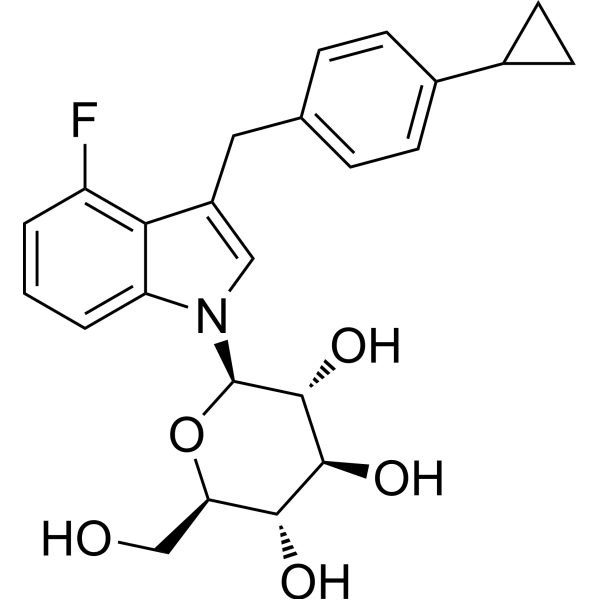
TA-1887 (JNJ-39933673) is a highly potent, selective and orally active SGLT2 inhibitor (IC50: 1.4 nM) with antihyperglycemic effects. TA-1887 can be used in the research of diabetes.
For research use only. We do not sell to patients.
- CAS No.: 1003005-29-5
- Formula: C24H26FNO5
- Molecular Weight:427.47
-
Storage:
Please store the product under the recommended conditions in the Certificate of Analysis.

To place orders, for customer services and technical support, please contact: MedChemExpress USA
Tel: 609-228-6898 E-mail: [email protected] [email protected]


-
 Biological Activity
-
Chemical Information
- Protocols
- Purity & Documentation
- References
-
 Help & FAQs




Biological Activity
Description
IC50 & Target
[1]|
SGLT2 1.4 nM (IC50) |
SGLT1 230 nM (IC50) |
Cellular Effect
|
Cell Line

|
Type | Value | Description | References |
|---|---|---|---|---|
| CHO-K1 | EC50 |
1.9 nM
Compound: 6
|
Inhibition of human SGLT2 expressed in CHO-K1 cells assessed as reduction in [14C]-alpha-methylglucopyranoside uptake after 2 hrs by liquid scintillation counting
Inhibition of human SGLT2 expressed in CHO-K1 cells assessed as reduction in [14C]-alpha-methylglucopyranoside uptake after 2 hrs by liquid scintillation counting
|
[PMID: 21090651] |
In Vivo
TA-1887 (3 mg/kg, oral administration) reduces blood glucose levels without influencing food intake in hyperglycemic high-fat diet-fed KK (HF-KK) mice[1].
TA-1887 (30 mg/kg/day, oral gavage for 2 weeks) significantly reduces GFR (glomerular filtration rate) in BSA-overloaded diabetic mice[2].
TA-1887 (0.01% w/w in chow, HF diets fed mice) antagonizes diabetic cachexia and decreases mortality in diabetic mice[3].
MedChemExpress (MCE) has not independently confirmed the accuracy of these methods. They are for reference only.
-
Animal Model:Sprague-Dawley rats[1]
-
Dosage:30 mg/kg
-
Administration:Oral administration
-
Result:Induced extensive UGE (urinary glucose excretion) through continuous suppression of renal glucose reuptake.
-
Animal Model:BSA-overloaded diabetic mice[2]
-
Dosage:30 mg/kg
-
Administration:Oral gavage for 2 weeks
-
Result:Suppressed the induction of TGF‐β2 level in vehicle‐treated BSA‐overloaded diabetic mice.
Suppressed COL3 gene levels.
-
Animal Model:Male Sprague-Dawley rats (pharmacokinetic assay)[1]
-
Dosage:3 mg/kg (i.v.), 10 mg/kg (p.o.)
-
Administration:Oral administration (p.o.), intravenous injection (i.v.)
-
Result:Pharmacokinetic (PK) parameters of TA-1887.
Parameters dose (mg/kg) Cmax (ng/mL) t1/2 (h) F (%) TA-18873 (i.v.) 3.9 TA-18873 10 (p.o.) 2723 3.9 78


Chemical Information
-
CAS No. 1003005-29-5
-
Molecular Weight 427.47
-
Formula C24H26FNO5
-
SMILES
FC1=C2C(N([C@@H]3O[C@H](CO)[C@@H](O)[C@H](O)[C@H]3O)C=C2CC4=CC=C(C5CC5)C=C4)=CC=C1
-
Synonyms
JNJ-39933673
-
Shipping
Room temperature in continental US; may vary elsewhere.
-
Storage
Please store the product under the recommended conditions in the Certificate of Analysis.

Protocols
-
Research Protocol for Metabolic Diseases
AMP-activated protein kinase, AMPK, is a conserved cellular energy sensor that responds to reduced cellular energy status and coordinates metabolism by increasing ATP-generating catabolic pathways while suppressing ATP-consuming anabolic processes. In metabolic disease research, the AMPK pathway is experimentally relevant because it regulates hepatic lipid synthesis, fatty acid oxidation, glucose production, skeletal-muscle glucose disposal, mTORC1-linked biosynthesis, autophagy, mitochondrial homeostasis, and whole-body energy balance. The central pathway logic is that energy stress, metformin, exercise-like stimulation, or direct AMPK activators increase AMPKα Thr172 phosphorylation and downstream substrate phosphorylation, including ACC and RAPTOR. Phosphorylation of ACC suppresses lipogenesis and supports fatty acid oxidation, whereas phosphorylation of RAPTOR suppresses mTORC1 signaling and links cellular energy status to growth and protein synthesis control. The pathway is linked


Purity & Documentation
References
[1]. Sumihiro Nomura, et al. Novel Indole-N-glucoside, TA-1887 As a Sodium Glucose Cotransporter 2 Inhibitor for Treatment of Type 2 Diabetes. ACS Med Chem Lett. 2013 Nov 13;5(1):51-5. [Content Brief]
[2]. Keiji Shimada, et al. Adenosine/adenosine type 1 receptor signaling pathway did not play dominant roles on the influence of sodium-glucose cotransporter 2 inhibitor in the kidney of bovine serum albumin-overloaded streptozotocin-induced diabetic mice. J Diabetes Investig. 2022 Jun;13(6):955-964. [Content Brief]
[3]. Taichi Sugizaki, et al. Treatment of diabetic mice with the SGLT2 inhibitor TA-1887 antagonizes diabetic cachexia and decreases mortality. NPJ Aging Mech Dis. 2017 Sep 8;3:12. [Content Brief]

Calculators
Concentration (start) × Volume (start) = Concentration (final) × Volume (final)


TA-1887 Related Classifications
HY-12608 Related Classifications
 Powered by Bioz